
An Unmarried Woman (1978 film)
1978 American comedy-drama by Paul Mazursky about a Manhattan woman's life after divorce; noted for Jill Clayburgh's performance and nominated for three Academy Awards.
Overview
An Unmarried Woman is a 1978 American comedy-drama written and directed by Paul Mazursky. The film follows the emotional and social journey of a middle-class New York woman who must rebuild her life after her long-term partner leaves her. Grounded in urban realism and character study, the picture was distributed by 20th Century Fox and became notable for its frank treatment of female independence and adult relationships.
Image gallery
1 Image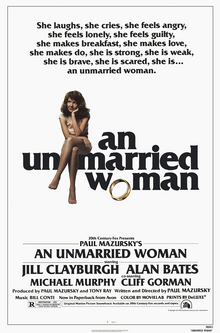
Plot and themes
The story centers on Erica Benton, a woman who confronts loneliness, anger, and new possibilities when her husband abandons their marriage. Rather than a sensationalized melodrama, the film emphasizes everyday choices, friendships, dating, and work as components of personal renewal. Themes include autonomy, the changing roles of women in the 1970s, emotional resilience, and the navigation of sex and companionship after a breakup.
Production and release
Shot and set largely in New York City, the film combines humorous moments with candid drama to portray realistic adult life. Mazursky both wrote and directed the piece, shaping its tone around intimate performances and situational detail. Released in 1978, it reached a wide audience and contributed to ongoing conversations about marriage, divorce, and gender expectations in contemporary American culture.
Reception and legacy
Critics praised the film for its honest character work and especially for the lead performance, which helped the movie secure three Academy Award nominations: Best Picture, Best Actress, and Best Original Screenplay. Over time the film has been referenced in discussions of cinema that foreground women's inner lives and the social shifts of the late 20th century. Its mix of gentle comedy and sober reflection remains influential for filmmakers examining adult relationships.
Cast
- Jill Clayburgh as Erica Benton — a central performance widely praised by critics.
- Alan Bates — plays an important supporting role in Erica's life.
- Michael Murphy — appears among the film's key male characters.
- Cliff Gorman and others round out an ensemble that emphasizes realistic interactions over star-driven spectacle.
While rooted in its era, the film's examination of self-discovery after the end of a long relationship continues to resonate with modern audiences and remains a touchstone for portrayals of adult female protagonists on screen.
Questions and answers
Q: When was An Unmarried Woman released?
A: An Unmarried Woman was released in 1978.
Q: Who directed and wrote An Unmarried Woman?
A: An Unmarried Woman was directed and written by Paul Mazursky.
Q: Who are the main actors in An Unmarried Woman?
A: Jill Clayburgh, Alan Bates, Michael Murphy, and Cliff Gorman are the main actors in An Unmarried Woman.
Q: Which company distributed An Unmarried Woman?
A: An Unmarried Woman was distributed by 20th Century Fox.
Q: How many Oscar nominations did An Unmarried Woman receive?
A: An Unmarried Woman received three Oscar nominations in 1979.
Q: What genre does An Unmarried Woman fall into?
A: An Unmarried Woman is a comedy drama movie.
Q: What is An Unmarried Woman about?
A: The plot of An Unmarried Woman is not mentioned in the text.
Related articles
Author
AlegsaOnline.com An Unmarried Woman (1978 film) Leandro Alegsa
URL: https://en.alegsaonline.com/art/3717