
Gewehr 98 (G98) Mauser rifle
The Gewehr 98 (G98) is Germany's standard bolt-action service rifle introduced in 1898. Noted for its controlled‑feed Mauser action, 5‑round stripper clip magazine, and wide influence on 20th‑century bolt‑action designs.
Overview
The Gewehr 98 (commonly abbreviated G98) is a bolt‑action military rifle introduced by the German Empire in 1898. Designed by Paul Mauser and produced by the Mauser company and other contractors, it became the standard infantry rifle for Germany through World War I and remained influential afterward. The G98 fires the 7.92×57mm Mauser cartridge (often called "8mm Mauser") and uses a 5‑round internal magazine loaded by stripper clip.
For a concise technical reference see Gewehr 98 summary and historical service notes at service history. The rifle's military use during the Great War is documented in many collections and archives (World War I sources).
Image gallery
10 Images


Design and characteristics
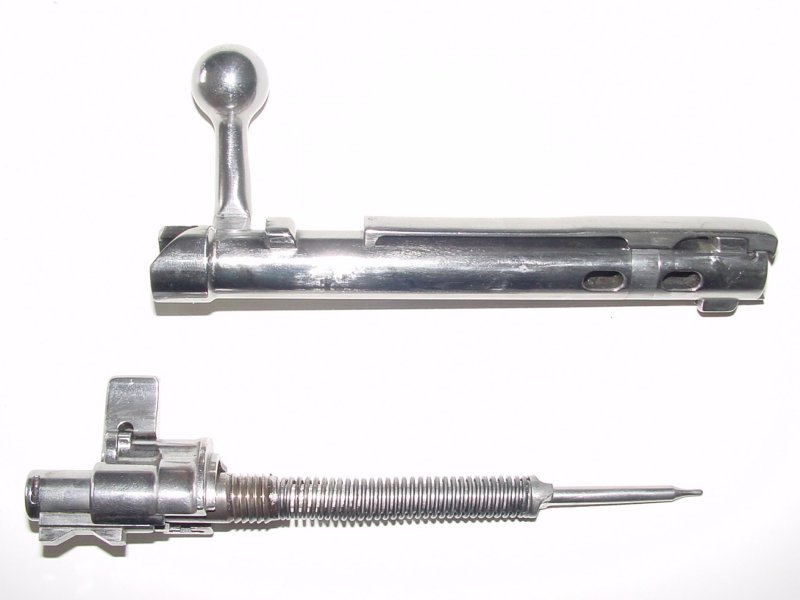
The G98 introduced or refined several features that became standard for bolt‑action rifles. It employs a strong, controlled‑round feed Mauser bolt with a large non‑rotating claw extractor that captures the cartridge rim as the round is stripped from the magazine. The bolt locks with dual front locking lugs and includes a third safety lug to help prevent catastrophic failure.
- Internal, detachable‑free, 5‑round box magazine loaded with 5‑round stripper clips.
- Long barrel and full‑length stock giving good accuracy and stability in prone and volley fire roles.
- Adjustable tangent rear sight (Lange Visier style) and robust iron sights suitable for long‑range volley shooting.
These design choices emphasized strength, reliability, and controlled feeding — qualities that made the action popular for military and sporting conversions.
Service history and variants
The G98 was adopted by the German military in 1898 and served as the primary infantry rifle through World War I. Variants and derivative weapons were produced for specialised roles: sniper conversions with telescopic sights, shorter cavalry and engineer carbine versions, and later simplified models for secondary and occupation use. In 1935 the German army began replacing the long G98 with the Karabiner 98k (Kar98k), a shorter carbine that retained the Mauser action but was better suited to mobile warfare.
Many foreign arms designers borrowed heavily from the G98's action. Examples include the United States' M1903 Springfield (M1903), and Japanese Arisaka types such as the Type 38 and Type 99 (Arisaka models). Detailed production and export records can be found in manufacturer and military files (military archives).
Legacy and influence
The G98's Mauser action is often regarded as the archetype of the modern bolt‑action rifle. Its controlled‑feed extractor, robust locking system and reliable feeding inspired a wide family of military rifles around the world. Sporting rifle makers adapted the same basic layout for hunting and target rifles, and many contemporary bolt designs still follow the same principles of controlled feed and sturdy locking lugs.
Collectors, historians and shooters study the G98 both as an important historical artifact and as a benchmark in firearm engineering. Technical comparisons and surviving examples are discussed in arms reference works and museums (carbine comparisons, international variants).
Notable facts and distinctions
- Although not the first bolt‑action rifle, the G98's action became a dominant global reference and was widely copied or adapted.
- Its 5‑round, stripper‑clip loading system allowed faster reloading than single‑shot rifles of earlier eras.
- The transition to the shorter Karabiner 98k reflects a shift from long‑rifle tactics to more mobile, rifle‑carbine employment.
For further reading and primary documentation use archived technical manuals and museum entries (technical manuals, design notes, historical overview, conflict records, successor models, comparative studies, export lists, related foreign designs, Arisaka comparisons).
Questions and answers
Q: What is the G98 Mauser rifle?
A: The G98 Mauser rifle is a bolt-action rifle used by Germany from 1898 until the end of World War I, which was the German military's main rifle during that time.
Q: When was the G98 Mauser rifle replaced?
A: The G98 Mauser rifle was replaced in 1935 by Kar98k, a carbine version of the G98.
Q: Was the G98 Mauser rifle the first bolt-action rifle ever made?
A: No, the G98 Mauser rifle was not the first bolt-action rifle ever made.
Q: Why is the G98 Mauser rifle so significant?
A: The G98 Mauser rifle is significant because its design is so well-liked by militaries worldwide that many bolt-action rifles copied its design.
Q: Which rifles made by other countries were based on the G98 Mauser rifle?
A: The American M1903 Springfield rifle and the Japanese Type 38 and Type 99 Arisaka rifles were based on the G98 Mauser rifle.
Q: Do modern bolt-action rifles still follow the design of the G98 Mauser rifle?
A: Yes, many modern bolt-action rifles still follow the basic design of the G98 Mauser rifle.
Q: How many rounds could the G98 Mauser rifle hold and how was it fed?
A: The G98 Mauser rifle held up to five 7.92 x 57mm Mauser rounds and it was clip-fed, which means that the shooter can load many bullets at one time, rather than just one bullet at a time.
Author
AlegsaOnline.com Gewehr 98 (G98) Mauser rifle Leandro Alegsa
URL: https://en.alegsaonline.com/art/37139
Sources
- militaryfactory.com : "Mauser Model 1898 (Gew 98) Bolt-Action Service Rifle - Imperial Germany"