
Furcula (wishbone): anatomy, function, and evolution
The furcula, or wishbone, is the fused clavicles found in birds and some theropod dinosaurs. It reinforces the shoulder girdle, helps in flight mechanics, varies among species, and appears in the fossil record.
The furcula—commonly called the wishbone—consists of two clavicles fused into a V- or U-shaped structure that sits between a bird's shoulder blades. It is part of the shoulder girdle and links to the scapulae and other elements of the pectoral skeleton. The name derives from Latin for "little fork," reflecting its distinctive forked shape. While compact, the furcula occupies a central role in how many birds move and cope with the forces generated during wing beats.
Image gallery
3 Images

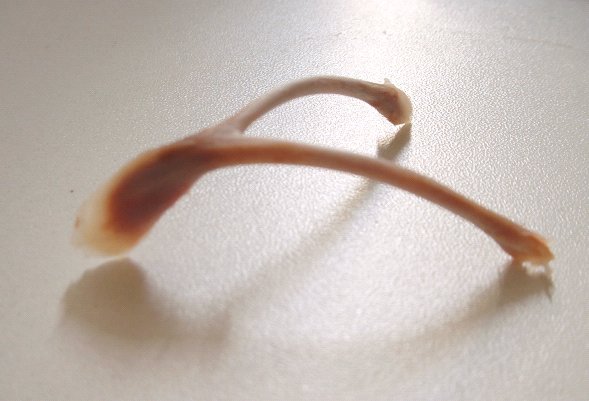
Anatomy and function
Structurally the furcula acts like a compressive strut and, in many species, an elastic spring. It is formed by the fusion of the two clavicles, and contributes to the rigidity of the thoracic skeleton. During flight the furcula resists forces that would otherwise splay the shoulders outward. Observations and imaging have shown that in some birds the furcula flexes during the wing stroke: it expands when the wings move downward and recoils as the wings are raised, storing and releasing energy to assist the upstroke and to return the shoulders toward the midline during recovery.
These mechanical roles are closely tied to flight, but the extent of elasticity and robustness varies. High-performance flyers often have a well-developed, springy furcula; in other species the bone may be stiffer, abbreviated, or partially reduced. X-ray studies and motion analyses (for example, historic film studies of starlings) have demonstrated the dynamic behavior of the furcula during wing cycles and its contribution to respiratory and muscular mechanics as well as to limb bracing. Modern imaging modalities, such as X-ray and computed tomography, continue to clarify those relationships.
Evolution and fossil record
Furculae are not unique to living birds. Paleontologists have identified similar fused clavicles in a range of theropod dinosaurs, indicating the structure has deep evolutionary roots. Well-known fossil taxa with a furcula include early bird relatives and certain non-avian theropods, and the presence of this element is an important character in discussions of the origin of avian flight and shoulder anatomy. Studies of fossils continue to refine how the furcula changed in shape and function along the lineage that produced modern birds; researchers compare fossil bones to living species to infer mechanical roles and locomotor capabilities.
Variation, importance and notable facts
- Species differences: some birds retain a prominent elastic furcula, others have a reduced or absent furcula yet still fly effectively.
- Functional diversity: beyond spring action, the furcula contributes to skeletal bracing, attachment sites for flight muscles, and may influence breathing mechanics.
- Fossil evidence: the structure appears across several groups of theropod dinosaurs, linking it to the broader story of bird origins.
Specific studies have used subjects such as starlings to illustrate furcular dynamics and referenced historical imaging work to show how the bone changes shape in flight (starlings). Researchers sometimes cite classic descriptions and modern imaging reports to explain variation across taxa and to place the furcula in a wider biomechanical context. Although popularly celebrated in the form of the wishbone ritual, the biological role of the furcula is primarily structural and functional rather than cultural.
Cultural note and concluding remarks
Beyond anatomy and paleontology, the furcula has a place in human culture as the "wishbone," where two people pull opposite ends after a bird has been cooked, with the larger piece said to bring good luck. This folk practice has no bearing on the bone's natural function but illustrates how a small anatomical element can gain symbolic meaning. Scientifically, the furcula remains significant for understanding avian flight mechanics, shoulder evolution, and the morphology of extinct theropods.
For further reading on shoulder anatomy and terminology see linked resources: scapulae, clavicles, and imaging studies via X-ray materials. Additional summaries and fossil overviews are available through general paleontology introductions theropod reviews and ornithological references on flight mechanics.
Questions and answers
Q: What is the furcula?
A: The furcula is a forked bone in birds and some extinct dinosaurs, commonly called the wishbone.
Q: What is the main function of the furcula in birds?
A: The main function of the furcula in birds is to strengthen the thoracic skeleton to withstand the forces of flight.
Q: How is the furcula formed in birds?
A: The furcula in birds is formed by the fusion of the two clavicles (shoulder blades).
Q: What is the function of the furcula during flight?
A: During flight, the furcula acts like a spring and stores some of the energy generated by contraction of the breast muscles, releasing the energy during the upstroke as the furcula snaps back to the normal position, which draws the shoulders toward the midline of the body.
Q: Is the furcula essential for flying in birds?
A: Surprisingly, the furcula is not essential for flying in birds, and there are a number of birds which can fly well, but have a reduced furcula, or none at all.
Q: Did theropod dinosaurs have furculae?
A: Yes, several groups of theropod dinosaurs had furculae.
Q: What does the term "strut" mean in relation to the furcula?
A: In relation to the furcula, "strut" refers to a structure which resists compression (pushing together) along its length.
Related articles
Author
AlegsaOnline.com Furcula (wishbone): anatomy, function, and evolution Leandro Alegsa
URL: https://en.alegsaonline.com/art/37061