
Fundamental Theorem of Calculus
Principle linking differentiation and integration: the theorem that connects antiderivatives with definite integrals and explains how integration and differentiation undo each other.
Overview
The fundamental theorem of calculus is the central result that connects two main operations of classical calculus: differentiation and integration. It explains how the definite integral of a function over an interval relates to antiderivatives, and how the process of integration can produce a function whose derivative recovers the original integrand. This connection underpins much of applied and theoretical analysis and is a foundation of calculus.
Image gallery
3 Images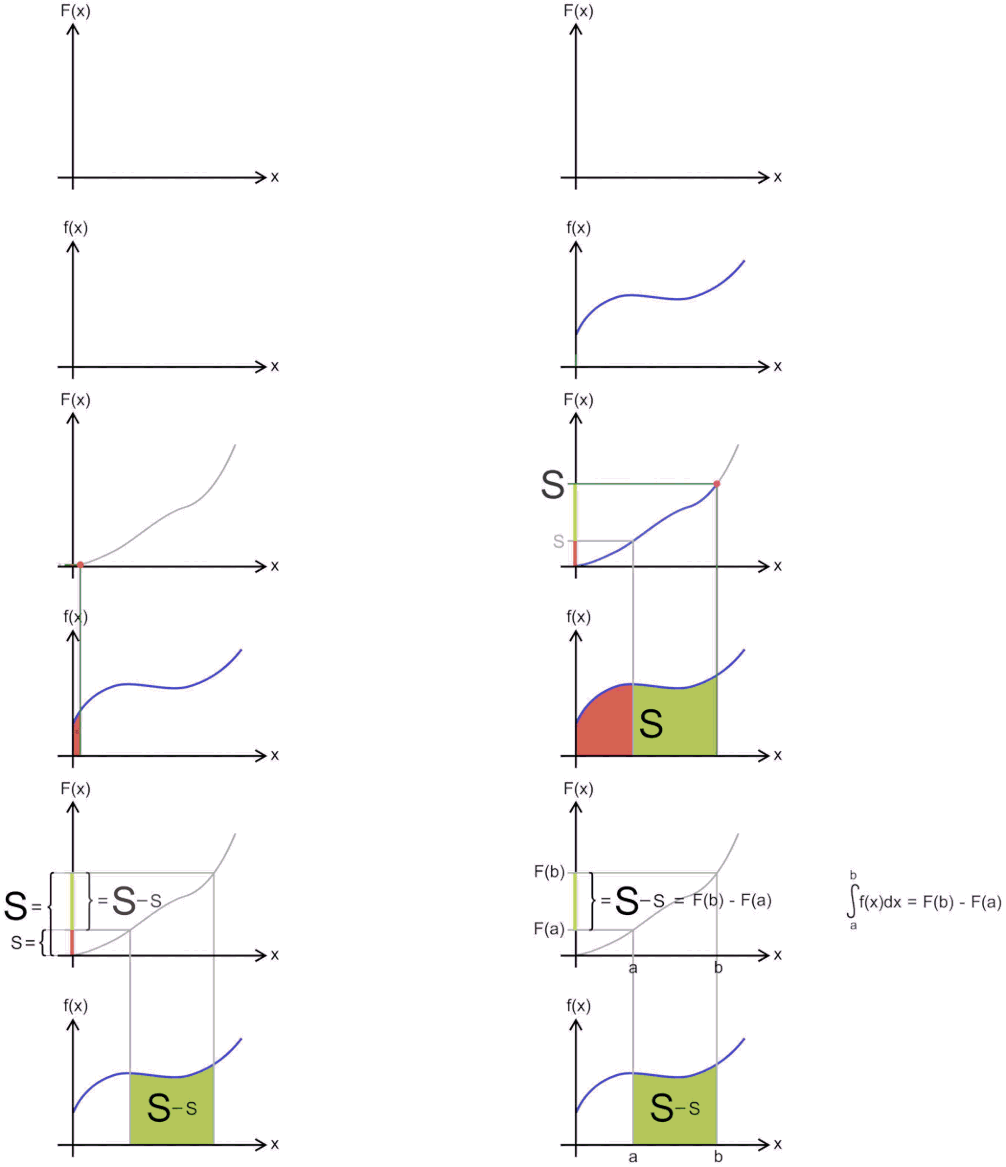

Statement and two parts
The theorem is usually presented in two complementary parts. Informally:
- First part (differentiation of an integral): If f is continuous on an interval and F(x) = ∫_a^x f(t) dt, then F is differentiable and F'(x) = f(x). In other words, forming the definite integral from a fixed lower limit to a variable upper limit yields an antiderivative of f.
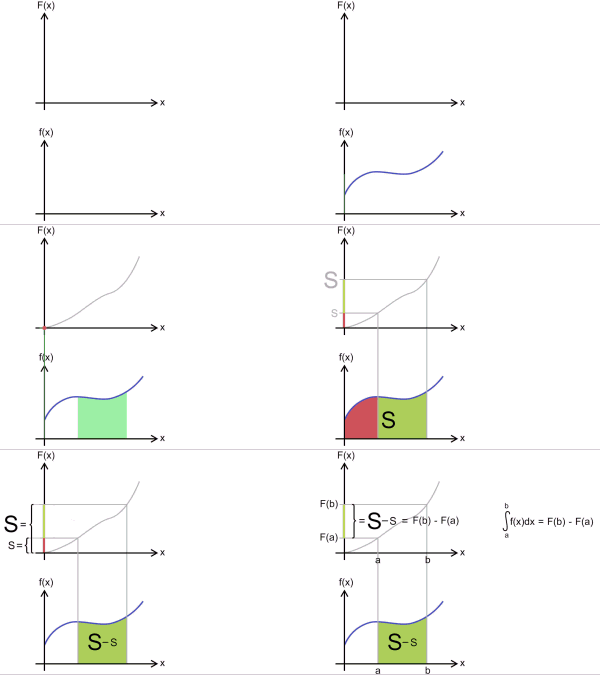
- Second part (evaluation using antiderivatives): If f has an antiderivative G on an interval (so G' = f), then the definite integral from a to b equals G(b) − G(a). This is often called the Newton–Leibniz formula and is the practical rule used to compute definite integrals.
Conditions and generalizations
Continuity of the integrand is a common hypothesis in elementary treatments because it guarantees the existence and nice behavior of the integral and the resulting antiderivative. More advanced versions relax continuity: for example, if f is integrable in the Riemann or Lebesgue sense, weaker conclusions still hold almost everywhere, and measure-theoretic formulations give precise statements about differentiability almost everywhere. The fundamental idea also extends to higher dimensions in the form of results such as Green's theorem, Stokes' theorem, and the divergence theorem.
Examples and applications
Two simple illustrations show the theorem at work. To compute ∫_0^π cos x dx, find an antiderivative G(x)=sin x and evaluate G(π)−G(0)=0−0=0. To form an antiderivative from an integrand, define F(x)=∫_1^x t^2 dt; then by the first part F'(x)=x^2 and F(x) equals (1/3)(x^3−1). Practical applications range from area and accumulated change computations to solving differential equations and analyzing physical systems where rates and accumulated quantities interact.
History and notable remarks
The link between integration and differentiation emerged in the 17th century in the work of Isaac Newton and Gottfried Wilhelm Leibniz and was later placed on firmer analytical footing by 19th-century mathematicians who clarified hypotheses and proofs. The fundamental theorem is often described as the bridge that unifies the two central operations of calculus and remains one of the most frequently used results in both pure and applied mathematics.
Key points
- The theorem gives both a method to construct antiderivatives and a way to compute definite integrals.
- Continuity (or appropriate integrability) of the integrand is important for the classical statements.
- Its spirit persists in many generalizations and is a prototype for broader integral–derivative dualities in analysis.
Questions and answers
Q: What is the fundamental theorem of calculus?
A: The fundamental theorem of calculus is an important concept in calculus that explains the relationship between the derivative and the integral, as well as the relationship between the definite integral and the indefinite integral.
Q: Why is the fundamental theorem of calculus essential to the study of calculus?
A: The fundamental theorem of calculus is central to the study of calculus because it provides a foundation for calculating integrals and finding solutions to numerous mathematical problems.
Q: How is the fundamental theorem of calculus broken down?
A: The fundamental theorem of calculus is divided into two parts, the first fundamental theorem of calculus and the second fundamental theorem of calculus.
Q: What does the first fundamental theorem of calculus explain?
A: The first fundamental theorem of calculus explains the relationship between the derivative and the integral. It states that if f(x) is continuous on [a, b], then the function F(x) = ∫a^x f(t) dt is differentiable on (a, b), and F'(x) = f(x).
Q: What does the second fundamental theorem of calculus explain?
A: The second fundamental theorem of calculus explains the relationship between the definite integral and the indefinite integral. It states that if f(x) is continuous on [a, b], then the definite integral of f(x) from a to b is equal to F(b) - F(a), where F(x) is an antiderivative of f(x).
Q: What is the significance of the first fundamental theorem of calculus?
A: The first fundamental theorem of calculus is significant because it enables us to evaluate definite integrals by finding antiderivatives of functions.
Q: How is the fundamental theorem of calculus used in real-world applications?
A: The fundamental theorem of calculus has many real-world applications, including in physics, engineering, and economics, where it is used to calculate areas, volumes, velocities, and other important variables.
Related articles
Author
AlegsaOnline.com Fundamental Theorem of Calculus Leandro Alegsa
URL: https://en.alegsaonline.com/art/37028