
Fritz Reuter: Life and literature of a Low German novelist
Comprehensive overview of Fritz Reuter (1810–1874), his life, imprisonment, use of Low German, major works, themes, style, and cultural legacy in 19th‑century northern Germany.
Fritz Reuter (7 November 1810 – 12 July 1874) was a German novelist best known for his warm, humorous and observant prose in Low German (Plattdeutsch). Born in Stavenhagen in the Grand Duchy of Mecklenburg‑Schwerin, Reuter drew on the speech, customs and everyday life of rural Mecklenburg to create sketches and longer narratives that have remained influential for regional literature and for the history of dialect writing in Germany.
Image gallery
5 Images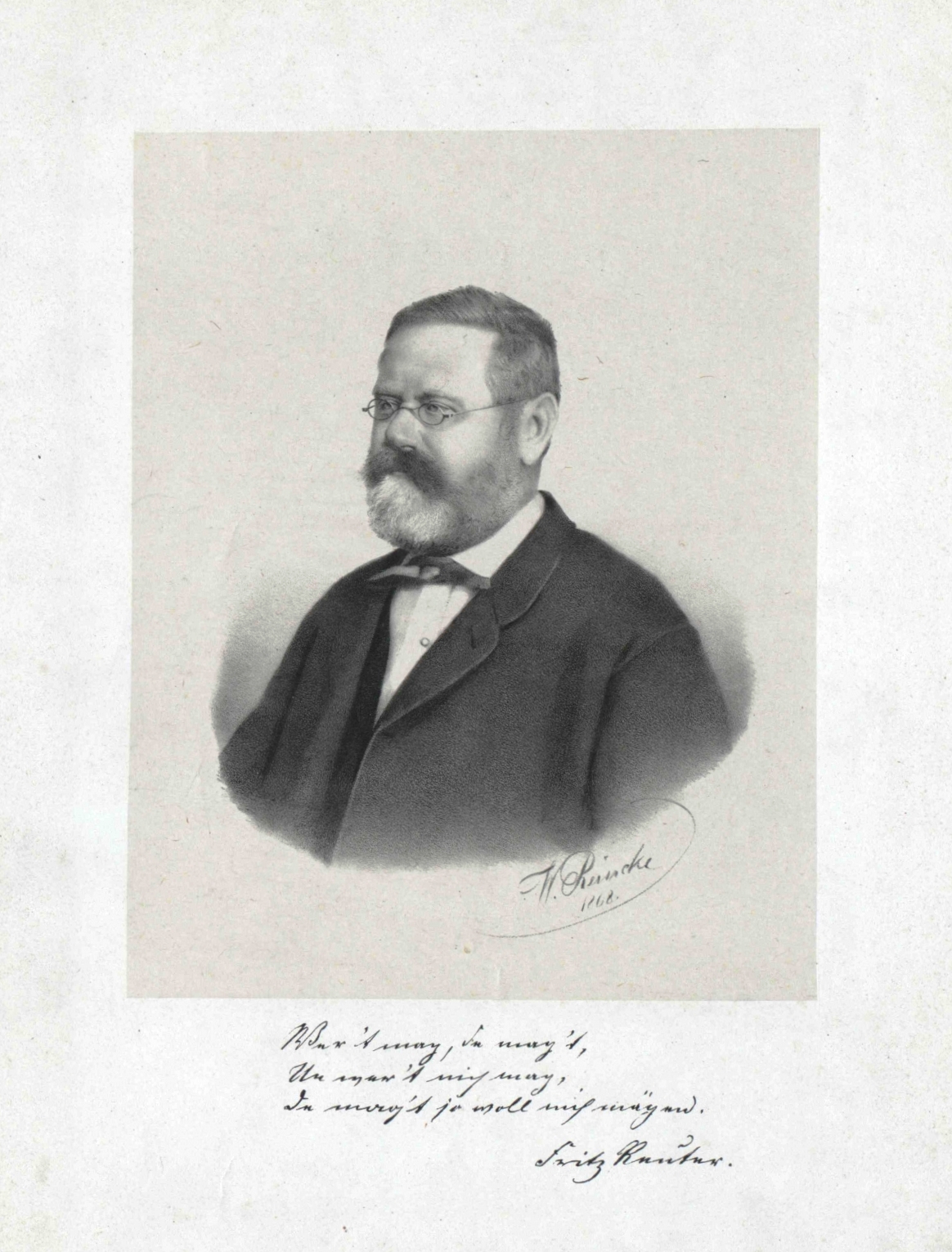


Early life and student years
Reuter received a classical education in his native region and began university studies at the University of Rostock. He continued at the University of Jena, where he became involved with a Burschenschaft, a nationalist student fraternity common at that time. In the charged political atmosphere of the 1830s his association with student activism attracted official attention and led to events that would shape much of his early adult life.
Arrest, sentence and imprisonment
In 1833 Reuter was arrested by the Prussian government. Authorities could not produce concrete evidence of conspiratorial acts, but his wearing of the fraternity colours and his political connections were judged sufficient to convict him of high treason. The initial sentence was capital punishment, later commuted by King Frederick William III to a long term of imprisonment. Reuter was held in several facilities in Mecklenburg and spent a period in the fortress of Dömitz; he was finally released in 1840 following a change in regime on the accession of Frederick William IV. The experience of confinement and of surveillance left a lasting impression on him and on his later outlook.
Return to Mecklenburg, family and teaching
After his release Reuter briefly resumed law studies but soon returned home to assist with the family farm. When his father died he relinquished farming, moved into education as a private tutor, and settled in the small town known at the time as Treptow‑an‑der‑Tollense in historic Pomerania. There he married Luise Kunze, the daughter of a Mecklenburg pastor. While working as a teacher he began to write in Low German and to publish sketches that recorded local types, anecdotes and the cadence of village speech.
Literary career and language
Reuter’s first notable publication appeared in 1853 in Low German; by the mid‑1850s he had left teaching to devote himself to writing and in 1856 moved to Neubrandenburg. He chose Plattdeutsch for much of his early fiction because it allowed him to capture idioms, humor and social nuance that standard High German would have flattened. His use of dialect is allied to a realist, character‑centred approach: vivid dialogue, gentle satire and compassionate attention to ordinary lives.
Major works
Among his best‑known books are Ut de Franzosentid and Ut mine Stromtid. Ut de Franzosentid is set in the years of the Napoleonic wars and recounts how rural communities confronted occupation, military quartering and the pressures of change. Ut mine Stromtid turns to the social tensions of the mid‑19th century and reflects upon events around 1848; it captures debates, hopes and anxieties at the local level rather than offering sweeping political manifestos. Both works are built from memorable character sketches of farmers, craftsmen, parish clerks and local functionaries.
Style and themes
Reuter’s prose is notable for its economy, psychological insight, and a tone that combines affection with ironic distance. He avoided didacticism; his moral outlook is humane rather than doctrinaire. Typical themes include the dynamics of village community, the impact of social change on traditional rural life, the interplay of personality and custom, and a recurrent comic sensibility that finds warmth in human foibles. His art lies in rendering particular lives in a way that illuminates broader social patterns.
Later years, reception and legacy
In 1863 Reuter moved to Eisenach, where he spent his final decade. Contemporary critics and later readers have sometimes judged his later output less striking than his early Low German sketches, but his reputation endures because he established a powerful regional voice and preserved forms of speech and social detail that would otherwise have been lost. He is commemorated in museums, local memorials and editions of his works; scholars of dialect literature and of 19th‑century rural culture continue to consult his books for their ethnographic as well as literary value.
- Representative works: Ut de Franzosentid, Ut mine Stromtid and a cycle of Low German sketches published from the 1850s onwards.
- Principal themes: rural community life, the effects of political upheaval on ordinary people, humor and moral observation, fidelity to dialect speech.
- Significance: helped to establish Plattdeutsch as a vehicle for literary expression and remains a key source for understanding Mecklenburg society in the 19th century.
Reuter’s work continues to be read and anthologized in Germany and studied by those interested in regional cultures, dialect literature and the social history of the nineteenth century. Editions and translations have brought several of his narratives to wider readerships, and his characters remain a reference point in regional memory and cultural heritage.
Questions and answers
Q: When was Fritz Reuter born?
A: Fritz Reuter was born on November 7, 1810.
Q: Where did he study at university?
A: Fritz Reuter studied at the University of Rostock and the University of Jena.
Q: What happened when he was arrested in Berlin by the Prussian government?
A: The Prussian government condemned him to death for high treason, even though they could only prove that he had worn the club's colours. King Frederick William III of Prussia changed this to imprisonment for thirty years.
Q: What did Reuter do after his release from prison?
A: After his release from prison, Reuter started studying law again at the University of Heidelberg but had to leave and go back to Stavenhagen and help to run his father's farm. When his father died, he gave up farming, and in 1850 became a private teacher in a little town then called Treptow-an-der-Tollense in Pomerania. Here he married Luise Kunze, the daughter of a Mecklenburg pastor.
Q: What are some of Reuter's best books?
A: Ut de Franzosentid and Ut mine Stromtid are two of Fritz Reuter's best books. In them he describes the men and women he knew in the villages and farmhouses of Mecklenburg. Ut de Franzosentid is set at the time of the fight against Napoleon while Ut mine Stromtid describes the revolutionary movement of 1848.
Q: Where did Reuter move after Neubrandenburg?
A: After leaving Neubrandenburg, Fritz Reuter moved to Eisenach where he died on 12 July 1874.
Q: How were his later writings compared with earlier works?
A: His later writings were not as good as his earlier ones written before moving to Eisenach
Related articles
Author
AlegsaOnline.com Fritz Reuter: Life and literature of a Low German novelist Leandro Alegsa
URL: https://en.alegsaonline.com/art/36781