
The Diary of Friedrich Kellner: My Opposition — a German Witness to the Third Reich
A concise encyclopedia entry on Friedrich Kellner's wartime diary 'Mein Widerstand' — its origins, contents, historical importance, publication, and distinguishing features as a primary source on Nazi Germany.
Overview
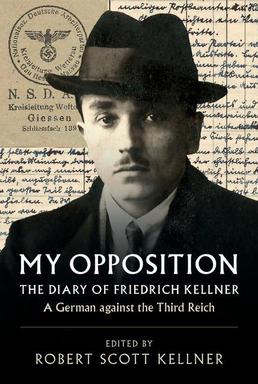
The Diary of Friedrich Kellner, written in secret during the Second World War, is a sustained first‑person record of daily life, political events and moral judgment under the Nazi regime. Kellner, a court official and former Social Democratic Party activist who relocated to Laubach after 1933, began the work in September 1939. He titled it "Mein Widerstand" ("My Opposition") and kept careful entries intended for future readers as a warning and historical testimony. The diary is widely regarded as an important contemporary document that captures both public events and private reactions within Germany during the war. Further reference.
Image gallery
10 Images





Contents and form
The complete diary comprises ten volumes with hundreds of dated entries, sketches of events, and a large number of clipped newspaper items that Kellner pasted into the pages to corroborate and contextualize his notes. He combined short observational entries with more reflective passages, recording rumors and official announcements alongside his assessments of policies, atrocities and the general mood among acquaintances. The mixture of contemporaneous notes and press fragments makes the work both a personal chronicle and a curated archive. More on contents.
Historical context and purpose
Kellner began writing as the German invasion of Poland marked the official start of the war. Having been politically active before the Nazi ban on the Social Democrats, he used the diary to resist intellectually and to document facts that he believed future generations should know. Rather than serving as a private confessional, the diary was explicitly produced as a counter‑record to official propaganda and public silence. It preserves eyewitness impressions of repression, the erosion of legal norms, and reports about persecution that Kellner personally opposed. Contextual source.
Publication, reception and use
Decades after the war, portions of the diary were brought to wider attention through scholarly editing and translation. An English edition, titled "My Opposition: The Diary of Friedrich Kellner — A German against the Third Reich," made the text more accessible to international readers. Historians, educators and museums have used the diary as a primary source to illustrate how ordinary Germans perceived and recorded the unfolding catastrophe, and to study resistance in non‑violent, intellectual forms. The diary has also informed public exhibits and documentary projects exploring grassroots opposition to totalitarianism. Publication details.
Notable features and distinctions
- Intentionality: Kellner wrote for the future, framing entries as testimony rather than private therapy.
- Documentation: The inclusion of contemporary newspaper clippings strengthens the record and shows what information was available domestically.
- Perspective: As an older, politically experienced civil servant, Kellner offers a distinct viewpoint from younger diarists or victims in hiding.
- Scope: The work combines local observation with commentary on national events and policies, making it valuable at multiple levels of analysis. Analytical notes
Because the diary is an immediate, contemporaneous testimony kept inside Germany, scholars treat it as a particularly informative source about how information circulated, how citizens interpreted official actions, and how dissent persisted in non‑public forms. For additional materials, archival descriptions and curated presentations of the diary are available through specialized collections and exhibitions. Related resources.
Questions and answers
Q: Who was Friedrich Kellner?
A: Friedrich Kellner was a justice inspector in the courthouse in Mainz, a political activist for the Social Democratic Party of Germany between 1918 and 1933, and the author of the diary "Mein Widerstand," which means "My Opposition."
Q: When did Kellner begin his secret diary?
A: Kellner began his secret diary when Hitler ordered the invasion of Poland in September 1939.
Q: Why did Kellner name his diary "Mein Widerstand"?
A: Kellner named his diary "Mein Widerstand" because it means "My Opposition," and he intended to write down what he saw and heard about what happened in Nazi Germany so that people later would know about it.
Q: How many volumes does Kellner's diary have?
A: Kellner's diary has ten volumes.
Q: How many pages are there in Kellner's diary?
A: There are 861 pages in Kellner's diary.
Q: How many dated entries are in Kellner's diary?
A: There are 676 dated entries in Kellner's diary.
Q: When was the English translation of Kellner's diary published?
A: The English translation of Kellner's diary was published in 2018 by Cambridge University Press under the title, "My Opposition: The Diary of Friedrich Kellner -- A German against the Third Reich."
Related articles
Author
AlegsaOnline.com The Diary of Friedrich Kellner: My Opposition — a German Witness to the Third Reich Leandro Alegsa
URL: https://en.alegsaonline.com/art/36721