
Freenet: decentralized, censorship-resistant peer-to-peer information storage
Freenet is a peer-to-peer network for censorship-resistant publishing and retrieval, emphasizing anonymity, distributed storage, volunteer infrastructure, and long-term development since 2000.
Overview
Freenet is a decentralized peer-to-peer system designed to allow publishing and retrieval of information without relying on central servers. Its stated aims include enabling freedom of speech and freedom of information, protecting users' identities, and making content removal difficult except by the original author. The project was started by Ian Clarke around 2000 and has been developed by a volunteer community. The software is distributed as free software, and production builds have been available while development continues toward later major releases.
Image gallery
4 Images


Design and operation
At its core Freenet combines a distributed data store with routing among cooperating nodes. Participants contribute disk space and bandwidth so data can be stored redundantly across many machines; this cooperative approach to data distribution is what enables resilience against takedown attempts. User requests are forwarded through multiple nodes, which makes it difficult to link who requested or published particular content and supports the project's goal of user anonymity.
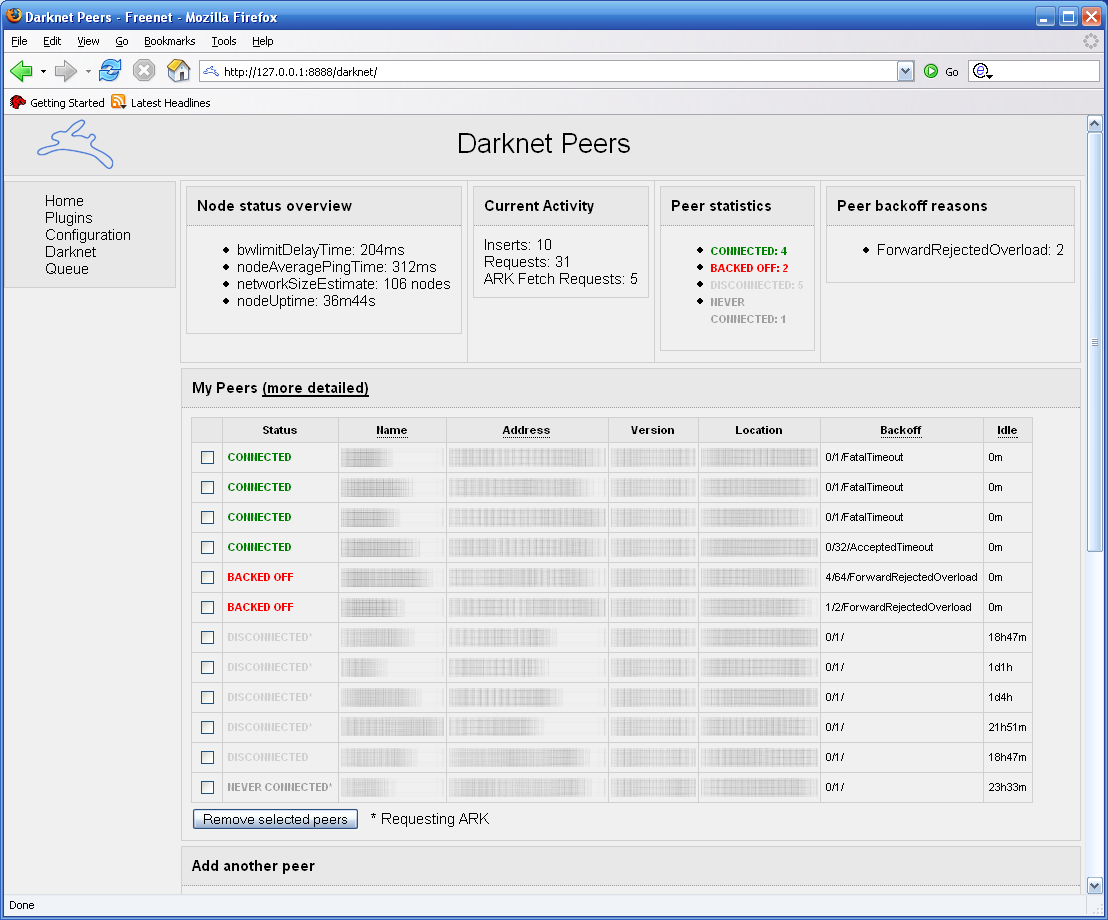
Nodes can be configured in different ways. In "opennet" mode a node connects to random peers, while in "darknet" mode it connects only to trusted friends; combining these modes is a common practice to balance discoverability and privacy. Freenet emphasizes plausible deniability: nodes cache and serve content without easily provable knowledge of its origin or meaning.
History and development
Freenet's development has been continuous since its inception in 2000. The project evolved through multiple iterations and a substantial rewrite around the 0.7 series to improve scalability, security, and usability. Though the team has spoken of future milestone releases, the network has long been usable and maintained by contributors. The system relies on volunteer bandwidth and storage provided by participants rather than centralized hosting.
Uses and examples
People use Freenet for a variety of purposes that often center on resisting censorship and enabling anonymous publication. Typical uses include:
- Hosting persistent documents and pages that remain available even if individual nodes go offline.
- Publishing whistleblower materials, independent journalism, or politically sensitive content where authors seek protection.
- Running forums and message boards that are harder to take down or surveil than conventional services.
- Experimenting with decentralized applications that leverage distributed storage and routing.
While Freenet's design helps protect free expression, those same properties have raised legal and ethical debates because the network can also be used to host illicit material. The project and its community typically emphasize harm-reduction, moderation tools, and legal awareness.
Distinctions and notable facts
Freenet differs from low-latency anonymity systems such as Tor in that it is optimized for storage and eventual retrieval rather than interactive, real-time connections. Its focus on content-addressed storage and replicated caches affects performance: retrieving obscure or unpopular content can be slower, while popular items become more readily available as they are replicated across the network. For further background on its architecture and goals see materials describing its decentralized overlay network and its censorship-resistant design choices.
For people exploring privacy-preserving tools, Freenet represents one approach among several—each with different trade-offs in speed, usability, and threat model. Community documentation and development resources remain the best sources for up-to-date configuration guidance and discussions about how to use the network responsibly; consult project pages and developer notes via links maintained by Freenet's contributors such as privacy and identity guidance and implementation references at project repositories.
Overall, Freenet is notable for its long-running, volunteer-driven development, its commitment to censorship-resistance and anonymity, and its particular suitability for storing and sharing information across a distributed, cooperative network.
Questions and answers
Q: What is Freenet?
A: Freenet is a decentralized network that aims to provide freedom of speech and information through a peer-to-peer network with protection of user's identity.
Q: What does censorship-resistant mean in the context of Freenet?
A: Censorship-resistant means it is not easy for anyone other than authors to remove content on Freenet.
Q: Who created Freenet?
A: Freenet was made by Ian Clarke.
Q: How does Freenet work?
A: Freenet works by putting together the volunteer bandwidth and storage space of member machines to allow users to anonymously publish or retrieve different kinds of information.
Q: What is the goal of Freenet?
A: The goal of Freenet is to provide freedom of speech and freedom of information through a peer-to-peer network with protection of user's identity.
Q: Has Freenet been released in version 1.0?
A: No, a version 1.0 of Freenet has not yet been released, but current builds are usable.
Q: Is Freenet free software?
A: Yes, Freenet is free software.
Related articles
Author
AlegsaOnline.com Freenet: decentralized, censorship-resistant peer-to-peer information storage Leandro Alegsa
URL: https://en.alegsaonline.com/art/36520
Sources
- freenetproject.org : "Freenet: People"
- freenetproject.org : Freenet News