
Freedom of Speech (painting) by Norman Rockwell
A 1943 oil painting by Norman Rockwell, part of his Four Freedoms series inspired by FDR's 1941 Four Freedoms speech; it depicts an ordinary man standing to speak at a town meeting as a symbol of democratic liberty.
Overview
Freedom of Speech is an oil painting created by Norman Rockwell as one of four works collectively known as the Four Freedoms. Rockwell produced the series in response to President Franklin D. Roosevelt's Four Freedoms address of January 6, 1941, which articulated universal rights Americans should defend. The images were completed in 1943 and presented a visual companion to the wartime rhetoric that emphasized civil liberties in the United States and abroad.
Image gallery
3 Images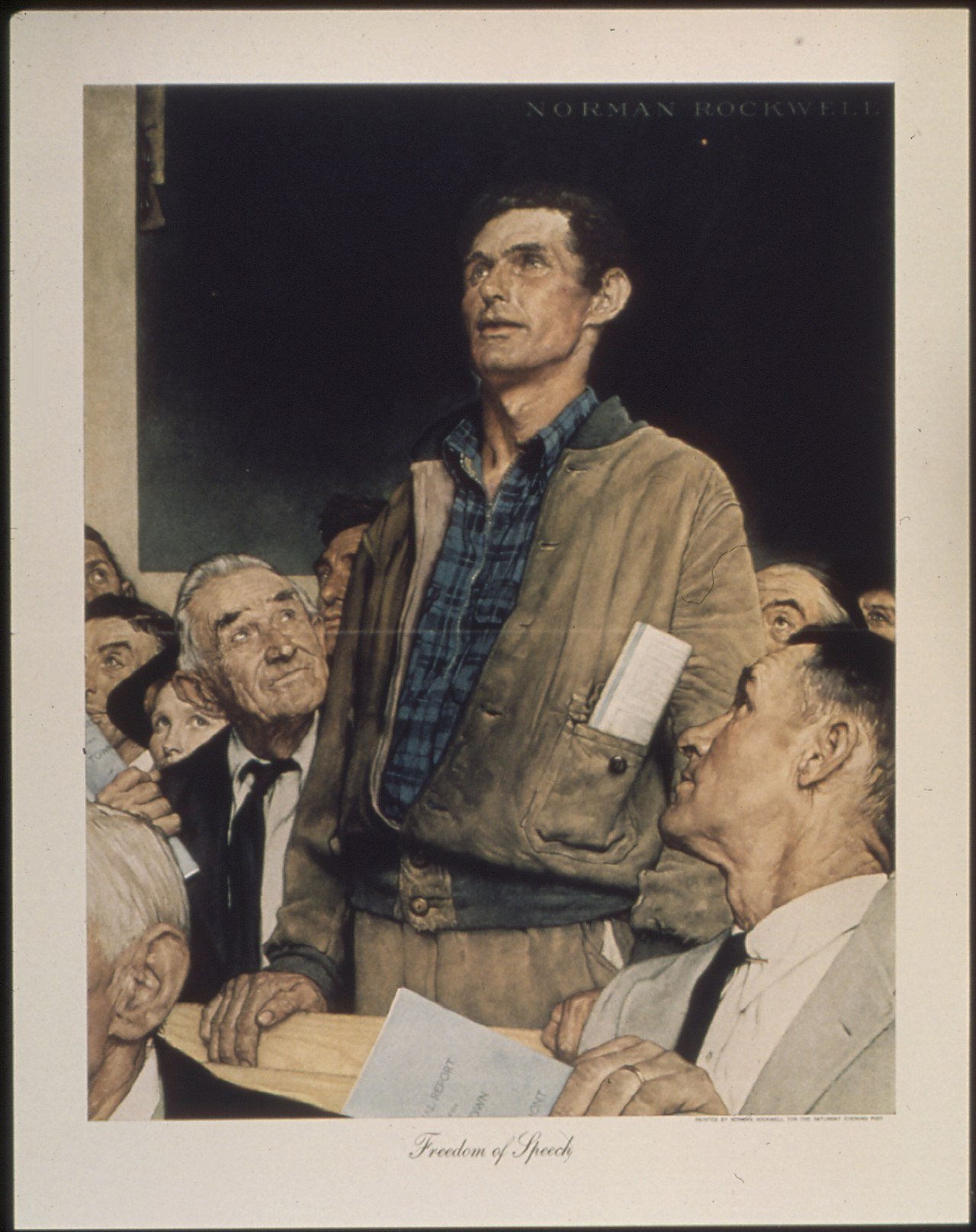


Description
The painting shows a single man standing in a modest public meeting, surrounded by seated listeners who turn their attention toward him. Rockwell adopts a realistic, illustrative style: careful detail in facial expressions, clothing, and gestures conveys character and social class. The design centers on the speaker — his posture upright, head slightly tilted, mouth poised mid-sentence — while the surrounding figures are rendered with individualized features that suggest respect and attentiveness rather than interruption.
Key features
- Figurative realism with tightly observed facial study and everyday apparel.
- Compositional focus on a single standing figure as the embodiment of the right to speak.
- Use of light and color to model form and direct the viewer's gaze toward the speaker.
- Absence of dramatic action; emphasis on civic ritual and ordinary citizenship.
History and reception
Rockwell's Four Freedoms series first reached a national audience when the paintings were reproduced and distributed during World War II. They were widely circulated in magazines and on posters, and they played a role in civilian morale and fundraising efforts during the war. Critics and the public reacted differently: many praised the works for their clarity and persuasive power, while some art critics dismissed them as sentimental or illustrative rather than avant-garde. Despite such debates, the images became enduring symbols of mid-20th-century American ideals.
Interpretation and legacy
The painting functions more as a civic icon than as a literal legal treatise: it illustrates the social practice of free speech, showing how the right can look in a small public assembly. Over time the work has been reproduced in educational materials, exhibited in museums, and referenced in discussions about art and democracy. It remains a widely recognized visual shorthand for the principle that ordinary people have a voice in public affairs.
Notable aspects include the series' combined cultural and wartime significance, the contrast between Rockwell's populist realism and contemporary modernist trends, and the work's continuing presence in collections and publications that explore American history and civic values.
Questions and answers
Q: Who painted Freedom of Speech?
A: Norman Rockwell painted Freedom of Speech.
Q: What is Freedom of Speech?
A: Freedom of Speech is a painting by Norman Rockwell that is part of his series of four paintings called the Four Freedoms.
Q: What inspired Norman Rockwell to make the Four Freedoms paintings?
A: Norman Rockwell was inspired to create the Four Freedoms paintings after hearing the Four Freedoms Speech by American President Franklin D. Roosevelt on January 6, 1941.
Q: How many paintings are in Norman Rockwell's Four Freedoms series?
A: Norman Rockwell's Four Freedoms series consists of four paintings.
Q: When was Franklin D. Roosevelt's Four Freedoms Speech?
A: Franklin D. Roosevelt's Four Freedoms Speech was delivered on January 6, 1941.
Q: What is the theme of the Four Freedoms series?
A: The Four Freedoms series by Norman Rockwell is inspired by the Four Freedoms Speech given by Franklin D. Roosevelt, which highlighted the importance of freedom of speech, freedom of worship, freedom from want, and freedom from fear.
Q: What is the significance of Freedom of Speech painting?
A: The Freedom of Speech painting by Norman Rockwell is a powerful representation of the essential freedom that people should have to express themselves freely, one of the fundamental values of democratic societies.
Related articles
Author
AlegsaOnline.com Freedom of Speech (painting) by Norman Rockwell Leandro Alegsa
URL: https://en.alegsaonline.com/art/36497
Sources
- michenermuseum.org : Pairs Famed American Illustrators Rockwell and Hargens for Fall Exhibitions in New Hope