
Free-Staters (Kansas): Settlers Who Opposed Slavery's Expansion in the 1850s
Free-Staters were mid-19th-century Kansas Territory settlers who resisted the extension of slavery; their coalition combined abolitionists and exclusionists, spawned rival constitutions, and helped shape Kansas statehood.
Overview
The term Free-Stater described a diverse coalition of settlers in the Kansas Territory during the 1850s who opposed the legal extension of slavery into that territory. Their actions were a central element of the violent and politically charged contest known as Bleeding Kansas. Free-Staters sought to ensure that Kansas would enter the Union as a state without slavery, but the movement encompassed a range of motives and views about race, labor and settlement.
Image gallery
1 Image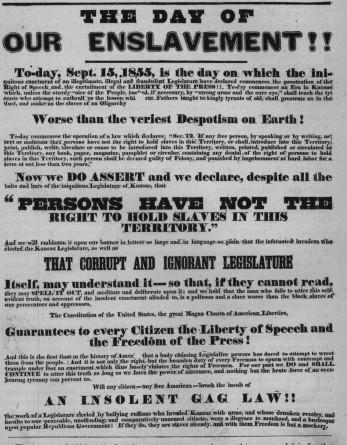
Origins and recruitment
Free-Staters included migrants from New England, the Midwest and other regions who came as individual settlers or as part of organized efforts. Some were committed abolitionists from New England and elsewhere who intended to fight slavery on moral grounds. Others were settlers from states such as Ohio, Iowa and other midwestern states who opposed slavery’s expansion for economic or political reasons. Organized colonization enterprises, most notably those associated with the New England Emigrant Aid Company, encouraged migration of anti-slavery settlers to tip territorial politics toward free-state outcomes.
Beliefs on slavery and race
While Free-Staters were united in resisting slavery’s legal importation into Kansas, they were not uniform in their attitudes toward African Americans. A significant number of Free-Staters were not abolitionists in the sense of advocating full civil equality: some favored exclusionary policies that would prevent both enslaved and free Black people from living in Kansas. Contemporary observers and later historians note that prejudice and a desire for "free soil" for white laborers shaped much early Free-State rhetoric. At the same time, committed abolitionists and equal-rights advocates worked within the movement and gradually influenced its platforms.
Labels, propaganda and opponents
Proponents of slavery often used the label "abolitionist" to describe all Free-Staters as a way of rallying southern opposition and portraying the contest as radical social change. Pro-pro-slavery forces, including armed bands from neighboring Missouri sometimes called "Border Ruffians," sought to control territorial politics by electoral interference and intimidation. Free-Staters rejected the expansion of slavery even as their ranks contained both moderates who disavowed racial equality and radicals who demanded immediate emancipation and equal rights.
Political organization and conflict
Free-Staters used multiple strategies to secure political control of Kansas. They organized migration and settlement to influence the territory’s population, formed local governments in opposition to pro-slavery authorities, and participated in both legal and extralegal contests over elections and law enforcement. Violent clashes, high-profile raids and retaliations marked the era: some actions were carried out by militant abolitionists and some by pro-slavery agitators, and both sides contributed to the breakdown of civil order for a time.
Constitutions and the path to statehood
A series of proposed constitutions reflected competing visions for Kansas. Free-State delegates drafted the Topeka Constitution in 1855 as an early anti-slavery charter. A later pro-slavery Lecompton Constitution sought to entrench slavery in the territory and became a national controversy. In 1858 Free-Staters produced the Leavenworth Constitution, which more directly reflected abolitionist influence by proposing broader rights for Black men, though it was not immediately successful. The compromise documents and continuing conflict culminated in the Wyandotte Constitution, accepted by Congress as the basis for Kansas's admission as a free state in 1861.
Notable figures and place names
Organizers such as Eli Thayer and associates of the New England Emigrant Aid Company played prominent roles in encouraging migration, though they often emphasized free-labor principles rather than explicit abolitionist goals. Leaders and activists who favored more assertive anti-slavery measures also became prominent within the Free-State camp as tensions escalated. Several communities and geographic names remember Free-Stater activity; for example, Holton, Kansas commemorates Edward Dwight Holton, a Milwaukee backer of Free-State settlement.
Legacy
The Free-State movement shaped the immediate outcome in Kansas and had broader consequences for national politics. It helped determine the balance between slave and free states at a pivotal time and fed into the emerging sectional alignments that prefaced the American Civil War. Historians emphasize the movement’s complex character: opposition to the expansion of slavery coexisted with racial exclusionist tendencies in parts of the coalition, while other members pressed for equal treatment and legal rights for African Americans. This internal diversity affected the content of constitutional proposals and the political compromises that ultimately led to statehood.
Interpretation and further research
Understanding Free-Staters requires attention to regional migration patterns, the role of organized colonization groups, and the interplay of moral, economic and political motives. For primary documents and contextual studies consult archival collections and scholarly treatments that cover settlers in the territory, the legal status of the Kansas Territory, contemporary debates over slavery, and the social dynamics of prejudice and exclusion. Comparative inquiry into claims for equal rights and reactions to discrimination illuminates how the Free-State movement changed over time. Close study of electoral contests, the activities of pro-slavery and anti-slavery factions, and the evolving series of constitutional drafts provides a fuller picture of how Kansas moved from territorial conflict to statehood under a free-state constitution.
- Key distinction: Free-Staters opposed the extension of slavery but were not a monolithic group of abolitionists.
- Methods: migration, organized settlement, rival governments and constitution-drafting were central tactics.
- Conflict: disputed elections, violent raids, and competing territorial authorities marked the period.
- Outcome: a sequence of proposed constitutions and national debate led to admission of Kansas as a free state.
For archival access and introductory overviews consult reference collections and educational resources identified by the placeholders above: settlers, Kansas Territory, Bleeding Kansas, slavery, state, abolitionists, New England, Ohio, Iowa, midwestern states, prejudice, pro-slavery, Eli Thayer, equal rights, discrimination, Leavenworth, and Holton, Kansas.
Questions and answers
Q: What was the name of the settlers in Kansas Territory during the Bleeding Kansas era?
A: The settlers were known as Free-Staters.
Q: Where did some of the Free-Staters come from?
A: Some Free-Staters came from New England, while others came from Ohio, Iowa, and other midwestern states.
Q: What did most Free-Staters believe at the beginning?
A: Most Free-Staters initially believed that all Black people should be excluded from settling in Kansas.
Q: How did pro-slavery Southerners characterize all Free-Staters?
A: Pro-slavery Southerners characterized all Free-Staters as abolitionists.
Q: What was included in the Topeka Constitution drafted by the Free Stater in 1855?
A: The Topeka Constitution would have excluded any black person from settling in Kansas, whether they were slaves or free.
Q: How did abolitionists differ from most of the settlers?
A: Abolitionists wanted equal rights for all blacks and to end discrimination against them, whereas most of the settlers seemed to want free soil for white people only.
Q: What was included in the Leavenworth Constitution proposed by the Free Stater in 1858?
A: The Leavenworth Constitution banned slavery and also would have given voting rights to black men.
Related articles
Author
AlegsaOnline.com Free-Staters (Kansas): Settlers Who Opposed Slavery's Expansion in the 1850s Leandro Alegsa
URL: https://en.alegsaonline.com/art/36474
Sources
- thefreedictionary.com : "free state"
- kshs.org : "Fighting Against Slavery in Kansas Territory"
- kshs.org : "Bleeding Kansas"
- civilwaronthewesternborder.org : "Topeka Constitution"
- history.com : "Abolitionist Movement"
- wisconsinhistory.org : "Honorable E. D. Holton: He Visits our Young City Amid the Firing of Cannon, The Ringing of Bells, Playing of Bands, And Rejoicing Generally"