
Fourteenth Amendment to the United States Constitution
Adopted in 1868, the Fourteenth Amendment defines national citizenship and restricts state power with due process and equal protection clauses; it underpins much modern civil-rights law.
Overview
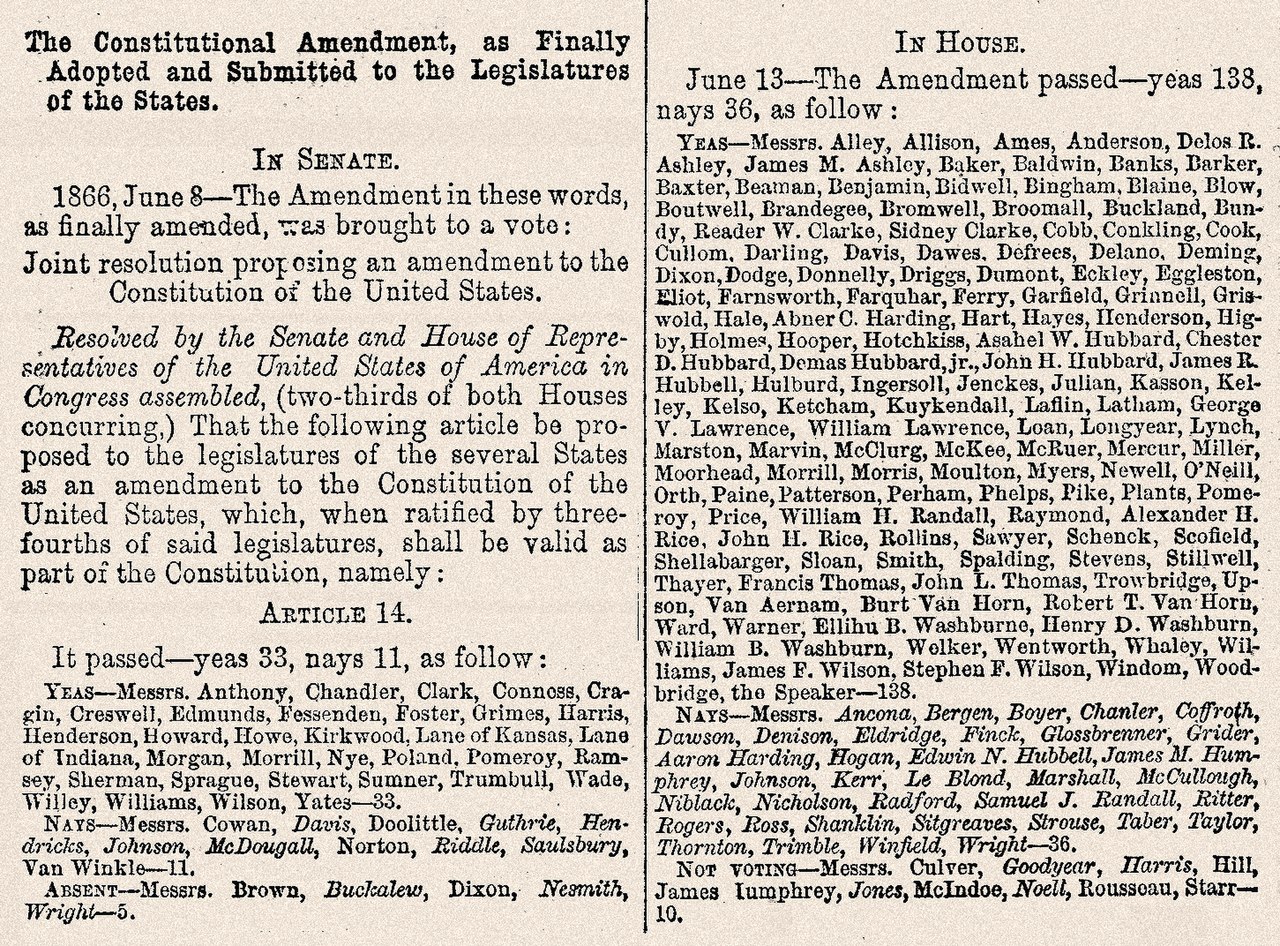
The Fourteenth Amendment, ratified on July 9, 1868, is one of the post–Civil War changes commonly called the Reconstruction Amendments. It addresses who is a citizen of the United States and places limits on state governments by requiring certain legal protections. The full amendment text is compact but has been read broadly by courts and scholars. It was proposed in the aftermath of the American Civil War to resolve legal and political questions affecting newly freed people and the nation as a whole.
Image gallery
8 Images




Key provisions
The most frequently cited paragraph is Section 1, which contains several distinct guarantees that operate together:
- Citizenship clause — recognizes national citizenship for people born or naturalized in the United States and resolves competing claims of state-based citizenship; see the citizenship clause.
- Due Process Clause — prohibits states from depriving any person of "life, liberty, or property" without due process of law; it has been used to apply many federal rights against the states.
- Equal Protection Clause — requires that states treat similarly situated persons alike and has provided the constitutional basis for a wide range of anti-discrimination rulings; often referenced as the Equal Protection Clause.
Other sections address representation in Congress, disqualification from public office for insurrection, the validity of the public debt, and give Congress enforcement power to implement the amendment. The amendment therefore affects how state laws (laws) operate where individual rights are implicated.
Historical context
The amendment grew out of questions about the status of former slaves, the reintegration of rebel states, and how to secure civil and political rights after slavery ended. Many of the former Southern states were required to ratify it as part of the process to regain full representation in Congress. Its adoption reflected political compromise and urgent national priorities during Reconstruction.
Judicial interpretation and impact
The Fourteenth Amendment is among the most litigated parts of the United States Constitution. Early Supreme Court decisions limited some provisions, but later jurisprudence expanded their scope. Through a process commonly called selective incorporation, the Supreme Court has relied on the Due Process and Equal Protection Clauses to apply many protections from the Bill of Rights to state actions. Landmark rulings invoking the amendment cover a broad array of subjects, from racial segregation to voting and family law; examples include several landmark decisions cited in constitutional debates and litigation.
Uses and notable cases
Because it constrains state authority, the Fourteenth Amendment has been central to major civil-rights developments: desegregation of public schools, expansion of voting rights, marriage-equality decisions, and rulings on privacy and bodily autonomy. Courts have at times relied on both the Equal Protection and Due Process Clauses in controversial and consequential cases, including, historically, Roe v. Wade and later disputes over election procedures and representation. Its role ensures that many conflicts between individual rights and state policies are resolved under a shared national standard.
Legacy and contemporary issues
Debate continues about the amendment's text and its proper scope. Scholars and judges disagree about the original meaning of some clauses, how broadly Congress may enforce the amendment under Section 5, and whether particular rights are protected by incorporation. Nonetheless, the Fourteenth Amendment remains a foundational provision for protecting civil rights and shaping the relationship between citizens and state governments in the United States.
For more on reconstruction-era amendments, constitutional clauses, and major cases that interpret the Fourteenth Amendment, see further resources and case law summaries available through legal and historical collections at Reconstruction resources and other specialized sites.
Questions and answers
Q: When was the Fourteenth Amendment adopted to the United States Constitution?
A: The Fourteenth Amendment was adopted on July 9, 1868.
Q: What were the issues that led to the proposal of the Fourteenth Amendment to the United States Constitution?
A: The issues related to former slaves following the American Civil War led to the proposal of the Fourteenth Amendment.
Q: What does the Fourteenth Amendment discuss?
A: The Fourteenth Amendment discusses citizenship rights and equal protection of the laws.
Q: Why was the Fourteenth Amendment bitterly contested?
A: The Fourteenth Amendment was bitterly contested because Southern states were forced to ratify it in order to regain representation in Congress.
Q: Which landmark decisions were based on the Fourteenth Amendment?
A: The Fourteenth Amendment forms the basis for landmark decisions such as Roe v. Wade (1972), and Bush v. Gore (2000).
Q: What is the significance of the Fourteenth Amendment?
A: The Fourteenth Amendment remains the most important Constitutional amendment since the Bill of Rights was passed in 1791.
Q: Why is the Fourteenth Amendment one of the most litigated parts of the Constitution?
A: The Fourteenth Amendment is one of the most litigated parts of the Constitution because it discusses citizenship rights and equal protection of the laws.
Tags
Related articles
Author
AlegsaOnline.com Fourteenth Amendment to the United States Constitution Leandro Alegsa
URL: https://en.alegsaonline.com/art/35919
Sources
- commons.wikimedia.org : Fourteenth Amendment to the United States Constitution
- www1.nickmalik.com : "Explaining the 14th Amendment in Non-Technical English"
- teachinghistory.org : "Voting Rights and the 14th Amendment"
- law.cornell.edu : "Privileges and Immunities Clause"
- loc.gov : "Primary Documents in American History; 14th Amendment to the U.S. Constitution"
- americanhistory.about.com : "14th Amendment Summary"
- shmoop.com : "14th Amendment"
- kids.laws.com : "14TH AMENDMENT"
- archives.gov : "Constitution of the United States: Amendments 11–27" · webcitation.org