
Four-horned antelope (Tetracerus quadricornis)
Small, solitary antelope of the Indian subcontinent notable for males bearing two pairs of horns; occupies dry forests and scrubland and faces habitat loss and hunting pressures.
Overview
The four-horned antelope (Tetracerus quadricornis), commonly known in Hindi as the chousingha, is a small bovine antelope native to the Indian subcontinent. It is unusual among bovids because adult males typically have two pairs of horns (four in total), while females are usually hornless or have very reduced horns. The species is solitary or found in small family groups and is adapted to a mix of grasses, browse and thicket habitats.
Image gallery
8 Images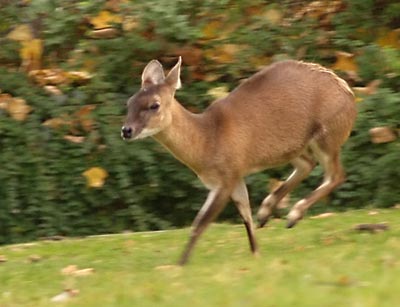




Physical characteristics
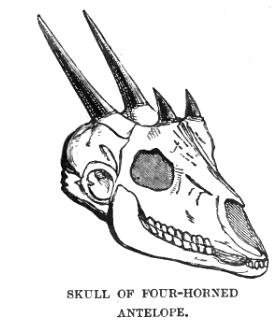
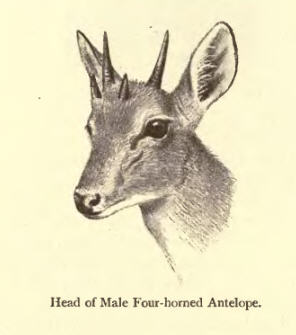
Adults are compact, standing roughly around 0.6 m at the shoulder and weighing on the order of 20 kg, making them one of the smaller antelope species. The coat is generally a light yellowish-brown with paler underparts; some individuals show darker markings on the legs and face. Males have four horns arranged as two pairs: a smaller anterior pair and a larger posterior pair. Posterior horns may reach about 10 cm in length while the front pair are shorter, often a few centimetres. Horn shape, size and presence can vary with age and between populations.
Behavior and diet
Four-horned antelopes are chiefly crepuscular, meaning they are most active at dawn and dusk, and they tend to avoid open plains in favor of cover. They feed on a combination of grasses, leaves, fruits and shoots, showing flexibility between grazing and browsing depending on season and local vegetation. Individuals are usually solitary; when social interactions occur they are often between territorial males and passing females or juveniles.
Habitat and distribution
The species occurs in parts of peninsular India and pockets of Nepal, inhabiting deciduous forests, dry scrub, thorny bush and nearby grasslands where cover and water are available. Populations are patchy and tied to areas that provide both food and dense undergrowth for concealment. Historically the group of bovids to which it belongs has a broader evolutionary background, but today the four-horned antelope is restricted to the Indian subcontinent.
Threats and conservation
Major threats include habitat loss from agriculture and development, fragmentation of suitable habitats, and hunting. The antelope has been hunted both for meat and, in some regions, as a trophy because of its unique four horns; accounts note pressure from hunters targeting these animals for trophies (trophy hunting) and for local consumption (meat). Current population estimates place the species in the low thousands, likely fewer than 10,000 individuals across its range, and it is the subject of conservation attention in protected areas and reserves.
Distinguishing facts and cultural notes
- Unique horns: The presence of two pairs of horns in males sets the species apart from most other bovids and is the source of its common name.
- Local names and significance: Known as the chousingha in Hindi, it appears in regional folklore and occasionally features in local hunting narratives.
- Range contrasts: Although today it does not occur in Africa, related bovids and the broader evolutionary lineage have had complex historical distributions; some ancestral lineages of bovids extended beyond the present range, and fossil or phylogenetic studies inform those relationships (historical context).
Conservation work emphasizes protecting remaining forest and scrub patches, reducing hunting pressure, and maintaining habitat connectivity so that small, isolated populations can persist. Important parts of its range include protected areas and managed reserves in India and Nepal, where surveys and monitoring continue to refine our understanding of distribution and numbers. For general species information and field identification notes see additional resources: size references, weight references, and regional conservation pages (India, Nepal).
Questions and answers
Q: What is the four-horned antelope?
A: The four-horned antelope is a bovine even-toed ungulate that is different from other bovines because it has four horns instead of two.
Q: What is the Hindi name for the four-horned antelope?
A: The Hindi name for the four-horned antelope is chousingha.
Q: How tall are four-horned antelope and how much do they weigh?
A: Four-horned antelope are about 0.60 meters high and they weigh about 20 kilograms.
Q: Where do four-horned antelope live?
A: Four-horned antelope live in India and Nepal, specifically in forests.
Q: What do four-horned antelope eat?
A: Four-horned antelope eat grass.
Q: Why are four-horned antelope hunted?
A: Four-horned antelope are hunted by trophy-hunters because of their four horns, but they are also hunted for their meat.
Q: Why are there now fewer than 10,000 four-horned antelopes?
A: There are now fewer than 10,000 four-horned antelopes due to habitat loss and hunting.
Related articles
Author
AlegsaOnline.com Four-horned antelope (Tetracerus quadricornis) Leandro Alegsa
URL: https://en.alegsaonline.com/art/35891
Sources
- species.wikimedia.org : Tetracerus
- commons.wikimedia.org : Tetracerus quadricornis
- wikidata.org : Q273580
- species.wikimedia.org : Tetracerus quadricornis
- animaldiversity.org : Tetracerus_quadricornis · web.archive.org
- biolib.cz : 33819
- eol.org : 1038785
- fossilworks.org : 149721
- gbif.org : 2441199
- inaturalist.org : 42386
- irmng.org : 11170181
- itis.gov : 625127
- apiv3.iucnredlist.org : 21661
- departments.bucknell.edu : 14200722