
Fountain pen — design, history, uses, and care
A fountain pen uses a nib and internal ink reservoir to deliver liquid ink by gravity and capillary action. This article explains parts, filling methods, history, practical uses, and basic maintenance.
Overview
A fountain pen is a writing instrument that delivers liquid ink to paper through a metal nib and an internal ink supply. Unlike disposable ballpoint or rollerball pens, a fountain pen relies on a controlled flow of ink that moves from a reservoir to the tip and onto the writing surface. For a basic definition see the term pen, and consider the fountain pen as a refined version focused on smooth, continuous ink delivery.
Image gallery
10 Images


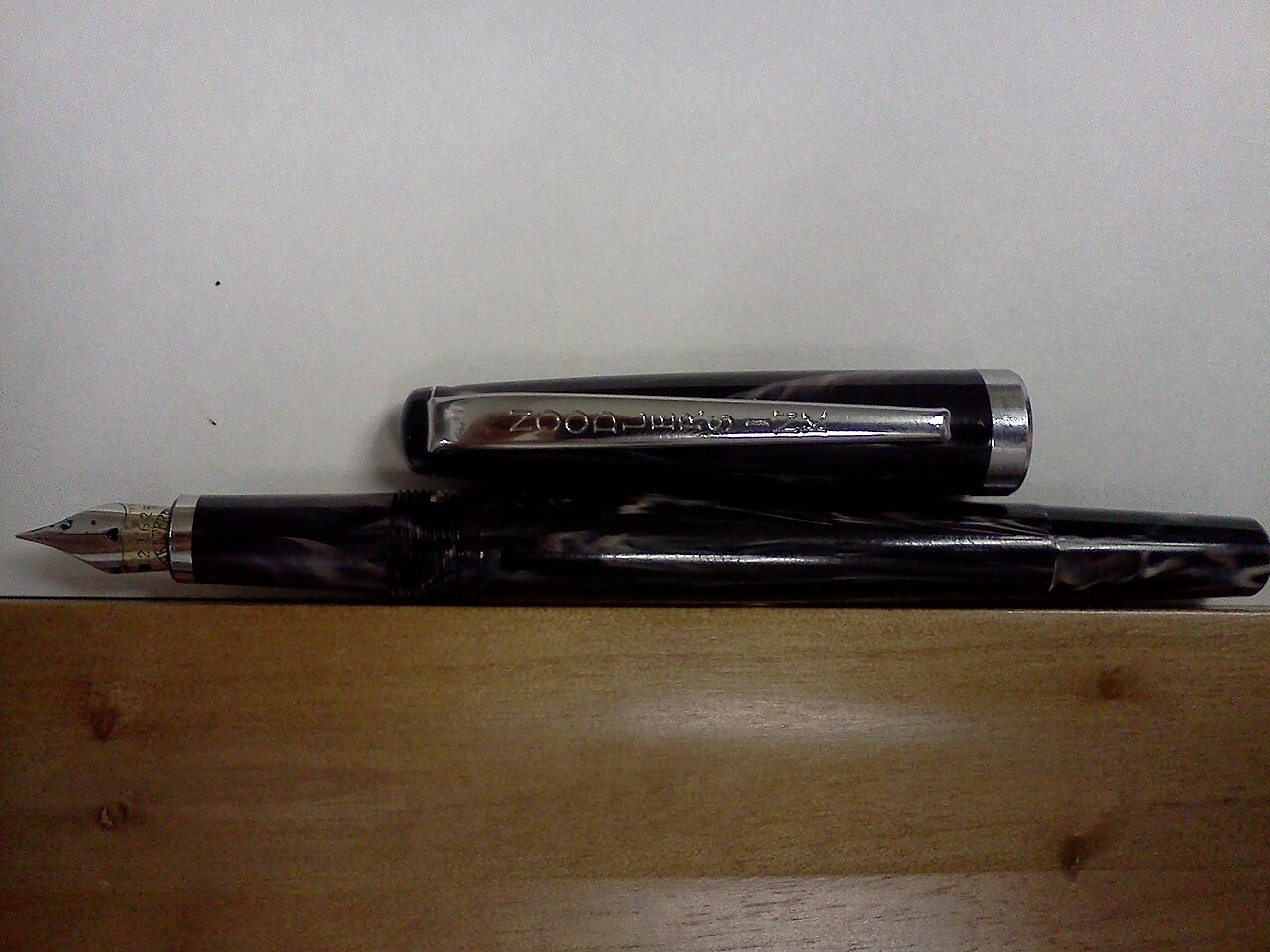

Parts and how it works
Key components include the nib, the feed (a slotted channel under the nib), the ink reservoir, and a cap or barrel. The nib is the visible metal tip that contacts paper; its shape and flexibility influence line width and writing feel. The feed regulates the ink returned to the nib. The reservoir stores ink and may be built into the body or exist as a removable cartridge. See a basic description of a reservoir of ink when comparing different filling systems.
Ink flow and mechanics
Ink movement in a fountain pen is primarily driven by gravity and capillary action. Capillary action draws ink along narrow channels in the feed to the nib slit; surface tension and air exchange between the reservoir and atmosphere maintain steady flow. Nib geometry and tipping material also affect how smoothly and evenly ink is laid down. Typical nib sizes range from extra-fine to extra-broad, and common materials include stainless steel and gold, often tipped with a hard alloy to resist wear.
Filling methods
Fountain pens use several filling systems, each with advantages and trade-offs. Common methods include:
- Removable ink cartridges — convenient and clean for many users.
- Converters — removable units that allow use of bottled ink while fitting in pens designed for cartridges.
- Piston or internal reservoir fillers — built-in mechanisms that draw ink directly into the barrel.
- Eyedropper pens — the entire barrel becomes the reservoir and is filled manually.
Some advanced designs use vacuum or other mechanisms to increase capacity and reduce leakage; for a technical approach to suction-based systems see descriptions of vacuum filling concepts.
History and development
The fountain pen evolved from dip pens and early attempts to enclose ink in a portable container. Reliable feeds and filling systems emerged during the 19th century, enabling pens that did not require frequent dipping. Innovators and manufacturers refined nib and feed designs, introducing safety features, disposable cartridges, and the wide variety of styles available today. The shift from purely functional tools to objects of personal expression and craftsmanship has driven both mass-market and luxury production.
Uses, advantages, and distinctions
Fountain pens are prized for a smooth, low-pressure writing experience, the ability to vary line width, and the broad palette of bottled inks, including colors and shading effects. They are used for everyday writing, professional signatures, calligraphy, sketching, and artistic applications. Compared with ballpoint pens, fountain pens generally require less hand pressure and can produce more expressive marks, but they need suitable paper and occasional maintenance to avoid clogging or drying.
Care, maintenance, and collecting
Regular cleaning—flushing the nib and feed with water or recommended solutions—prevents buildup and maintains reliable flow. Long-term storage should avoid leaving water-soluble inks to dry in the feed. Many enthusiasts collect fountain pens for historical interest, design, or craftsmanship. Refillable fountain pens also appeal to users concerned about waste from disposable pens, as they can be used for decades with proper care.
Notable facts and practical tips
- Select nib size based on handwriting and paper type; broader nibs deliver more ink and show shading more clearly.
- Use inks formulated for fountain pens; pigmented or India inks can clog unless specified as safe for pen use.
- When starting with a fountain pen, try bottled ink and a converter for flexibility, or use cartridges for ease and travel.
For further technical details, compatibility guides, and repair advice, consult dedicated resources and communities that focus on fountain-pen maintenance, models, and inks.
Questions and answers
Q: What is a fountain pen?
A: A fountain pen is a pen that has a nib and a reservoir of ink.
Q: How does a fountain pen draw ink?
A: The pen draws ink from the reservoir through a feed to the nib. The ink travels by a combination of gravity and capillary action.
Q: What is the nib of a fountain pen?
A: The nib is the part of the pen that writes on the paper.
Q: How do different shapes and styles of nibs affect writing?
A: Different shapes and styles of nibs can change the amount of ink distributed and the thickness of your writing line.
Q: Are nibs replaceable in most fountain pens?
A: Yes, most fountain pens have replaceable nibs.
Q: How are reservoirs of ink filled in fountain pens?
A: Filling the reservoir with ink may be done manually, by a Pasteur pipette (eyedropper) or syringe. However, usually it is done by an internal filling mechanism which creates suction. A piston mechanism or a vacuum transfers ink directly through the nib into the reservoir.
Q: What are pre-filled ink cartridges in some fountain pens?
A: Some pens have removable reservoirs in the form of pre-filled ink cartridges.
Related articles
Author
AlegsaOnline.com Fountain pen — design, history, uses, and care Leandro Alegsa
URL: https://en.alegsaonline.com/art/35874
Sources
- richardspens.com : richardspens.com/ref/fillers/fillers.htm
- books.google.com : Developments and Changes in Science Based Technologies
- nibs.com : "Where's the Iridium?"
- vintagepens.com : "Who Invented The Fountain Pen?"
- richardspens.com : richardspens.com/ref/fillers/lever.htm