
Fort Knox: U.S. Army Post and the United States Bullion Depository
Fort Knox is a U.S. Army installation in Kentucky best known for the United States Bullion Depository and its long history as a military post named for Henry Knox.
Fort Knox is a United States Army installation in north-central Kentucky that is closely associated with the United States Bullion Depository. The installation began as a military post and training area and takes its name from Henry Knox, an artillery officer in the Continental Army. Today the name "Fort Knox" commonly signifies both the army base and the nearby high-security repository that stores a large portion of the nation's official gold reserves.
Image gallery
10 Images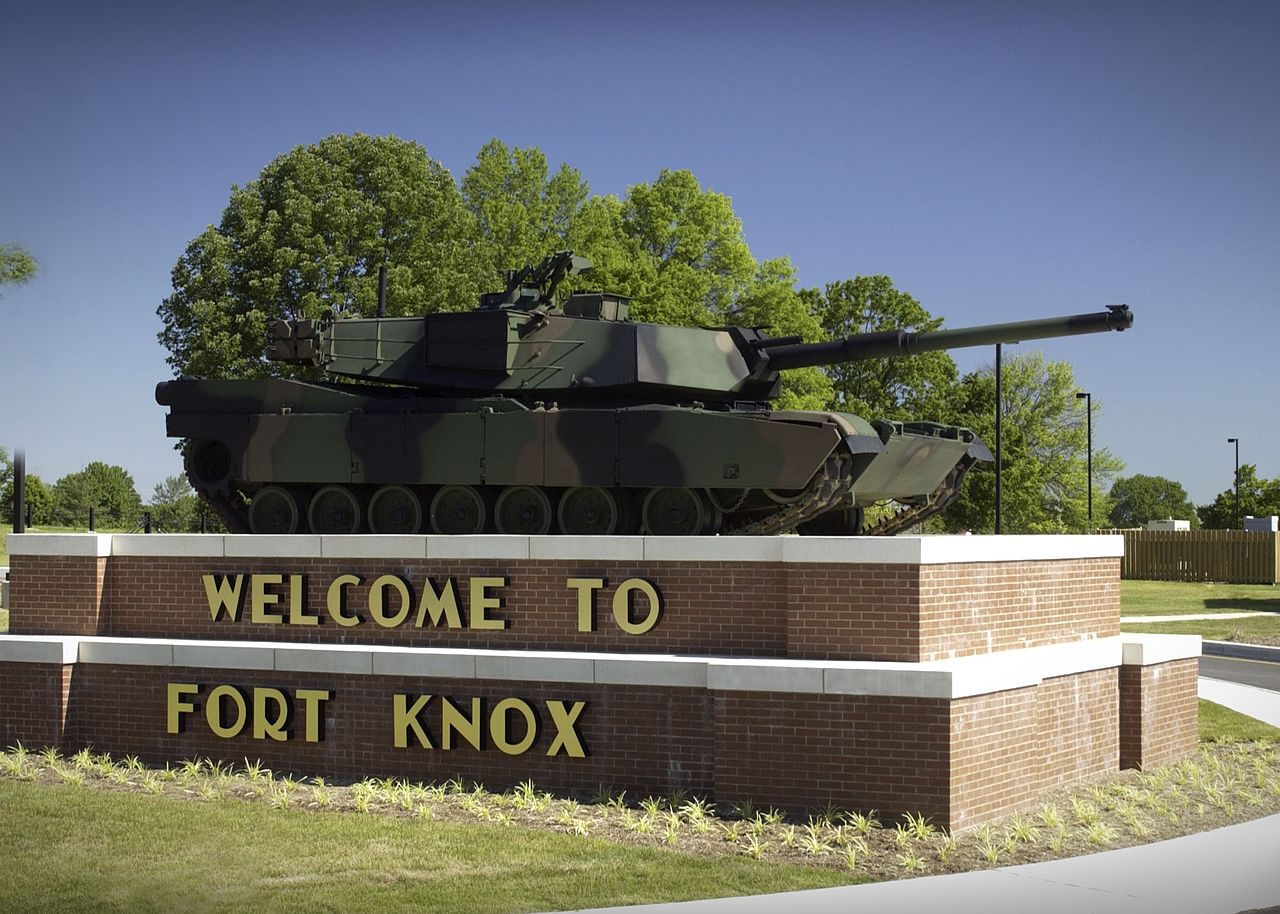




History and development
Fortified earthworks and military camps have existed on and near the present site since the American Civil War when field fortifications were constructed around 1862 during the American Civil War. After that conflict many of the temporary camps were abandoned, and the site saw renewed military use as the United States expanded its training capacity in the years leading into World War I, around 1917. Throughout the 20th century the installation grew into a permanent post with barracks, training ranges and support facilities.
United States Bullion Depository
Adjacent to the fort is the U.S. Bullion Depository, the reinforced vault building often simply called "the depository" or "Fort Knox." Constructed in the 1930s, the depository was intended to consolidate and protect government-held gold and other monetary reserves. The building's heavy security, remote location relative to major population centers, and reinforced construction have made it a symbol of secure storage. Access to the vault itself is highly restricted, and the depository is not generally open for public tours.
Role and facilities
Over its history Fort Knox has performed several military functions: it has been a major training center, housed armor and mechanized units, and supported logistics and personnel functions for the Army. For several decades it was widely known as the home of armor training, though many organizational responsibilities have changed over time. The post contains ranges, administration buildings, family housing, and preserved historic sites that reflect different phases of its development.
Notable facts and cultural significance
- Fort Knox is named for Revolutionary War general Henry Knox, who later served as the first U.S. Secretary of War.
- The Bullion Depository remains one of the most secure government vaults and frequently appears in popular culture as shorthand for extreme security.
- Because of security and operational needs, many parts of the installation are closed to casual visitors; information about public access is controlled by the Army.
Although the base and the depository are often mentioned together, they are distinct: one is an active military post with changing operational roles, and the other is a federal storage facility with a long-standing financial role. For official or historical information about the post and the depository consult authoritative sources and government releases that document changes in mission, access, and holdings. More background can be found through official military and historical resources such as those linked here: U.S. Army post overview, general state information at state tourism and geography pages, and historical summaries and archival materials at the other referenced links above.


History
The fort was built in 1862 during the Civil War and was then called Fort Duffield. After the war, it was neglected. During World War I, the fort was recommissioned and enlarged. In the process, it was named for Henry Knox, a Revolutionary War general and later Secretary of War. At times the fort covered an area of 162 km2. After the war, however, operations were again greatly reduced.
In the 1930s, the fort became a permanent location for armored troops. The United States wanted to catch up with the German Reich, which was heavily mechanized at the beginning of World War II. By 1943, Fort Knox consisted of 3820 buildings on a total area of 432 km2.
Stationed units
 1st Infantry Division
- 3rd Infantry Brigade Combat Team (IBCT) (Infantry Brigade)
- 3rd Logistics Command
- 19th Engineer Battalion
Related articles
Author
AlegsaOnline.com Fort Knox: U.S. Army Post and the United States Bullion Depository Leandro Alegsa
URL: https://en.alegsaonline.com/art/35752