
Formation and evolution of the Solar System
Summary of how the Solar System formed from a rotating cloud of gas and dust about 4.6 billion years ago, how planets and smaller bodies originated, and how the system has changed over time.
Overview
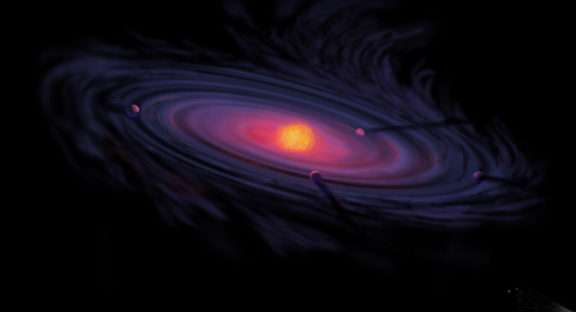
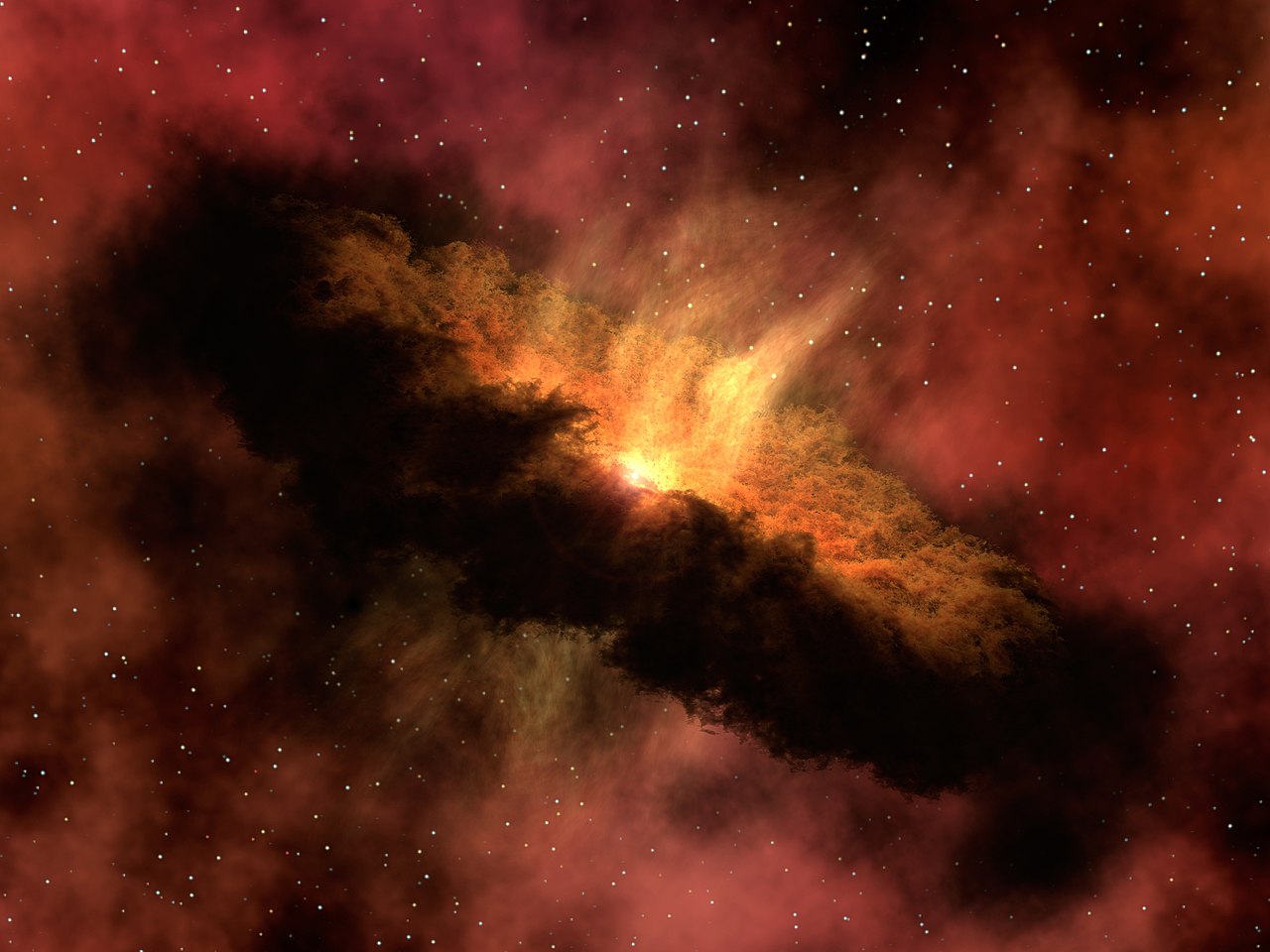
The formation and subsequent evolution of the Solar System explains how the Sun, the planets, their moons, asteroids, comets and other small bodies originated and changed. Modern explanations place the birth of the system at about 4.6 billion years ago, when a portion of a cold, interstellar cloud of gas and dust collapsed under gravity. Over time that collapsing cloud turned into a hot central star surrounded by a rotating disk of material from which planets formed. The broad framework for this picture is called the nebular theory.
Image gallery
10 Images



Formation process and stages
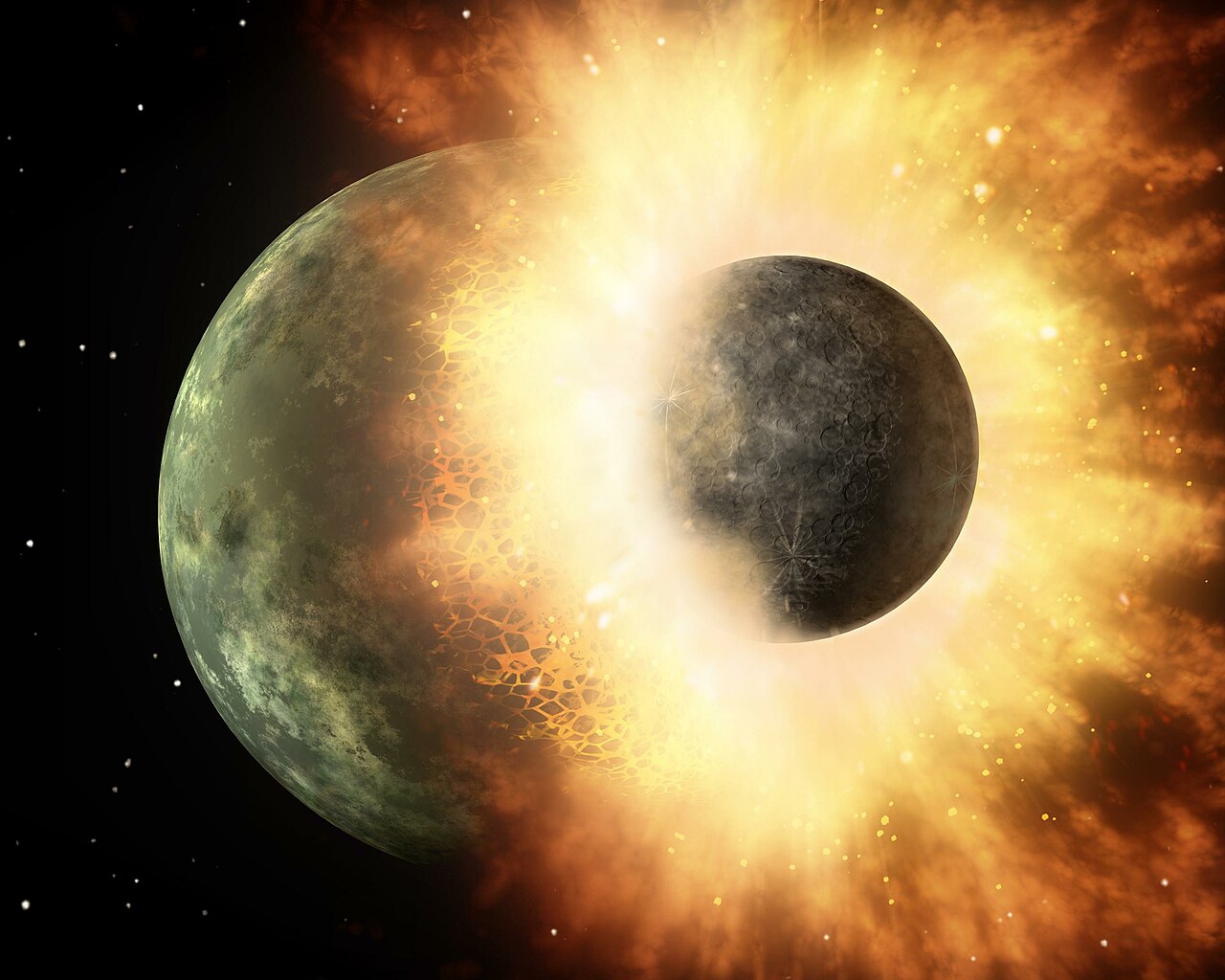
The collapse began when a region of a molecular cloud lost support against gravity and contracted. As the gas fell inward it spun faster and flattened into a protoplanetary or accretion disk. Most of the mass collected in the center to form the protosun, while solids in the disk stuck together, grew into kilometer-scale planetesimals, and then into planetary embryos by continued collisions and accretion. Where conditions allowed, these embryos became the rocky inner planets; farther out, where ices were stable, larger cores could collect and retain massive envelopes of hydrogen and helium, producing the giant planets.
Key physical mechanisms
Several physical effects shaped the outcome. Conservation of angular momentum produced the flattened, rotating disk and determined the distribution of orbital motion. Aerodynamic drag, collisions, and gravitational interactions caused migration and orbital reshaping of forming bodies. Heating from the young Sun, together with the chemistry of the disk (temperature, pressure, and composition), produced a radial gradient in materials: refractory rocks and metals dominated the inner region, volatile ices and gases were more abundant beyond the so-called snow line. Photoevaporation and the solar wind eventually dispersed the gas in the disk, ending the main era of planet formation.
Composition, differentiation and structure
Planets and smaller bodies show strong compositional differences that reflect their origins and subsequent evolution. Terrestrial planets are dense, made largely of silicates and metals, and internally differentiated into cores, mantles and crusts through heat from accretion, radioactive decay, and large impacts. Gas giants contain massive envelopes of hydrogen and helium around denser cores, while ice giants have larger proportions of water, ammonia and methane ices mixed with rock. Small bodies such as asteroids and comets preserve a record of early Solar System materials and processes, with meteorites providing laboratory samples that constrain timescales and chemistry.
Later evolution: dynamics, migration and bombardment
The Solar System continued to evolve after the main formation phase. Planetary migration — the change of planets' orbits caused by interactions with the remaining disk or with planetesimals — can explain resonant orbital patterns and the current architecture of giant planets. Episodes of heavy bombardment reshaped surfaces and influenced planetary atmospheres. The Kuiper belt and the hypothesized Oort cloud serve as reservoirs for comets and tell of scattering processes that operated early on. Long-term evolution also involves tidal interactions, secular resonances and occasional collisions that still modify orbits and surfaces today.
Origin of elements and stellar context
The elements heavier than hydrogen and helium that make up planets and life were produced in earlier generations of stars. Nucleosynthesis in massive stars and their explosive deaths distributed metals into the interstellar medium; these elements were incorporated into the cloud that formed the Solar System. Isotopic compositions measured in meteorites provide evidence of that stellar heritage and set chronological markers for early events.
Evidence and scientific importance
Evidence for this narrative comes from astronomical observations of young stars and disks, laboratory study of meteorites and comet samples, spacecraft measurements of planets and small bodies, and numerical models of disk dynamics and planet growth. Understanding Solar System formation places our system in the broader context of planetary systems around other stars and informs questions about the conditions for life, the frequency of Earth-like planets, and the long-term fate of planetary environments.
Further reading and links
- Introduction and overview
- The Solar System
- Age estimates and chronology
- Molecular clouds and star-forming regions
- Interstellar gas and dust
- Mass distribution and gravity
- Stellar nucleosynthesis basics
- Nuclear fusion in stars
- Formation of helium and heavier elements
- The Sun: structure and evolution
- Angular momentum and disk formation
- Density and temperature gradients
- Protoplanetary disks
- Solar gravity and orbital balance
- Radiative energy from stars
- Electromagnetic radiation in astrophysics
- Disk chemistry and radiation
- Terrestrial planet formation
- Asteroids and small bodies
- Gas and ice giant formation
- Role of supernovae in enrichment
- Main-sequence stars and life cycles
Questions and answers
Q: What is the nebular theory?
A: The nebular theory is a process by which solar systems are created. It explains how a large cloud of gas in an area of space can be pulled together by gravity, eventually forming a star like the Sun and planets.
Q: How does the Sun get its energy?
A: The Sun gets its energy from changing hydrogen into helium through a fusion reaction at its core, releasing heat, light and other forms of electromagnetic radiation.
Q: What causes the planets to spin around their own axis?
A: The original gas cloud had different densities in different places, causing it to spin around the Sun and each planet's own axis. This spinning was increased due to contraction under gravity (conservation of energy) and conservation of angular momentum.
Q: Where do all the elements come from that make up terrestrial planets, moons, asteroids etc.?
A: All elements apart from hydrogen and helium come from earlier generations of stars that exploded billions of years ago near our young Solar System - these huge supernovas produced higher elements.
Q: Why do huge stars run through their life cycle much faster than smaller stars?
A: Huge stars have even higher pressures and temperatures inside them as compared with an average main sequence star like the Sun - this causes them to run through their life cycle much faster than smaller stars.
Q: What caused the formation of our Solar System about 4.6 billion years ago?
A: About 4.6 billion years ago there was a large cloud of gas nearby our area of space - all things with mass gravitate towards one another so this pulled all the gas towards the center until it reached high enough pressure for hydrogen atoms to fuse together into helium, beginning our star we know as the Sun.
Related articles
Author
AlegsaOnline.com Formation and evolution of the Solar System Leandro Alegsa
URL: https://en.alegsaonline.com/art/35680
Sources
- ui.adsabs.harvard.edu : 1994ApJ...421..640N
- doi.org : 10.1086/173678
- ui.adsabs.harvard.edu : 1999ApJ...525..330Y
- doi.org : 10.1086/307867
- arxiv.org : arxiv.org/abs/astro-ph/0012399
- adsabs.harvard.edu : adsabs.harvard.edu/abs/2010ConPh..51..381W
- newchurchhistory.org : newchurchhistory.org/articles/glb2007/baker.pdf
- ui.adsabs.harvard.edu : 1993QJRAS..34....1W
- newscientist.com : "Birth of the planets: the Earth and its fellow planets may be survivors from a time when planets ricocheted around the Sun like ball bearings on a pinball table"
- ui.adsabs.harvard.edu : 1989Metic..24..347W
- doi.org : 10.1111/j.1945-5100.1989.tb00700.x
- exoplanet.eu : "The Extrasolar Planet Encyclopaedia — Catalog Listing"