
Fobos-Grunt: Russian Phobos sample-return mission (2011)
Fobos-Grunt was an uncrewed Russian mission launched in 2011 to return a soil sample from Phobos. The mission failed to leave Earth orbit and reentered in 2012, but influenced later planetary exploration plans.
Overview
Fobos-Grunt (also spelled Phobos-Grunt) was an uncrewed Russian spacecraft intended as a robotic sample-return mission to Phobos, one of Mars' moons. The programme combined Martian orbital science with a lander tasked to collect and return a small soil sample to Earth. It was the first major Russian interplanetary attempt after earlier 1990s efforts and attracted international attention for its ambitious goals and its co-passengers, including an experimental Chinese orbiter.
The project aimed to study Mars and its near-space environment while returning material from Phobos for laboratory analysis. Scientific objectives included characterising the moon's surface composition, investigating Mars' atmosphere and dust, and measuring plasma and radiation conditions in the Martian system. The mission also carried experimental payloads to test biological and technical systems for long-duration travel.
Image gallery
10 Images
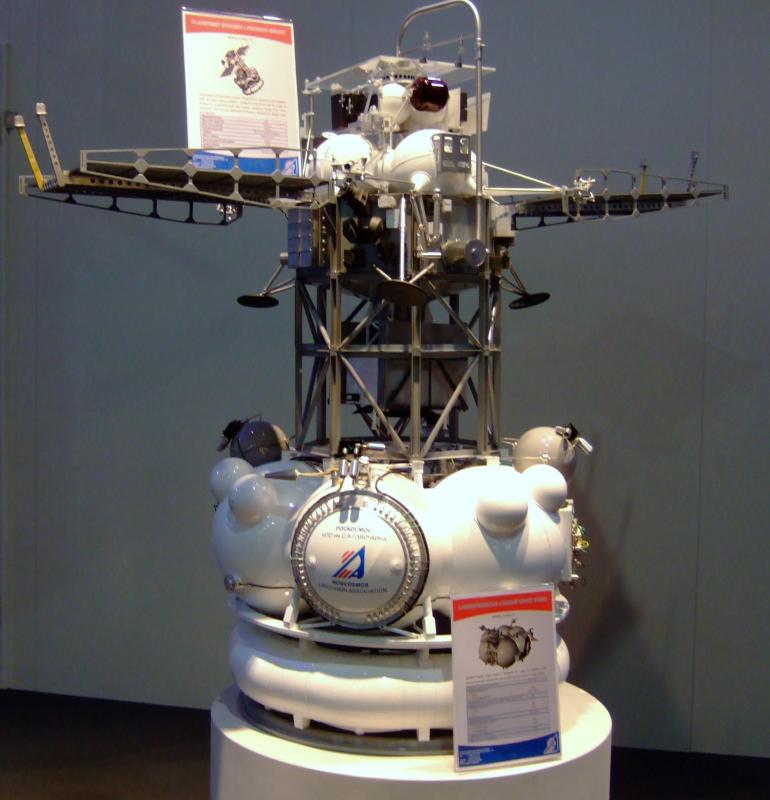


Spacecraft and payload
The Fobos-Grunt vehicle combined an Earth departure stage, an interplanetary bus, and a descent/ascend lander designed to drill or scoop regolith from Phobos and place a sealed sample container into an ascent module. Instruments were selected to examine surface mineralogy, particle environments, and atmospheric phenomena around Mars. International elements included the Chinese satellite Yinghuo-1 and the Living Interplanetary Flight Experiment, which tested the survivability of microorganisms in deep space.
Launch and mission timeline
- Launch: The mission lifted off on 8 November 2011 from Baikonur Cosmodrome aboard a Zenit launcher (Baikonur, launch vehicle).
- Initial orbit and anomaly: Shortly after deployment, the spacecraft remained trapped in low Earth orbit when its propulsion system failed to perform the planned trans-Mars injection burn. Ground teams sought to diagnose and recover the probe.
- Outcome: Despite tracking and recovery attempts, Fobos-Grunt reentered Earth's atmosphere in January 2012 and was destroyed during reentry.
Scientific aims and planned operations
Had it succeeded, Fobos-Grunt would have placed instruments in Martian orbit to monitor atmospheric dynamics and dust storms, study charged-particle environments, and characterise radiation near Mars. The primary feature was the Phobos lander, intended to collect approximately 200 g of soil, encase it in a sealed return capsule, and deliver it back to Earth for detailed laboratory study—an outcome that would have provided direct samples from a primitive body in the inner Solar System.
Failure, reaction and legacy
The mission's failure prompted reviews of project management, hardware redundancy, and software testing within the Russian space community. Its loss also ended the planned ride for the Chinese orbiter, which would have conducted its own Martian observations. Concerns briefly arose about hazardous propellants surviving reentry, leading to international monitoring of the decaying orbit. Lessons learned influenced future sample-return planning and cooperative international efforts in planetary exploration.
Notable facts and context
- Fobos-Grunt's name literally means "Phobos-Soil" (Фобос-Грунт).
- The mission was widely cited as Russia's most ambitious interplanetary undertaking since Mars 96 and carried multiple scientific and technological experiments (mission, destination).
- Key study areas included Mars' atmosphere and dust dynamics (dust), charged-particle and plasma environments (plasma), and radiation conditions (radiation).
- Data about the launch and loss, international partners, and subsequent analyses are available through mission archives and technical reports (Mars context, planetary studies, sample return goals).
Further background, technical documentation, and follow-up studies may be consulted via institutional repositories and mission summaries maintained by space agencies and research organisations (return to Earth, launch details, spacecraft designation, international payloads).
Questions and answers
Q: What was Fobos-Grunt?
A: Fobos-Grunt was an unmanned Russian spacecraft.
Q: What was the purpose of Fobos-Grunt?
A: The purpose of Fobos-Grunt was to study Mars' atmosphere and dust storms, plasma, and radiation. It was also meant to land on Phobos, a moon of Mars, and return a 200 g soil sample to Earth.
Q: When was Fobos-Grunt launched?
A: Fobos-Grunt was launched on 8 November 2011 (UTC), aboard a Zenit rocket, at Baikonur Cosmodrome.
Q: What is the meaning of the name Phobos-Grunt?
A: The name Phobos-Grunt is Russian for Phobos-Soil.
Q: Was Phobos-Grunt a successful mission?
A: No, Fobos-Grunt was not a successful mission. It failed to leave Earth's orbit and did not reach Mars.
Q: When was the last interplanetary mission launched by Russia before Fobos-Grunt?
A: The last interplanetary mission launched by Russia before Fobos-Grunt was Mars 96.
Q: What Chinese spacecraft was sent together with Fobos-Grunt?
A: The Chinese spacecraft sent together with Fobos-Grunt was Yinghuo-1.
Related articles
Author
AlegsaOnline.com Fobos-Grunt: Russian Phobos sample-return mission (2011) Leandro Alegsa
URL: https://en.alegsaonline.com/art/35325
Sources
- galspace.spb.ru : galspace.spb.ru/index244.html
- kyivpost.com : "Russian spacecraft for Fobos-Grunt program to be controlled from Yevpatoria"
- planetary.org : "Timeline for the Phobos Sample Return Mission (Phobos Grunt)"
- cnes.fr : "Phobos-Grunt: destination Mars in 2011"
- solarsystem.nasa.gov : "Phobos-Grunt"
- esa.int : "Phobos-Grunt"