
Flying frog (gliding treefrog)
Arboreal frogs that glide between trees using extensive webbing and skin flaps. Mostly tropical, best known in the Old World genus Rhacophorus; glide to escape predators and move in the canopy.
A flying frog is a common name for several tree-dwelling frog species that can glide through the air. The term is a misnomer: these amphibians do not achieve powered flight but use enlarged feet, skin membranes and body posture to slow descent and steer while moving between branches. Their lifestyle and anatomy are adapted to life high in the forest canopy.
Image gallery
3 Images

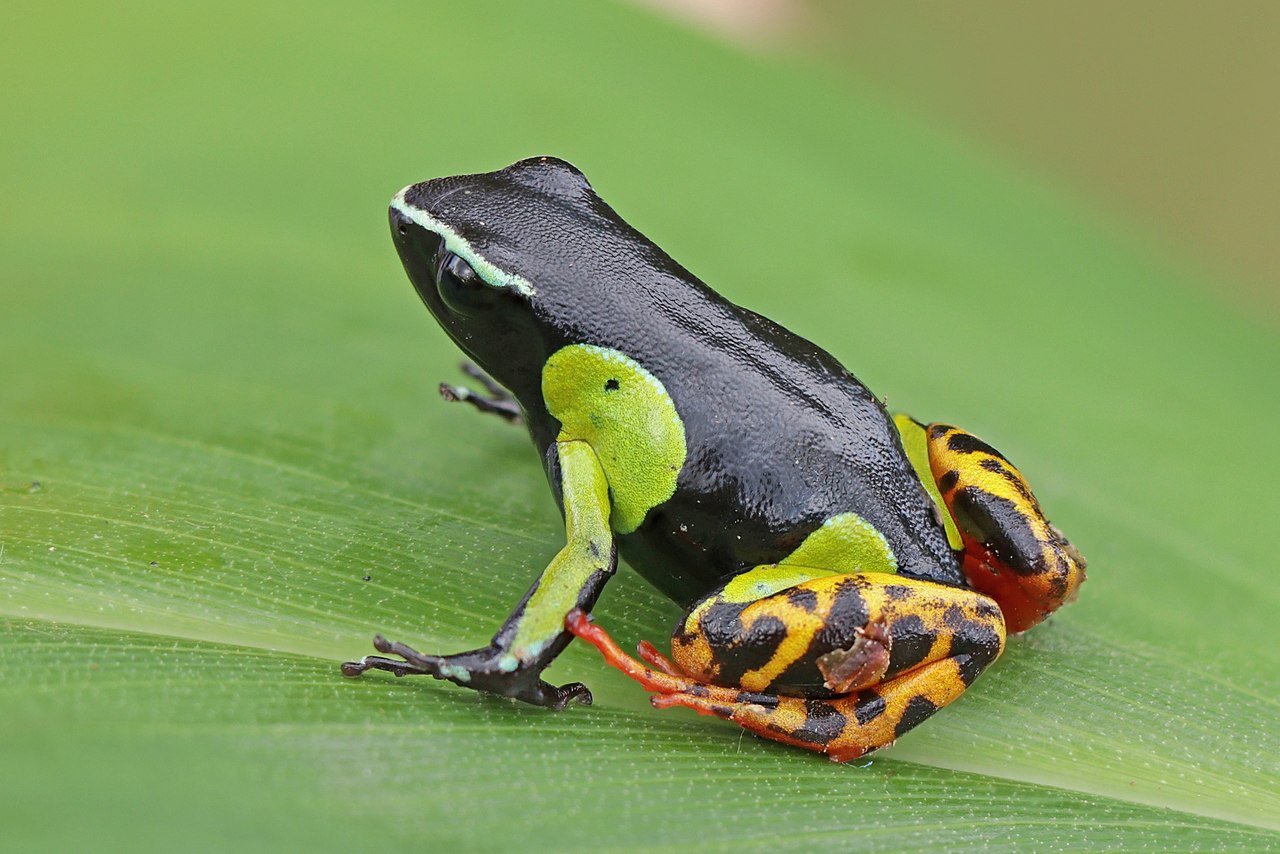
Characteristics and adaptations
Gliding frogs share a set of morphological traits that aid in controlled aerial movement. Typical features include widely webbed toes, long limbs, flattened body shapes, and sometimes loose skin along the flanks or limbs that increases surface area. By spreading their limbs and webbing they create lift and drag, allowing precise, often long-range glides that reduce a fall's impact and permit efficient movement without returning to the ground.
Behavior, reproduction and ecology
These frogs are primarily nocturnal and arboreal. Gliding helps in predator avoidance, territory shifting, and accessing scattered food resources. Many species reproduce in trees by depositing eggs on leaves above water; upon hatching tadpoles drop into pools below. Some Old World species build foam nests for eggs, a behavior that keeps embryos moist until hatching.
History, taxonomy and distribution
Early naturalists noted these animals' dramatic leaps. Alfred Russel Wallace made one of the first field reports of a gliding treefrog, a specimen later described by George Albert Boulenger as Rhacophorus nigropalmatus. The best-known group is the Old World genus Rhacophorus, but similar gliding forms occur in multiple treefrog lineages worldwide. For a concise definition see frog references and historical accounts such as those by Alfred Russel Wallace.
Notable facts and distinctions
- Gliding is passive—these frogs cannot sustain powered flight like birds or bats.
- Not all treefrogs with webbing are effective gliders; performance varies by species and habitat.
- Convergent evolution: unrelated frog lineages have evolved similar gliding adaptations in different tropical regions.
Interest in flying frogs spans natural history, ecological study and conservation. Because many are restricted to forest canopies, they can be sensitive to deforestation and habitat fragmentation. Observations of their gliding behavior continue to inform understanding of locomotion, predator–prey dynamics, and the evolution of arboreal life in amphibians.
Questions and answers
Q: What is a flying frog?
A: A flying frog is a frog that can glide, but it cannot fly.
Q: Where do flying frogs live?
A: Flying frogs live their life in trees, high above the ground.
Q: Who reported one of the earliest observations of a flying frog?
A: Alfred Russel Wallace reported one of the earliest observations of a flying frog.
Q: Which species of flying frog did George Albert Boulenger describe?
A: George Albert Boulenger described Rhacophorus nigropalmatus.
Q: What are some genera of flying frogs?
A: Some genera of flying frogs include Rhacophorus, Polypedates, and Ptychohyla.
Q: Can flying frogs fly as they name suggests?
A: No, flying frogs cannot fly as their name suggests, but they can glide.
Q: What is the special ability of a flying frog?
A: The special ability of a flying frog is the ability to glide.
Related articles
Author
AlegsaOnline.com Flying frog (gliding treefrog) Leandro Alegsa
URL: https://en.alegsaonline.com/art/35307