
Flags of the U.S. states and territories
Overview of the design, history, and significance of the flags used by the fifty U.S. states, the District of Columbia, and U.S. territories, with notes on distinctive designs and modern reforms.
The flags of the United States’ states, the District of Columbia, and its territories are symbols used for identification, ceremony, and civic pride. While the national flag represents the union as a whole, subnational flags express local history, government, and culture. Each state and territory typically has an official banner adopted by its government, and these flags appear at capitols, schools, civic events, and on public buildings.

Design characteristics and common motifs
A large number of U.S. state flags share similar visual themes: a state seal or coat of arms set against a plain field, frequently blue. This approach emphasizes official emblems but often results in low recognizability at a distance. Several flags depart from the seal-on-blue pattern and are widely regarded as more distinctive. Common alternative motifs include unique color schemes, historical heraldry, indigenous symbols, simplified emblems, or geometric devices that read well at small scale.
- Distinctive heraldry: A few states display intricate historical or heraldic patterns derived from colonial families or regional coats of arms.
- Native and regional symbols: Several flags incorporate local flora, fauna, or indigenous motifs to reflect geography and heritage.
- Simplified, bold devices: Stars, bars, crosses, or single bold symbols can increase legibility and recognition.
History and origins
State and territorial flags developed at different times and for different purposes: some grew from militia banners, territorial seals, or early government standards, while others were created during periods of state identity-building. Adoption is usually a legislative act or executive order. Designs have frequently been revised to update symbolism, clarify imagery, or replace complicated seals with simpler, more reproducible graphics. Influences include colonial emblems, national military colors, and local artistic traditions.
Flags of territories and the District of Columbia
In addition to the fifty states, several U.S. possessions and the federal district maintain official flags. The District of Columbia’s flag, widely used in municipal contexts, is a simple, bold device derived from a historic family coat of arms and commonly seen on city signage and apparel. Territories such as Puerto Rico, Guam, the U.S. Virgin Islands, American Samoa, and the Northern Mariana Islands each have flags that draw on indigenous, cultural, and geographic imagery and are used alongside the U.S. national flag in local and federal contexts.
Controversies, reform movements, and design principles
Some state flags have attracted criticism for poor design, low distinctiveness, or elements now regarded as offensive—particularly imagery associated with the Confederacy. In response, civic organizations, designers, and legislatures have encouraged redesigns that follow basic vexillological principles: simplicity, meaningful symbolism, limited colors, no lettering or seals, and distinctiveness. These campaigns often involve public competitions, legislative debate, and referendums, reflecting shifting public attitudes toward history and representation.
Beyond official changes, flags function as living cultural objects. They can foster local pride, spark debate about history, and serve as tools for education. As long as communities continue to engage with their symbols, state and territorial flags will evolve in form and meaning while remaining visible markers of American regional identity.
National flag and seal
| Date | Function | Description | |
|
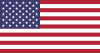
| since July 4, 1960 | 7 red and 6 white horizontal stripes, in the gösch a blue field with 50 white stars | |
|
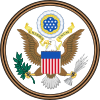
| since 1782 | Seal of the USA | The seal shows a bald eagle holding an olive branch and a bundle of arrows in its fangs, which is supposed to express the readiness for peace, but also for battle. In its beak it carries a ribbon with the motto of the USA: E pluribus unum (Latin: "Out of many one"). |
|
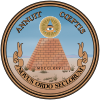
| since 1782 | Reverse side of the seal of the USA | The 13-tiered pyramid on the back has the Roman numeral MDCCLXXVI (1776) at the base, the founding year of the United States. In addition, the pyramid appears to be unfinished with the raised capstone. The Latin saying Annuit cœptis means something like "He (God) has blessed what has been begun". |
Service Flags
Military flags, seals and emblems
| Date | Function | Description/comment | |
|
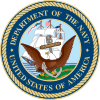
| Seal of the Department of the Navy | The seal shows a three-masted sailing ship under sail, in front of it an anchor and the US heraldic eagle. The inscription reads Department of the Navy above and United States of America below. | |
|
| 1960-2002; since 2019 | U.S. Navy galley | 50 white stars on blue cloth. |
|
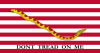
| 2002–2019 | First Navy Jack of the US Navy in the War on Terror | Seven red and six white horizontal stripes, diagonally a rattlesnake, in the lowest white stripe the black text: Dont tread on me ("Do not tread on me"). A flag with a similar motif (rattlesnake on a yellow background with identical slogan) was the Gadsden Flag, which was flown in the American independence movement around 1775. |
|
| Seal of the Department of the Army | ||
|
| Logo of the US Army | ||
|
| since 1947 | Seal of the Department of the Air Force | |
|
| Insignia on military aircraft and helicopters of the US Air Force, US Army, US Coast Guard, US Marine Corps and the US Navy | ||
|
| Logo of the US Air Force | ||
|
| Seal of the US Marine Corps | ||
|
| Flag of the US MarineCorps | ||
|
| Flag of the US Coast Guard | ||
|
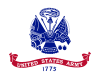
| Flag of the US Army | ||
|
| since 15 May 2020 | Flag of the US Space Force | |
|
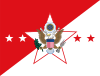
| Flag of the Chief of Staff of the Army |
|







Questions and answers
Q: What do the flags of the U.S. states and territories exhibit?
A: The flags of the U.S. states, territories and federal district exhibit a variety of regional influences and local histories, as well as different styles and design principles.
Q: What design pattern do the majority of the states' flags share?
A: The majority of the states' flags share the same design pattern consisting of the state seal superimposed on a monochrome background, commonly blue.
Q: Which is the most recent current state flag?
A: The most recent current state flag is that of Mississippi, as of January 11, 2021.
Q: Which is the most recent current territorial flag?
A: The most recent current territorial flag is that of the Northern Mariana Islands, as of July 1, 1985.
Q: What is the purpose of the state seal on the flags?
A: The state seal is superimposed on the flags to symbolize the state's sovereignty and to represent its history and values.
Q: How do the flags of the U.S. states and territories differ from each other?
A: The flags of the U.S. states and territories differ from each other in terms of their design patterns, colors, and symbols, which reflect local history, culture, and geography.
Q: What is the significance of the blue monochrome background on many state flags?
A: The blue monochrome background on many state flags is commonly associated with the United States and represents loyalty, justice, and perseverance.
Related articles
Author
AlegsaOnline.com Flags of the U.S. states and territories Leandro Alegsa
URL: https://en.alegsaonline.com/art/34980