
Flag of Turkmenistan
National flag of Turkmenistan: design, symbolism and history, including the carpet guls, crescent and stars, adoption dates, and the emblematic wreath reflecting declared neutrality.
Overview
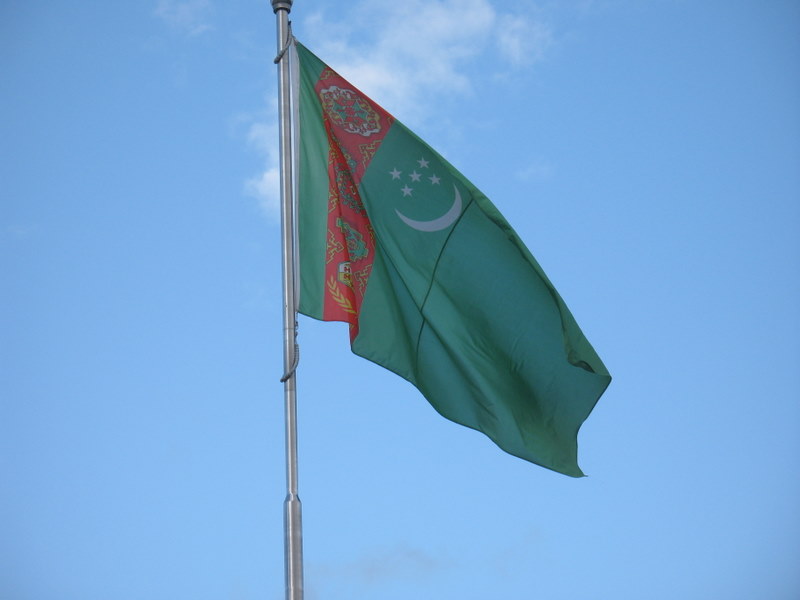
The national flag of Turkmenistan is distinctive for its dense ornamentation and symbolic elements. It features a green field with a vertical red stripe near the hoist bearing traditional carpet motifs, accompanied by a white waxing crescent and five white stars at the fly. The flag has been used in its present proportions since the early 1990s and was subject to a formal standardization of dimensions in the years that followed.
Image gallery
3 Images

Design and symbolism
The basic composition combines a plain green field with a narrow, vertically oriented red stripe placed immediately adjacent to the hoist. On the green field, in the upper hoist-side canton, a white waxing crescent is shown with its horns pointing away from the stripe. To the right of the crescent are five white five-pointed stars arranged in a pattern. The green and red colors have cultural and historical resonance for the Turkmen people and for many Turkic societies, while the crescent is a common Turkic and Islamic symbol interpreted on the flag as hope and renewal. The five stars are conventionally taken to represent the country’s five provinces (welayatlar).
Carpet guls and tribal representation
The red stripe contains five traditional carpet "guls"—geometric medallion designs used in Turkmen rugs. Each gul is associated with one of the major historical Turkmen tribes. In standard descriptions the five guls are listed in order from top to bottom and correspond to the Teke, Yomut, Arsary, Chowdur and Saryk tribes. These motifs emphasize the importance of carpet-weaving as both an art form and a marker of clan identity; the same or similar motifs also appear in Turkmen national heraldry and state decorations.
History and adoption
Following the country's independence from the Soviet Union, Turkmenistan adopted a national flag drawing on pre-existing cultural symbols. The first post‑Soviet version was introduced in the early 1990s; its proportions and official specifications were refined in subsequent years. The flag’s detailed ornamentation has earned it informal descriptions as one of the most elaborately decorated national flags in regular use.
Wreath, neutrality and notable features
A stylized olive-wreath-like emblem appears beneath the carpet guls on the red stripe. This wreath was added to reference the country’s international status of permanent neutrality, a status that was recognized by a decision of the United Nations General Assembly in the 1990s. The inclusion of the wreath and the complex textile motifs means the flag departs from simplified heraldic norms, favoring cultural specificity and internal symbolism over minimalism.
Usage and protocol
The flag is used in government buildings, public ceremonies, and diplomatic contexts. As with most national flags, there are conventions governing its display, such as order of precedence with other flags and respectful handling. The use of traditional patterns makes accurate reproduction important for official purposes; simplified or distorted versions are usually avoided in formal settings so that tribal guls and the crescent-and-star arrangement remain recognizable.
Further reading
- Official adoption and legal text
- Standardization of proportions and variations
- General information about Turkmenistan
- Early post‑Soviet flag introduction
- Government publications on national symbols
- Carpet guls and weaving traditions
- Symbolism of the olive branches
- Comparative flags and international symbols
- Turkic symbols and the crescent motif
- Administrative divisions represented by the stars
- Heraldic commentary on complex flag elements
- United Nations recognition of neutrality
- Timeline of international acknowledgements
- Documents related to permanent neutrality
Questions and answers
Q: What is the ratio of the flag of Turkmenistan?
A: The flag of Turkmenistan was adopted on January 24, 2001 in a 2:3 ratio as its national flag, though it was adopted in a 1:2 ratio on February 19, 1992.
Q: What colors appear on the flag of Turkmenistan?
A: The flag of Turkmenistan features a green field with a vertical red stripe near the hoist side.
Q: What symbols are featured on the flag?
A: On the flag of Turkmenistan there are five carpet guls (designs used in producing rugs) stacked above two crossed olive branches similar to those on the UN's flag; a white waxing crescent moon, typical of Turkic symbology; and five white five-pointed stars appear in the upper corner of the field just to the fly side of the red stripe.
Q: Why were these colors and symbols chosen for this particular flag?
A: The green and red colors have been venerated historically by the Turkmen people, whilethe waxing crescent moon symbolizes their hope for a shining future andthe stars represent their five provinces (Welayatlar). The carpet designs alongthe hoist represent their five major tribes or houses.
Q: What does the wreath symbolize?
A: The wreath represents "permanent neutrality," which was accepted bythe United Nations General Assembly on December 12, 1995.
Q: Who is not represented by this particularflag?
A:The Salyr (Salor), a tribe that declined asa resultof military defeat before modern times, is not represented nor are several smaller tribes or subtribes.
Related articles
Author
AlegsaOnline.com Flag of Turkmenistan Leandro Alegsa
URL: https://en.alegsaonline.com/art/34949