
Flag of Turkey
The national flag of Turkey features a white crescent and star on a red field. Its symbols trace back through Ottoman and earlier Anatolian traditions; proportions and colors were standardized by law in 1936.
The flag of Turkey displays a white crescent moon and a five-pointed star set against a vivid red background. In Turkish the banner is commonly called Türk bayrağı and is also known by the traditional names Ay Yıldız ("moon-star") and Alsancak ("red banner"). The red field and the white emblem are the most immediately recognizable elements and appear across civic, military, and ceremonial contexts nationwide. Flag of Turkey is an internationally recognized national symbol and a focal point of civic identity.
Image gallery
9 Images





Design and symbolism
The primary visual elements are the red field and a white crescent embracing a five-pointed star. The crescent and star motifs have long historical associations in the region and, over time, became closely associated with the Ottoman state and later the Republic. The colors and shapes carry multiple layers of meaning: red is traditionally associated with bravery, sacrifice, and the historic banners of Anatolia, while the crescent and star are widely viewed as emblems of sovereignty and continuity. For some observers the symbols also have cultural and religious connotations, but they function principally as national emblems rather than doctrinal insignia. For further reference on terminology in Turkish, see Türk bayrağı.
History and development
The present composition draws its immediate visual lineage from late Ottoman flags. A version with a similar crescent-and-star arrangement became prominent in the Ottoman period and was officially adopted during the reforms of the 19th century. With the foundation of the Republic of Turkey in 1923 the emblem continued in use and underwent formal legal definition in the 20th century. The modern flag formalizes a long visual tradition that incorporates elements that predate the Ottomans and were used in various forms across Anatolia and the eastern Mediterranean. Historical comparisons and evolutions are discussed in sources about the Ottoman and republican transition; see an overview at Ottoman and Turkish flags.
Legal standardization and specifications
The precise geometry and color shade of the flag were fixed by national legislation during the 1930s to ensure uniform reproduction. The law defines the relative placement and proportions of the crescent and star so that their positions appear consistent on flags of different sizes. The red tone commonly cited for reproduction is approximated by Pantone 186; one commonly used RGB approximation is (227, 10, 23). Technical diagrams and official specifications are available in government publications and vexillological references. For notes on the red field and color, see color and design.
Uses, etiquette, and cultural importance
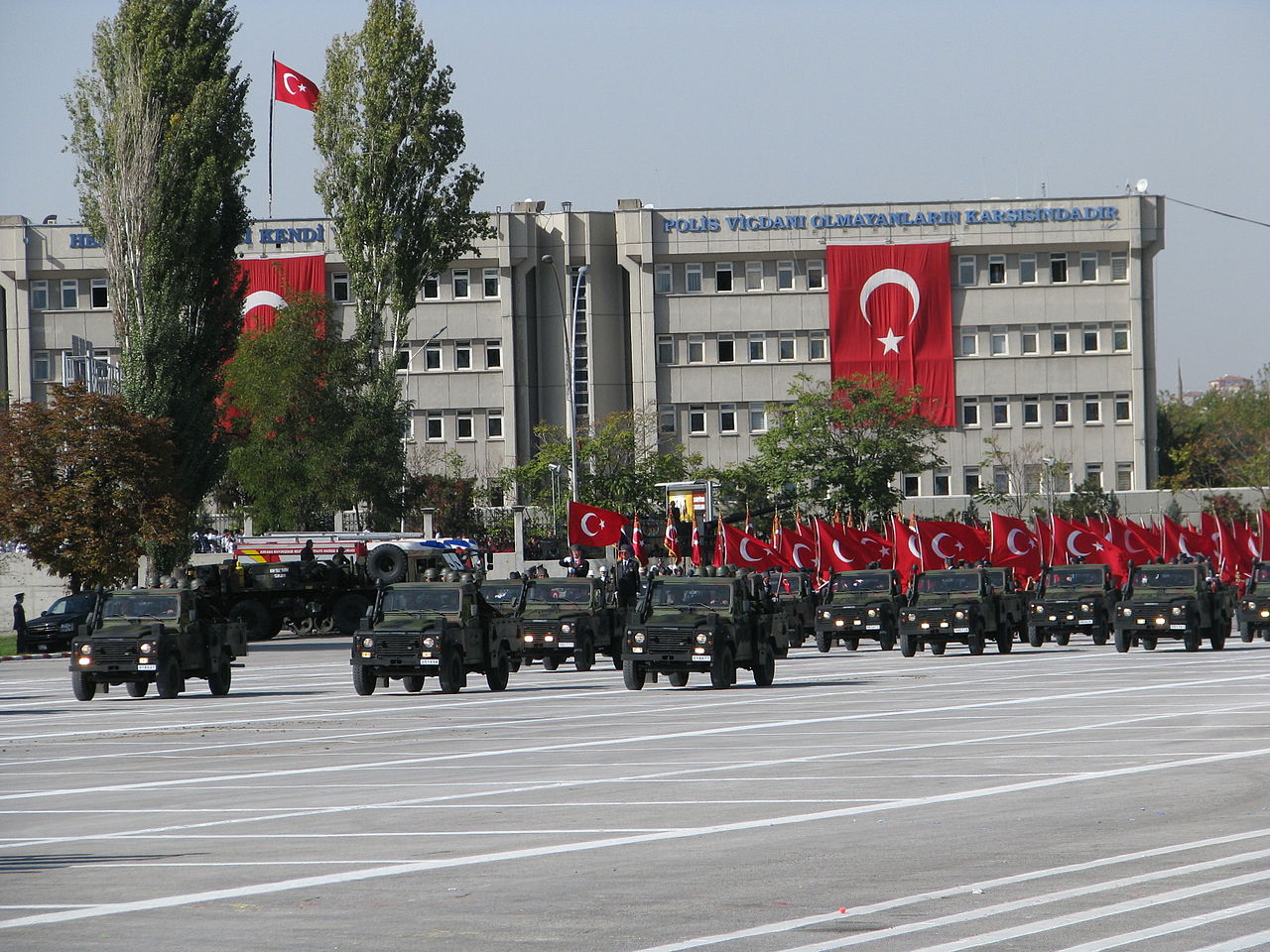
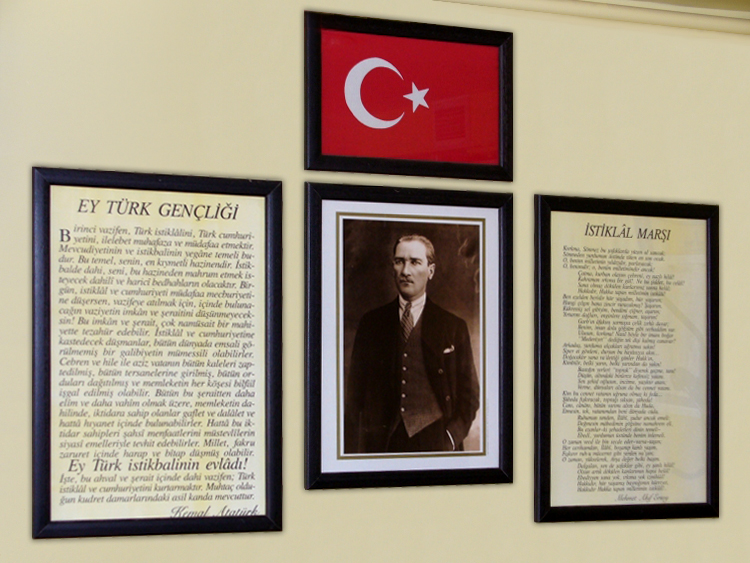
The Turkish flag is displayed in a wide range of public and private contexts: government buildings, schools, military ceremonies, sporting events, and national holidays such as Republic Day. Turkish law and custom prescribe respectful treatment of the flag: improper use or desecration may be subject to legal penalty. The banner also appears on tombs of prominent figures, in funeral rites for military personnel, and in numerous commemorative practices. Examples of its civic role and protocols can be found in general guides to national symbols at flag etiquette.
Notable distinctions
- The current flag retains visual continuity with late Ottoman designs while being legally codified for the modern republic.
- Its emblematic crescent and star have a deep and multi-layered history across the eastern Mediterranean and Central Asia, where similar motifs have appeared in earlier heraldry and coinage.
- Standardization in the 20th century focused on reproducibility, ensuring that the emblem appears consistent at all scales.
Together, these aspects make the flag of Turkey a compact expression of historical continuity, legal identity, and civic symbolism. Additional context and detailed historical study are available through specialized vexillology publications and national archives. Learn more or consult official sources for precise diagrams and legal texts.
Questions and answers
Q: What is the flag of Turkey?
A: The flag of Turkey is a red background with a white crescent moon and a star.
Q: What is the Turkish name for their flag?
A: The Turkish name for their flag is Ay Yıldız or Alsancak.
Q: What are the origins of the Turkish flag design?
A: The Turkish flag design has a complex origin since it is an ancient design, and uses the same symbols of the late flag of the Ottoman Empire which was adopted in 1844 with the Tanzimat reforms.
Q: What is the geometric proportion of the Turkish flag?
A: The geometric proportion of the Turkish flag was legally standardized with the Turkish Flag Law in 1936.
Q: What is the shade of red used in the Turkish flag?
A: The shade of red used in the Turkish flag is approximated by Pantone 186, or RGB (227, 10, 23).
Q: What is the meaning of the crescent and star on the flag of Turkey?
A: The crescent and star on the flag of Turkey are traditional symbols of Islam, representing faith and strength.
Q: What is the significance of the Tanzimat reforms in relation to the Turkish flag?
A: The Tanzimat reforms, adopted in the Ottoman Empire in 1844, included the adoption of the moon and star symbols on the flag, which are still present on the flag of Turkey today.
Author
AlegsaOnline.com Flag of Turkey Leandro Alegsa
URL: https://en.alegsaonline.com/art/34948