
Flag of Canada — the Maple Leaf (National Flag)
The national flag of Canada, adopted 15 February 1965, features a stylized red maple leaf on a white square with red bars. This article explains its design, history, symbolism, uses and protocol.
Overview
The national flag of Canada, commonly called the "Maple Leaf" or l'Unifolié in French, was formally adopted on 15 February 1965. Its simple, bold design consists of a single stylized maple leaf centered on a white square (a "pale") flanked by two vertical red bars. The flag is the principal national symbol used by governments, public institutions and citizens to represent Canada at home and abroad. For official adoption documents and dates see Adoption and proclamation.
Image gallery
7 Images



Design and characteristics
The flag uses only two colors—red and white—which are recognized as Canada's national colours. The basic proportions are 1:2 (height to width), with the central white band occupying half the width of the flag and the two red side bands together occupying the remaining half. In heraldic terms the wide central band is often called a Canadian Pale, a name coined because the pale there is wider than the traditional narrow vertical stripe. The maple leaf in the center is a stylized, eleven-point leaf that has become an instantly recognizable emblem of Canada.
- Colors: red and white (official national colours)
- Proportions: 1:2
- Central motif: stylized 11-point maple leaf
- Heraldry: design referred to as a Canadian Pale; see more on heraldry and flag design
History and development
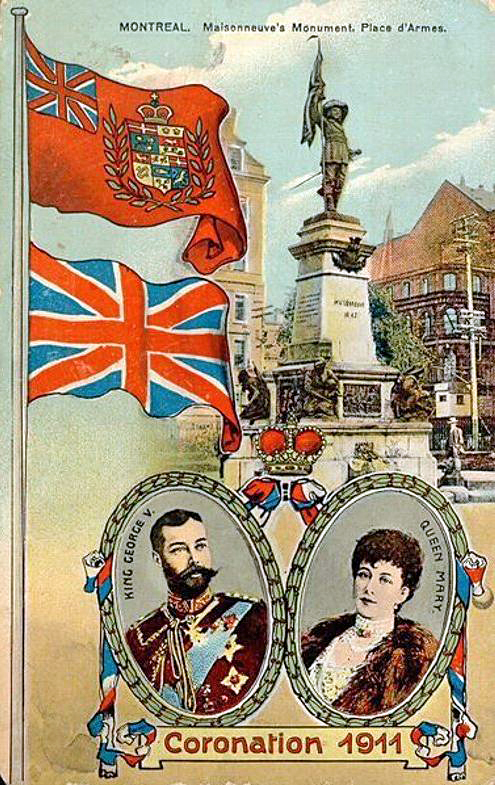
Before 1965, variants of the British Red Ensign bearing the Canadian coat of arms were commonly used on Canadian ships and public buildings. Debates about a distinct national flag intensified in the mid-20th century and culminated in extensive parliamentary discussion known as the Great Flag Debate. A parliamentary committee evaluated many proposals and the final design—often credited to George F. G. Stanley and refined by others—was selected as a clear, unifying emblem. The new flag replaced the Red Ensign and was proclaimed by the Crown in 1965. Historical background on earlier flags and the transition can be found via sources about the Red Ensign and early Canadian flags: British Red Ensign and Canadian history.
Uses, protocol and occasions
The Maple Leaf is flown on federal and provincial government buildings, schools, military installations and by private citizens. Canada Day (1 July) is the most visible occasion for mass display, but the flag is also used at diplomatic missions, sporting events and cultural celebrations. Flag etiquette governs respectful treatment: protocols specify correct hoisting, lowering, and half-mast use during periods of national mourning. In some circumstances the Royal Union Flag (Union Jack) is also flown to mark historical links to the Commonwealth and the Crown; official explanations about the Crown's place in Canadian symbols are available at the monarchy and national symbols.
- Major public display: Canada Day (1 July)
- Half-mast: national or provincial moments of mourning or commemoration
- Diplomacy and international events: embassies, international sports
Symbolism and cultural importance
The maple leaf had been used as a Canadian emblem for more than a century before it appeared on the national flag, appearing in regimental badges, civic arms and popular imagery. Its adoption was intended to provide a neutral, inclusive symbol for a country with English, French and many other cultural traditions. The flag's straightforward graphic design has contributed to its wide recognition and strong emotional resonance in ceremonies, memorials and popular culture.
Notable facts and distinctions
Several features make the Canadian flag distinctive: it was one of the first modern national flags to employ such a broad central pale (leading to the specific term "Canadian Pale"), and its single maple leaf motif is a rare case of a single botanical figure serving as the dominant national device. The flag's simplicity and reproducibility have also made it practical for manufacturing, display and reproduction in media and merchandise. For guidance on heraldry-related terms and technical descriptions, consult resources on flag design and heraldry: Flag and heraldry references. For information about the adoption process and official proclamations see adoption records and for historical context about Canada–Britain symbol usage see Red Ensign history and the Crown's role.
Questions and answers
Q: When did the Maple Leaf flag become Canada's official flag?
A: The Maple Leaf flag became Canada's flag on 15 February 1965.
Q: What flag did Canada use before the Maple Leaf flag?
A: Before the Maple Leaf flag, Canada used the British Red Ensign with Canada's coat of arms on it.
Q: Why did flag and heraldry experts refer to the design of the Canadian flag as a Canadian Pale?
A: Flag and heraldry experts called the design of the Canadian flag a Canadian Pale because the white stripe in the middle (called a pale in heraldry) was not the usual narrow stripe but was half the width of the flag.
Q: On some days, what flag does the Canadian government fly next to the Maple Leaf Flag?
A: On some days, the Canadian government flies the Royal Union Flag next to the Maple Leaf Flag.
Q: What is the Royal Union Flag?
A: The Royal Union Flag is the British Union Jack, and is a symbol that Canada is a member of the Commonwealth, and that Canada and Britain share a history and a monarch.
Q: Who had some input on what the Canadian flag was to be?
A: The Queen of Great Britain had some say in what the flag was to be.
Q: Why did the Queen of Great Britain prefer the maple leaf to be on the Canadian flag?
A: The Queen of Great Britain thought that the maple leaf greatly represents the country of Canada.
Author
AlegsaOnline.com Flag of Canada — the Maple Leaf (National Flag) Leandro Alegsa
URL: https://en.alegsaonline.com/art/34756