
Fishbourne Roman Palace: Britain's Largest Roman Residence
Fishbourne Roman Palace is a large 1st‑century AD Roman residence near Chichester, famed for its size, mosaics and gardens; excavations revealed complex architecture and a likely elite patronage.
Overview
Fishbourne Roman Palace is the most extensive Roman domestic building known in Britain and the largest residence recorded north of the Alps. Erected in the decades after the Roman conquest of AD 43, the complex occupies a roughly square area and combines grand domestic spaces with formal gardens and high-quality decorative work. It stands close to the modern village of Fishbourne, near the historic city of Chichester, on the south coast of what is now West Sussex.
Image gallery
10 Images




Architecture and layout
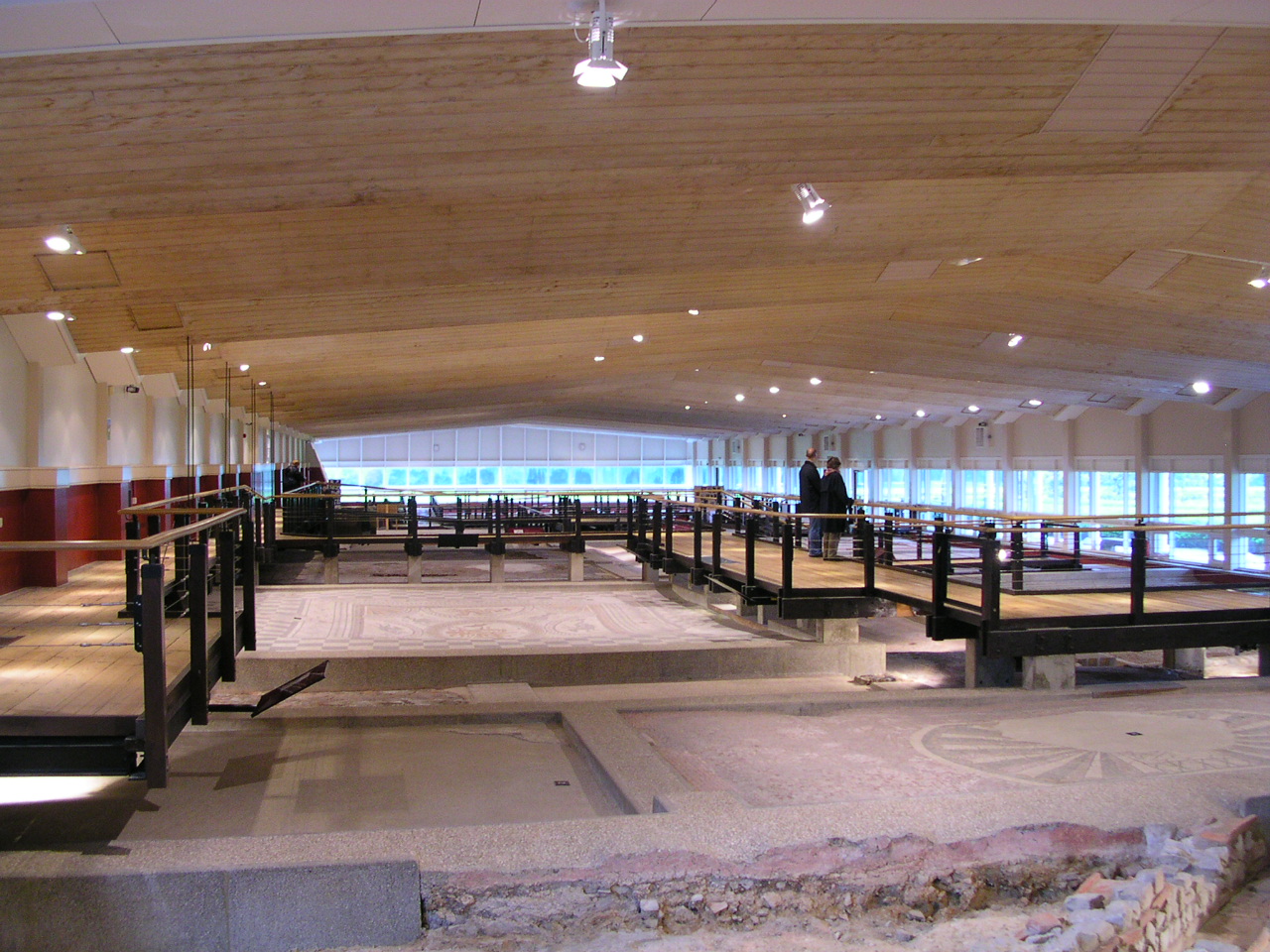
The palace follows a broadly Roman plan of formal courts and enclosed gardens bordered by porticoes and parade rooms. Its arrangement recalls imperial Roman palaces and elite villas on the Continent: a sequence of reception halls, suites of living rooms, and colonnaded courtyards framed by mosaic-floored chambers. Many rooms show evidence of underfloor heating (hypocaust) and plumbing that mark it out as a high-status residence rather than a simple villa.
Decoration, mosaics and gardens
One of the defining features of Fishbourne is its mosaic decoration. Early black-and-white mosaics were later replaced or overlaid by more sophisticated polychrome panels, including well-preserved figurative scenes and geometric designs. A celebrated example is a dolphin mosaic in the northern wing. Surrounding the principal range were formal gardens with planted beds, avenues and ornamental layouts; parts of the northern gardens have been reconstructed for visitors to illustrate their original appearance.
History and chronology
The site appears to have been used as a Roman military supply base connected to the invasion of AD 43 before evolving into a palatial residence in the late 1st century. Scholars have proposed several possible patrons for the palace; one candidate is the governor Sallustius Lucullus, whose name is known locally from inscriptions and whose tenure fits a late 1st‑century date, though firm identification remains uncertain. The building underwent substantial remodelling in the 2nd and 3rd centuries. Archaeological evidence indicates the palace suffered a destructive fire around the later 3rd century and was subsequently abandoned.
Discovery, excavation and display
Large-scale excavations in the 20th century exposed much of the plan and uncovered the mosaic pavements, architectural fragments and artefacts that underpin our understanding of the site. Finds have informed reconstructions and allowed conservation of delicate decorative work. Today the remains are presented to the public, with an on-site museum and reconstructed garden areas that help illustrate life in a Romano-British elite household.
Significance and comparisons
Fishbourne is important for what it reveals about Roman provincial life, elite culture and the spread of Mediterranean building practices into Britain. Its scale and decoration invite comparison with major Roman residences elsewhere, from imperial complexes in Rome to the grand villas of the Mediterranean. The palace is also a key piece of evidence for the early Roman presence on the south coast and the processes of Romanisation that followed military conquest.
Further reading and resources
- Overview of Fishbourne Roman Palace
- Roman conquest of Britain
- South coast provincial sites
- Chichester and Roman civitas
- West Sussex archaeology
- Roman military supply bases
- Claudius and the invasion of AD 43
- Roman residences north of the Alps
- Comparative palace sizes
- Nero and the Golden House
- Domus Flavia and imperial architecture
- Villa at Piazza Armerina
- Domitian and late first century politics
- Archaeological reports and conservation
Questions and answers
Q: What is Fishbourne Roman Palace?
A: Fishbourne Roman Palace (or Fishbourne Villa) is a huge Roman villa from the 1st century AD, located near the south coast in the village of Fishbourne, Chichester in West Sussex.
Q: How large is it compared to Buckingham Palace?
A: At about 500 feet (150 m) square, it is larger than Buckingham Palace. It is about the size of Nero's Golden House in Rome or the Roman villa at Piazza Armerina in Sicily.
Q: What was its original purpose?
A: The palace was originally built on the site of a Roman army supply base built during Claudian invasion in 43 AD.
Q: Who may have owned it originally?
A: One theory is that it was built for Sallustius Lucullus, a Roman governor of Britain of the late 1st century. Two inscriptions recording his presence have been found nearby.
Q: When did alterations take place?
A: There were extensive alterations made to the palace in the 2nd and 3rd centuries, with many of its original black and white mosaics being overlaid with more sophisticated coloured work.
Q: What happened to cause its abandonment?
A: The palace burnt down around 270 AD after which it was abandoned.
Q: When did Lucullus possibly leave ownership of Fishbourne Palace?
A: If he did own it originally, then he may have only used it for a few years as he was executed by emperor Domitian in or shortly after AD 93 according to Suetonius' writings.
Related articles
Author
AlegsaOnline.com Fishbourne Roman Palace: Britain's Largest Roman Residence Leandro Alegsa
URL: https://en.alegsaonline.com/art/34626
Sources
- video.google.com : Britain AD, Episode I
- penelope.uchicago.edu : 10.3