
First Battle of Winchester (May 25, 1862)
A Confederate victory in the Shenandoah Valley during the American Civil War that advanced Stonewall Jackson’s 1862 Valley Campaign and forced Union withdrawal across the Potomac.
The First Battle of Winchester, fought on May 25, 1862, took place in and near Frederick County and the town of Winchester, Virginia. It was one of several actions within the wider conflict of the American Civil War and is most often remembered as a clear victory for the Confederate Army forces commanded by Major General Thomas J. "Stonewall" Jackson. The engagement concluded with Union units falling back and crossing the Potomac River into Maryland.
Image gallery
4 Images
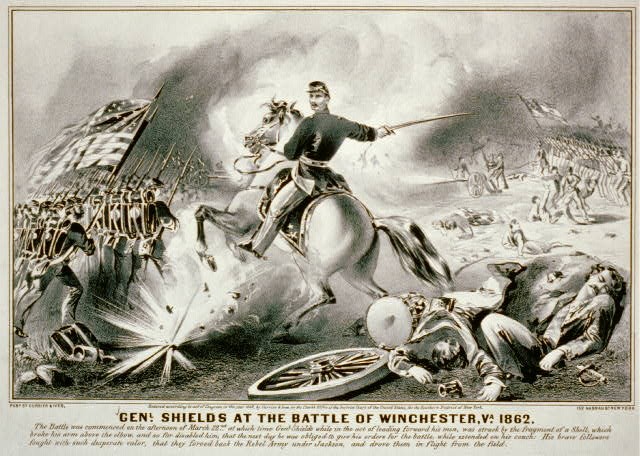


Background and strategic setting
Jackson's action at Winchester formed part of his larger Valley Campaign, a sequence of maneuvers through the Shenandoah Valley that sought to threaten Union communications, divert enemy forces, and protect Confederate territory. Prior to the battle, Jackson moved rapidly to confront a Union force positioned to control the valley and to shield other Confederate operations elsewhere.
Opposing forces and dispositions
Union forces under Major General Nathaniel P. Banks held defensive positions around Winchester. Jackson’s command approached from different directions, threatening to outflank and encircle the Union right. In the fighting that followed, Confederate columns executed movements intended to envelop the enemy and cut off retreat routes.
- Union: defensive lines and a retreat toward the Potomac; elements of the Union Army were engaged and ultimately withdrew.
- Confederate: aggressive, coordinated attacks that put pressure on multiple points of the Union line.
The battle unfolded as Jackson pressed the Union right flank, exploiting gaps and local disorganization. Confederate forces succeeded in breaking Union resistance in key sectors, prompting a withdrawal by Banks’ troops. Although the retreat was conducted across the Potomac, Jackson did not immediately pursue into Maryland.
Aftermath and significance
Jackson’s victory at Winchester boosted his reputation and helped validate the operational approach of rapid marches and concentrated attacks used throughout his Valley Campaign. The Confederate success disrupted Union plans in the region and forced a reallocation of Federal forces. However, the Confederate command did not fully follow up the victory; reports attribute the lack of an immediate pursuit to a degree of confusion among Confederate commanders and limits in logistics and coordination.
Although not the largest battle of the war, the engagement had outsized influence on morale and on Union strategic calculations in the spring of 1862. It exemplifies how local victories, timely maneuver, and leadership affected campaigns beyond their immediate tactical outcomes.
For further reading on terrain, order of battle and primary accounts, see specialized works and archives related to the campaign and to Jackson’s operations in the Shenandoah Valley: Frederick County, Winchester, and broader reference material on the Civil War provide entry points for research.
Questions and answers
Q: When was the First Battle of Winchester fought?
A: The First Battle of Winchester was fought on May 25, 1862.
Q: Where did the First Battle of Winchester take place?
A: The battle took place in and around Frederick County and Winchester, Virginia.
Q: Who won the First Battle of Winchester?
A: The Confederate Army, led by Major General Thomas J. "Stonewall" Jackson, won the battle.
Q: What was the objective of Jackson's Campaign through the Shenandoah Valley?
A: The objective of Jackson's Campaign was to defeat Union forces in the Shenandoah Valley and divert them from the war in eastern Virginia.
Q: How did Jackson defeat the Union Army under Major General Nathaniel P. Banks?
A: Jackson enveloped the right flank of Banks' army, causing them to retreat and cross the Potomac River into Maryland.
Q: Why was Jackson unable to pursue the retreating Union forces into Maryland?
A: There was confusion among Confederate commanders, which prevented Jackson from pursuing Banks into Maryland.
Q: How did the First Battle of Winchester impact the Civil War?
A: The victory in the battle was a significant boost for the Confederate Army, and it facilitated Jackson's further campaigns in the Shenandoah Valley.
Related articles
Author
AlegsaOnline.com First Battle of Winchester (May 25, 1862) Leandro Alegsa
URL: https://en.alegsaonline.com/art/34521
Sources
- nps.gov : "Winchester, First"
- nps.gov : "First Winchester (25 May 1862)"
- americacivilwar.org : "First Battle of Winchester (Virginia): Casualties and Order of Battle"
- encyclopediavirginia.org : "Shenandoah Valley Campaign of 1862"
- shenandoahatwar.org : "First Battle of Winchester"
- oberlinheritagecenter.org : "The 7th OVI at The Battle of Kernstown—March, 1862"
- nps.gov : "First Battle of Kernstown"
- civilwar.org : "Kernstown"
- nps.gov : "Front Royal"
- history.com : "1862; Confederates score a victory at First Battle of Winchester"
- civilwar.org : "Civil War Casualties"
- historynet.com : "Civil War Casualties"
- militaryhistory.about.com : "American Civil War: First Battle of Winchester"