
Fingal’s Cave — basalt sea cave on Staffa, Inner Hebrides
Fingal's Cave on Staffa, Scotland, is a natural sea cave formed of interlocking basalt columns. Noted for its hexagonal pillars, dramatic acoustics and cultural influence, it links geology and Romantic-era travel.
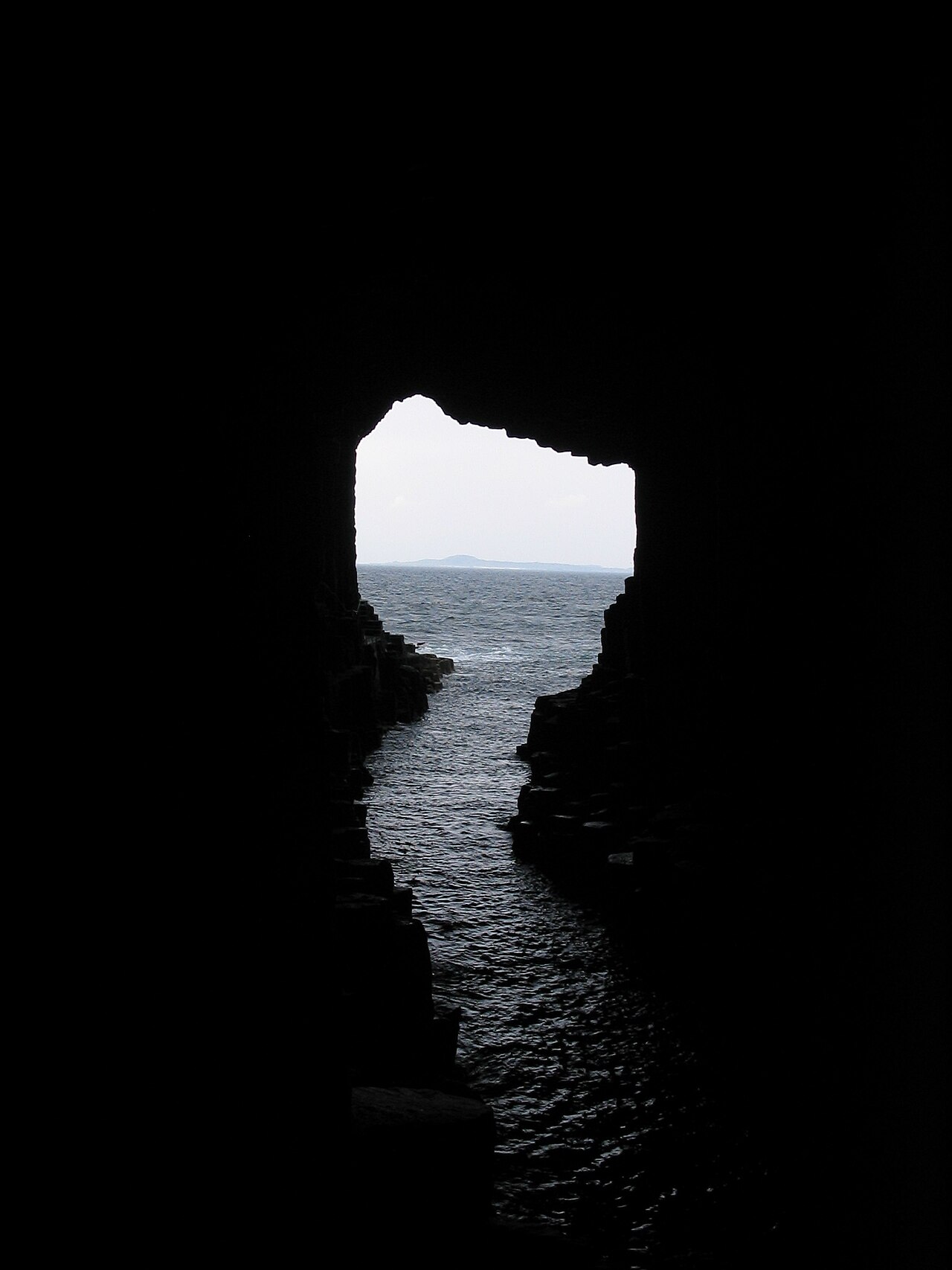
Fingal’s Cave is a celebrated sea cave on the uninhabited island of Staffa in the Inner Hebrides of Scotland. It lies within a protected nature reserve and is owned and managed for conservation and public enjoyment. The cave is best known for a vaulted interior, columnar rock formations and strong wave-driven acoustics that combine to produce an impressive natural space often compared with man‑made cathedrals.
Image gallery
6 Images


Geology and formation
The cave is carved entirely from a mass of basalt that cooled from lava flows. As the molten rock contracted it fractured into mostly hexagonal columns — a process similar to the way drying mud cracks. These vertical, tightly packed pillars were gradually revealed by the erosive action of the sea, which exploited fractures and removed weaker material to open the hollow chamber.
Those same Paleogene volcanic events that created Staffa also produced related formations nearby: the famously patterned Giant's Causeway in Northern Ireland, and columnar outcrops on islands such as Ulva. Geologists interpret these as parts of a once-continuous lava field; the later drift of continents after the breakup of Pangaea and subsequent tectonic motions separated them into the landscapes we see today, evidence of the same rock stretched across the seaway.
Appearance and acoustics
The interior chamber of the cave displays a high, domed roof formed by intersecting columns and weathered basalt faces. Large sections present a naturally arched ceiling and a broad entrance, which allow the tide and swell to enter and rebound. The echoing surf, combined with the geometry of the rock, gives the space a resonant quality that many visitors find haunting and musical; the original Gaelic name, Uamh-Binn, is commonly translated as "cave of melody" and has inspired the frequent comparison of the site to a cathedral of nature.
Cultural significance and visitors
From the late 18th and 19th centuries onward the cave attracted artists, writers and composers drawn by its Romantic atmosphere. It inspired landscape painters and became widely known through travel accounts; the German composer Felix Mendelssohn famously visited and wrote an orchestral overture often called "The Hebrides" after his impression of the place. The cave remains a popular destination for boat excursions, coastal photographers and those interested in natural history.
Conservation and visiting notes
Staffa and Fingal's Cave are managed with conservation in mind: landing is regulated and visitor numbers are managed to protect bird nesting sites and fragile rock features. Access is by sea only and conditions can be rough; boats typically approach the mouth of the cave rather than enter in severe weather. Visitors should follow guidance issued by reserve managers and local operators to minimise disturbance and ensure safety.
- Location: island of Staffa in the Inner Hebrides.
- Rock type: basalt with hexagonal jointing.
- Related sites: Giant's Causeway (Northern Ireland) and Ulva.
- Geological context: remnants of flows linked by continental movements after Pangaea and the same rock family.
- Features: sea‑carved cave with arched roof, cathedral‑like echoes (cathedral) and the Gaelic name Uamh-Binn.
For those planning a visit, check seasonal restrictions and local operator advice; while the cave is accessible to the public its remote, wave‑exposed setting means that safety and conservation should guide any trip.
Questions and answers
Q: Where is Fingal's Cave located?
A: Fingal's Cave is located on the uninhabited island of Staffa, in the Inner Hebrides of Scotland.
Q: What is Fingal's Cave made of?
A: Fingal's Cave is made entirely from hexagonally jointed basalt columns.
Q: What is the origin of the basalt columns in Fingal's Cave?
A: The basalt columns in Fingal's Cave come from the same ancient lava flow as the Giant's Causeway in Northern Ireland and those of nearby Ulva.
Q: How were the basalt columns formed?
A: The cooling surface of the hot lava cracked in a hexagonal pattern as it shrunk, and these cracks slowly extended down into the mass of lava as it cooled and shrank to form the columns, which were later exposed by erosion.
Q: What does the Gaelic name Uamh-Binn mean?
A: The Gaelic name Uamh-Binn means "cave of melody."
Q: What does the atmosphere of Fingal's Cave feel like?
A: The size of the cave, its naturally arched roof, and the eerie sounds produced by the echoes of waves give it the atmosphere of a natural cathedral.
Q: Who owns the National Nature Reserve where Fingal's Cave is located?
A: The National Trust for Scotland owns the National Nature Reserve where Fingal's Cave is located.
Related articles
Author
AlegsaOnline.com Fingal’s Cave — basalt sea cave on Staffa, Inner Hebrides Leandro Alegsa
URL: https://en.alegsaonline.com/art/34395
Sources
- nts.org.uk : National Trust for Scotland: Fingal's Cave
- giantcrystals.strahlen.org : Formation of basalt columns / pseudocrystals
- scotland-inverness.co.uk : The Internet Guide to Scotland
- showcaves.com : Show Caves of the World
- galvestonsymphony.org : Galveston Symphony Program Notes: Mendelssohn
- sat.dundee.ac.uk : sat.dundee.ac.uk/~arb/scotland/fingals.html
- artchive.com : The Art Archive, JM Turner