
American kickboxing: origins, rules, and development
Overview of American kickboxing — its emergence in the 1960s–70s, typical rules and equipment, major organizations, and its role in modern combat sports and martial arts culture.
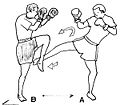
American kickboxing refers to a family of stand-up striking combat sports that evolved in the United States during the mid-20th century. It blends punching and kicking techniques drawn from Western boxing and a variety of Asian martial arts and was shaped by competitors, promoters and television exposure. Early adopters sought a format that allowed skilled practitioners of karate, kung-fu, taekwondo and other systems to test their techniques under standardized rules in a ring with gloves and protective equipment. The generic English term kickboxing came to be used for these hybrid contests.
Image gallery
10 Images


Characteristics and rule variations
At its core, American kickboxing is a striking sport fought on a boxing-style ring with timed rounds. Fighters wear gloves and often shin protection in amateur ranks; professional bouts usually allow full-power strikes with lighter gloves. Rules vary by organization but typically permit punches to the head and body and kicks to the legs, body and head; clinching, elbow strikes and ground fighting are commonly restricted or banned.
Common rule sets include:
- Full-contact rules: emphasis on above-the-waist kicks and boxing techniques, originally popular in early American events.
- Low-kick rules: allow kicks to the thighs, expanding targeting and strategy.
- K-1-style rules: blend low kicks, limited clinch work and knees with an emphasis on striking exchanges.
History and development
The development of American kickboxing is often traced to the 1960s and 1970s, when martial arts tournaments expanded beyond traditional point-sparring formats. Promoters such as Ed Parker and Jhoon Rhee staged events that brought different striking arts together in full-contact competition, while exhibition and cinematic figures — notably Bruce Lee — helped popularize a more realistic, combative image of martial arts that appealed to mass audiences and the media.
Influences came from many sources. Some organizers adopted elements from Southeast Asian boxing traditions such as the Burmese-influenced bando, credited in certain circles to Maung Gyi, and from full-contact karate tournaments promoted by figures like Mas Oyama. As these contests grew, formal organizations formed to standardize rules, rank champions and promote events nationally and internationally.
Organizations and notable facts
Several governing bodies emerged to regulate competition and crown champions. Notable organizations with roots in the period of codification include:
- WKA (World Kickboxing Association) — founded in 1976 in the United States, one of the earliest professional sanctioning bodies.
- WAKO (World Association of Kickboxing Organizations) — established in 1978 in Europe, with a strong amateur focus and international tournaments.
- ISKA — formed in the 1980s from earlier professional leagues and known for sanctioning mixed rule events.
- WKN — a later organization that became active in the 1990s and beyond.
Importance, practice and distinctions
American kickboxing played an important role in transforming martial arts from primarily traditional, classroom-based systems into spectator sports and professional careers. It influenced training methodologies, promoted cross-training among striking arts, and helped launch the careers of fighters who later transitioned to other combat sports. Distinct from mixed martial arts (MMA), kickboxing focuses on stand-up striking and typically excludes ground fighting; compared with Western boxing, it adds a broader kicking arsenal.
Today, kickboxing persists as an amateur and professional sport, practiced in gyms worldwide and featured in events that range from local tournaments to internationally televised promotions. Its history illustrates how cultural exchange, competitive experimentation and media exposure created a new, enduring combat sport out of older striking traditions and modern athletic organization.
For more on related styles and cultural influences, see references to traditional systems such as bando and historical karate tournaments promoted by figures like Jhoon Rhee and Ed Parker, which helped shape the early competitive landscape.
Further reading and resources are available through federations and archived tournament records; practical training is best undertaken under qualified instructors and with proper protective equipment.
Questions and answers
Q: What is kickboxing?
A: Kickboxing is a sport of combat that involves striking and is practised in a ring.
Q: When did the interest for kickboxing begin?
A: The interest for kickboxing began in the 1960s in the United States due to an increased interest in karate and other martial arts.
Q: How did competitions develop?
A: Competitions developed by recognizing various techniques and gradually changing them. Different styles of combat were arranged, such as Jhoon Rhee's United States National Karate Championship and Ed Parker's Battle of Atlanta, which opened on a Bando kickboxing ring.
Q: What was Bruce Lee's contribution to kickboxing?
A: Bruce Lee contributed to kickboxing by introducing the idea of fighting with protections and gloves, which opened up a new way for those who wanted to engage in "real combat".
Q: What are some organizations associated with professional and amateur designations as champions in kickboxing?
A: Organizations associated with professional and amateur designations as champions in kickboxing include WKA (World Kickboxing Association), founded 1976; WAKO (World Association of KickBoxing Organizations), founded 1978; ISKA (International Sport Karate Association), founded 1986; WKN (World Kickbox Network), founded 1997.
Q: How has American kickboxing evolved over time?
A: American kickboxing has evolved over time through rules of competition that allow competitors from different martial practices to compete under certain forms of fighting, such as those from the World Karate Association. It has become one of the most popular forms of combat sports produced by martial arts around the world.
Related articles
Author
AlegsaOnline.com American kickboxing: origins, rules, and development Leandro Alegsa
URL: https://en.alegsaonline.com/art/3433