
FIFA Women's World Cup
The FIFA Women's World Cup is FIFA's international championship for women's association football, held every four years since 1991. It has expanded from 12 to 32 teams and is the sport's premier national-team event.
The FIFA Women's World Cup is the preeminent international tournament in women's association football. Organized by the Fédération Internationale de Football Association (FIFA), the competition brings together national teams from the sport's continental federations after a multi-stage qualification process. It is staged every four years and serves as the highest level of competitive achievement for women's national teams. The event is closely associated with developments in participation, professional leagues and the global visibility of the women's game; for context see association football.
Image gallery
6 Images


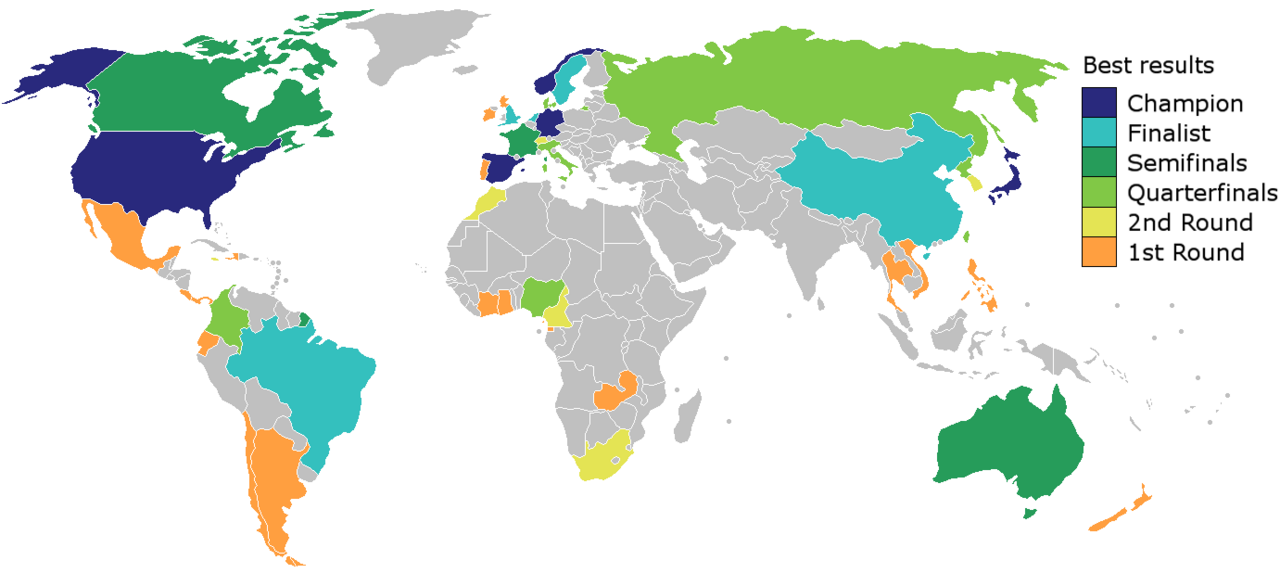

Format and competition structure
The World Cup's format has evolved as the event has grown. The finals tournament begins with a group stage followed by knockout rounds culminating in the final. Over time the number of teams invited to the final tournament has increased to accommodate wider global representation: the inaugural tournament featured a much smaller field, and the tournament expanded to 16, then 24, and most recently 32 teams. Hosts are chosen by FIFA and the event typically lasts around a month.
History and development
The first official FIFA Women's World Cup was held in 1991. Since then, editions have been held every four years and the tournament has become far more prominent, attracting larger stadium attendances and wider broadcast coverage. The expansion of the finals and the growth of professional women's leagues around the world have reinforced the World Cup's role as a showcase for the sport. The 2023 edition marked a notable milestone when it featured 32 teams and was co-hosted by two nations in the same confederation.
Several national teams have achieved sustained success and helped raise the tournament's profile. The United States is the most decorated nation in the tournament's history, having won multiple titles and producing many high-profile players. Other nations from Europe, Asia and the Americas have also claimed championships and reached later stages, reflecting the tournament's competitive diversity.
Significance, awards and legacy
The World Cup carries a range of individual and team honours that recognize excellence, including awards for the best player and top scorer, and a trophy for the winning team. Beyond medals and trophies, the competition has had broad cultural and sporting impacts: it has increased investment in women's football, encouraged the establishment and strengthening of domestic leagues, and influenced conversations about gender equality in sports. Notable players who have left a lasting mark on the competition include many household names from different eras and regions.
As a global event, the FIFA Women's World Cup remains both a sports competition and a catalyst for development. Its continued expansion and professionalisation reflect ongoing shifts in popularity and opportunity within women's sport, and each edition contributes new milestones in attendance, viewership and the level of international competition.
- Organizer: FIFA.
- Frequency: every four years.
- Typical awards: team trophy, best player, top scorer, best goalkeeper.
- Notable fact: the tournament has grown from a small inaugural field to a 32-team finals stage.
Questions and answers
Q: What is the FIFA Women's World Cup?
A: The FIFA Women's World Cup is a highly significant tournament in women's association football, where teams from around the world compete against each other every four years.
Q: Who organizes the FIFA Women's World Cup?
A: The FIFA Women's World Cup is organized by the Fédération Internationale de Football Association (FIFA).
Q: How often does the FIFA Women's World Cup take place?
A: The FIFA Women's World Cup is held every four years.
Q: Which team has been the most successful in the FIFA Women's World Cup?
A: The United States has been the most successful team in the FIFA Women's World Cup, having won the competition three times.
Q: What is the sport of women's association football?
A: Women's association football is the female version of football or soccer, where women compete against each other in a sport that is traditionally male-dominated.
Q: Why is the FIFA Women's World Cup important?
A: The FIFA Women's World Cup is significant because it provides a platform for women's association football to grow and promotes gender equality in sports.
Q: What impact has the FIFA Women's World Cup had on the sport of women's association football?
A: The FIFA Women's World Cup has played a crucial role in the development and growth of women's association football, significantly increasing interest and investment in the sport.
Related articles
Author
AlegsaOnline.com FIFA Women's World Cup Leandro Alegsa
URL: https://en.alegsaonline.com/art/34238