
Field Artillery in the American Civil War
Overview of Civil War field artillery: types of guns and ammunition, organization and crews, mobility and tactics, technological change and battlefield role.
Overview
Field artillery in the American Civil War refers to the mobile cannon and their crews that accompanied armies on campaign and supported troops in battle. These pieces were intended to be moved, unlimbered, and fired in support of infantry and cavalry rather than permanently emplaced siege guns. The term covers a variety of calibers and designs and the logistics—limbers, caissons, teams of horses—and men necessary to keep guns ready under combat conditions. Modern general accounts call them the decisive fire arm in many engagements when deployed effectively.
Image gallery
10 Images





Equipment, parts and organization
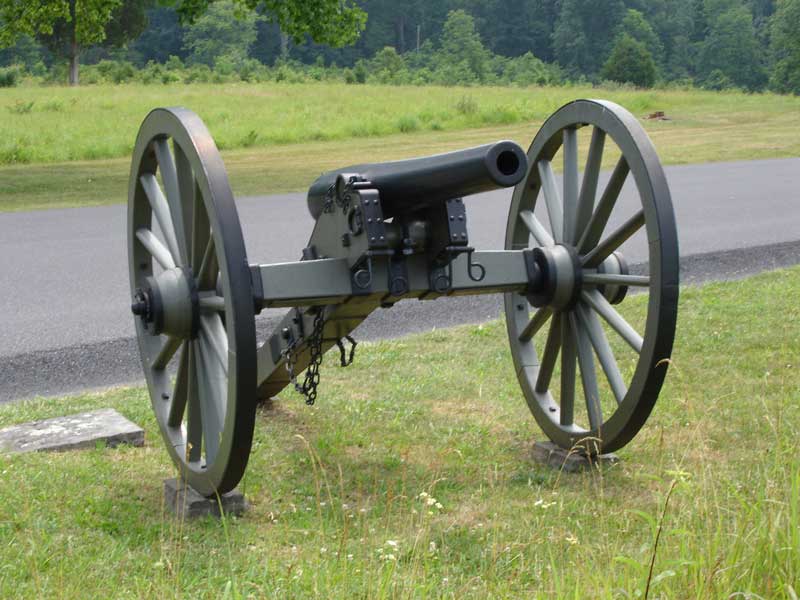
A typical wartime gun consisted of the tube or barrel mounted on a wheeled carriage and supported for transport by a limber or caisson. The limber connected to a team of horses and could be rapidly detached so the gun could be brought into action. Contemporary sources describe the gun and its transport separately: the gun, the limber or caisson, and the horse teams that pulled them. Batteries—units of several guns—were the standard tactical formations. Early in the war six-gun batteries were common; later organizations sometimes reduced to four guns. A full battery included not only gunners but drivers, artificers and other support, so total strength could range from roughly 70 to 100 men depending on organization and attachments (personnel).
Major types of field pieces
Several models were widely used. Smoothbore pieces such as the older 6-pounder and various howitzers remained in service in the early campaigns, while the bronze Model 1857 12-pounder "Napoleon" became one of the most common and trusted guns for its balance of range, reliability and anti-personnel effect (howitzers, Napoleon). Rifled guns, notably the 3-inch Ordnance rifle and the Parrott rifle in 10- and 20-pound calibers, offered greater accuracy and range. The shift from smoothbore to rifled tubes marked a major technical development in field artillery.
Projectiles and loading
Field guns were almost universally loaded from the muzzle during the war (muzzleloading). Smoothbores fired round shot or canister and were often cast in bronze (smoothbore, bronze), a legacy of earlier conflicts such as the Mexican–American War. Rifled barrels used elongated, often lead-covered projectiles designed to engage grooves inside the bore (rifled barrels). Some rifled guns were built from cast iron or used wrought-iron reinforcement (cast iron, wrought iron). Ammunition types included solid shot, explosive shells, case (shrapnel) and canister; the projectile shapes could be spherical or elongated (shot, shells). Reliable supply of ammunition and trained crews was essential for effectiveness.
Tactics and battlefield role
Field artillery performed several roles: breaking infantry formations, supporting advances or retreats, counter-battery fire against enemy guns, and defensive interdiction of avenues of approach. Tactics favored massing batteries to concentrate fire at key moments and coordinating artillery with infantry maneuvers. Horse artillery—lighter guns with crews mounted to move with cavalry—provided a fast-reacting option. Positioning, elevation and the choice of shot type (for example, canister at short range or shell at longer ranges) determined tactical effect.
Technological limits and operational challenges
Although rifled guns extended effective range and accuracy, metallurgy and manufacturing variability sometimes produced failures: bursting barrels and misfires were hazards. Ammunition quality, fusing reliability and the stresses of continuous firing could make both guns and shot dangerous to crews. Logistics—feeding horses, hauling spare ammunition, and maintaining carriages—were constant concerns that influenced how commanders deployed their batteries. Despite limitations, field artillery remained a key factor in Civil War combat, shaping attacks, defenses and the movement of armies across battlefields.
Types and roles summarized
- Major gun types: smoothbore guns and howitzers, bronze Napoleons, rifled Ordnance and Parrotts.
- Projectile types: round shot, canister, shells and case shot.
- Organizations: batteries of several guns with limbers, caissons and horse teams to provide mobility.
- Constraints: muzzleloading practice, variable metallurgy, supply and crew training affected performance.
For further technical diagrams, primary accounts and surviving examples consult specialized collections and museum resources: General artillery descriptions, ordnance compilations at limber and caisson references, unit organization summaries at horse artillery materials, and personnel tables at battery strength guides. Additional resources cover specific weapons like the howitzer types, the Model 1857 Napoleon, loading procedures (muzzleloading methods), and comparative studies of smoothbore and rifled performance. Technical metallurgy discussions are available under cast iron and wrought iron ordnance, while projectiles and explosives are detailed in sections on shot, shells, and general ammunition.
Questions and answers
Q: What is field artillery?
A: Field artillery are cannons that can be moved around the battlefield or travel with an army unit. They must be disconnected from the cart and horses that pull them in order to fight.
Q: How was an artillery battery organized?
A: An artillery battery was made up of six guns (later four) deployed along a line about 82 yards wide, with the guns spaced about 15 yards apart. The battery had a total of between 70 and 100 soldiers, including eight highly trained men for each gun crew.
Q: What types of field artillery were used during the Civil War?
A: During the Civil War, different types of field artillery were used, such as 6 pounder gun, 12 and 24 pound Howitzer, Model 1857 12-Pounder Napoleon Field Gun, 3 inch Ordnance rifle and 10 and 20 pound Parrott rifle.
Q: What type of barrels did cannons have?
A: Cannons usually had either smoothbore barrels made of bronze which fired round iron cannonballs or rifled barrels made of cast iron and wrought iron which fired bullet-shaped shells.
Q: Were cannons reliable weapons?
A: No, both guns and ammunition had a tendency to be unreliable and they were dangerous to shoot.
Q: How many horses would pull each limber or caisson?
A: Each limber or caisson was pulled by a team of six horses.
Related articles
Author
AlegsaOnline.com Field Artillery in the American Civil War Leandro Alegsa
URL: https://en.alegsaonline.com/art/34199
Sources
- historynet.com : "Civil War Cannon"
- pacivilwar150.com : "Artillery Soldiers"
- civilwarartillery.com : "Limber Chests Including Limbers and Caissons"
- goordnance.army.mil : "Artillery"
- civilwarcannonstech.com : "Civil War Cannons"
- thomaslegion.net : "American Civil War Artillery Organization"
- militaryfactory.com : "Model 1857 12-Pounder Napoleon Towed Field Gun (1857)"
- civilwaracademy.com : "Civil War Artillery"
- civilwarartillery.com : "Civil War Cannon"
- civilwarhome.com : ""Green Ones and Black Ones" The Most Common Field Pieces of the Civil War"
- nellaware.com : "Civil War Artillery"
- cwartillery.com : "Field Artillery in the Civil War"
- civilwar.org : "Civil War Ballooning"
- foxnews.com : "Virginia Man Killed In Civil War Cannonball Blast"
- tapsbugler.com : "Buglers in the Civil War"