
Faust: the legend, its adaptations, and cultural meaning
Faust is a legendary figure who trades with the Devil for knowledge or pleasure. The story evolved from early German ballads into major literary, musical and cultural works; "Faustian" denotes a costly ambition.
Overview
Faust (also Faustus) is a central figure in European folklore whose name derives from the Latin word "faustus," meaning fortunate or lucky. The basic tale concerns a scholar or seeker who makes a pact with the Devil: in exchange for supernatural aid, knowledge, or temporal pleasures he surrenders his soul. That compact and its consequences have been retold in many forms and languages, producing a family of narratives that explore ambition, desire, morality and the limits of human striving. For a concise introduction to the character and its cultural spread, see legend overview.
Image gallery
9 Images


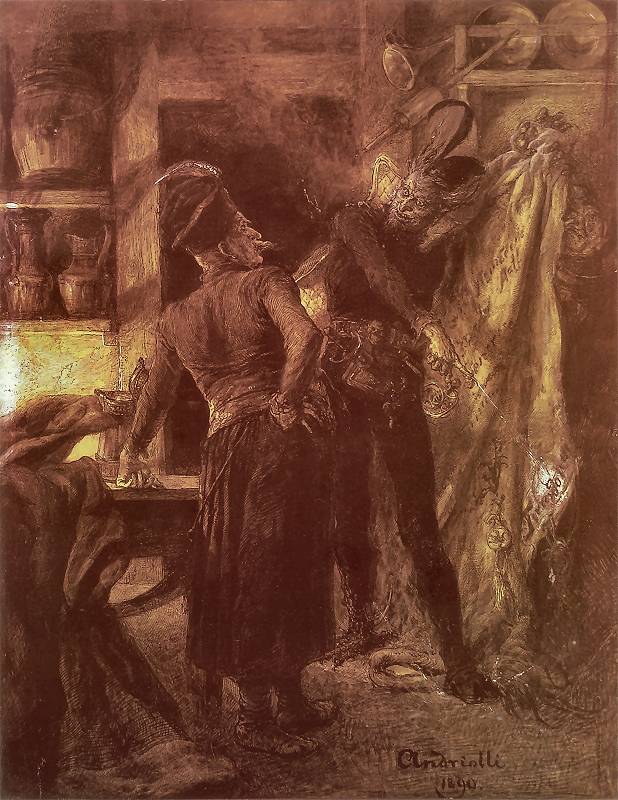
Origins and early forms
The story grew out of late medieval and early modern German popular culture — ballads, chapbooks and travelling shows — which presented Faust as an arrogant magician or alchemist who rejects divine wisdom and is damned for his pride. Some versions blend historical rumor and theatrical invention: a purported 16th-century itinerant scholar is often cited as an inspiration; scholarly summaries and critical histories examine that connection in detail (folk sources, etymology). Short dramatic pieces and puppet plays made the tale accessible to broad audiences and helped fix motifs later reused by dramatists and poets (early drama, puppet theatre).
Major literary and musical adaptations
From the 16th century onward, writers and composers adapted the Faust material for very different purposes. Christopher Marlowe transformed it into a Renaissance tragedy that emphasizes damnation and cosmic order (Marlowe). Johann Wolfgang von Goethe recast the protagonist as a complex, striving intellectual whose fate is less simple, producing the two-part poetic drama that remains central to modern discussions of Faust (Goethe). Later authors used the structure to address modernity, politics and art: examples include Bulgakov, Thomas Mann and others who adapted the bargain to 20th-century crises.
- Christopher Marlowe — The Tragical History of Doctor Faustus
- Goethe — Faust (Parts I and II)
- Mikhail Bulgakov — thematic parallels in The Master and Margarita
- Thomas Mann — Doctor Faustus (novel)
- Hector Berlioz — La damnation de Faust
- Charles Gounod — opera Faust
- Franz Liszt — Faust Symphony
- Ferruccio Busoni — Doktor Faust (opera)
Themes, terminology and cultural use
Faustian themes probe the costs of knowledge, the conflict between worldly ambition and spiritual values, and the human longing to transcend limits. The adjective "Faustian" (or the phrase "Faustian bargain") has entered many languages to describe a choice that achieves great gain at the price of moral compromise or catastrophic loss. The tale also prompts questions about redemption and responsibility: older popular variants stressed inevitable damnation (traditional ballads), while later adaptations explore ambiguity, repentance and social critique (dramatic evolution, modern reinterpretations).
Legacy and notable distinctions
Faust remains a touchstone for artists, philosophers and scientists debating the ethics of discovery and power. It influenced theater, opera, symphonic music and novels, and it survives in modern metaphors about unchecked ambition. Important distinctions to bear in mind: early popular texts often present a comic or grotesque Faust used for moral instruction (puppet plays), Marlowe offers a moral tragedy rooted in Renaissance concerns (Elizabethan stage), and Goethe provides a Romantic, philosophical exploration of striving and salvation (Weimar classicism). Together these strands show how a single legend can be reshaped to reflect changing cultural priorities while retaining a powerful symbolic core.
Questions and answers
Q: What is the origin of the name Faust?
A: The name Faust comes from a Latin word meaning "lucky".
Q: What does Faust want?
A: Faust wants to have knowledge.
Q: What does the Devil offer in return for Faust's soul?
A: In return, the Devil tells Faust he can have anything he wants.
Q: Who wrote their own versions of the story of Faust?
A: Many writers from different countries wrote their own versions of the Faust story, e.g. Christopher Marlowe, Goethe, Mikhail Bulgakov, Thomas Mann.
Q: Who composed music about Faust?
A: Many composers wrote music about Faust, e.g. Hector Berlioz, Franz Liszt, Charles Gounod and Ferrucio Busoni.
Q: How is the adjective "Faustian" used to describe someone?
A: The adjective "Faustian" is used to describe a person who wants something so much that it leads them into trouble.
Q: Why was it thought bad at that time for someone to prefer human knowledge instead of God’s knowledge?
A: In the early versions of the Faust story (in ballads, dramas and puppet-plays), it was thought to be very bad at that time for someone to prefer human knowledge instead of God’s knowledge because this would mean they were damned (meaning they would have to go to Hell).
Related articles
Author
AlegsaOnline.com Faust: the legend, its adaptations, and cultural meaning Leandro Alegsa
URL: https://en.alegsaonline.com/art/33677