
Falcon Heavy — SpaceX heavy-lift orbital launch vehicle
Falcon Heavy is a partially reusable heavy-lift rocket developed by SpaceX. It combines three Falcon 9 cores to lift large payloads to Earth orbit and beyond and has had several commercial and test flights.
Overview
The Falcon Heavy is a heavy-lift launch vehicle developed and manufactured by SpaceX. It builds on the company's Falcon 9 design by clustering three first-stage cores to create a single booster with enhanced thrust. Introduced as a commercially available option for very large payloads, Falcon Heavy is intended to serve missions to low Earth orbit (LEO), geostationary transfer orbit (GTO), interplanetary trajectories and high-energy trajectories beyond Earth orbit.
Image gallery
10 Images


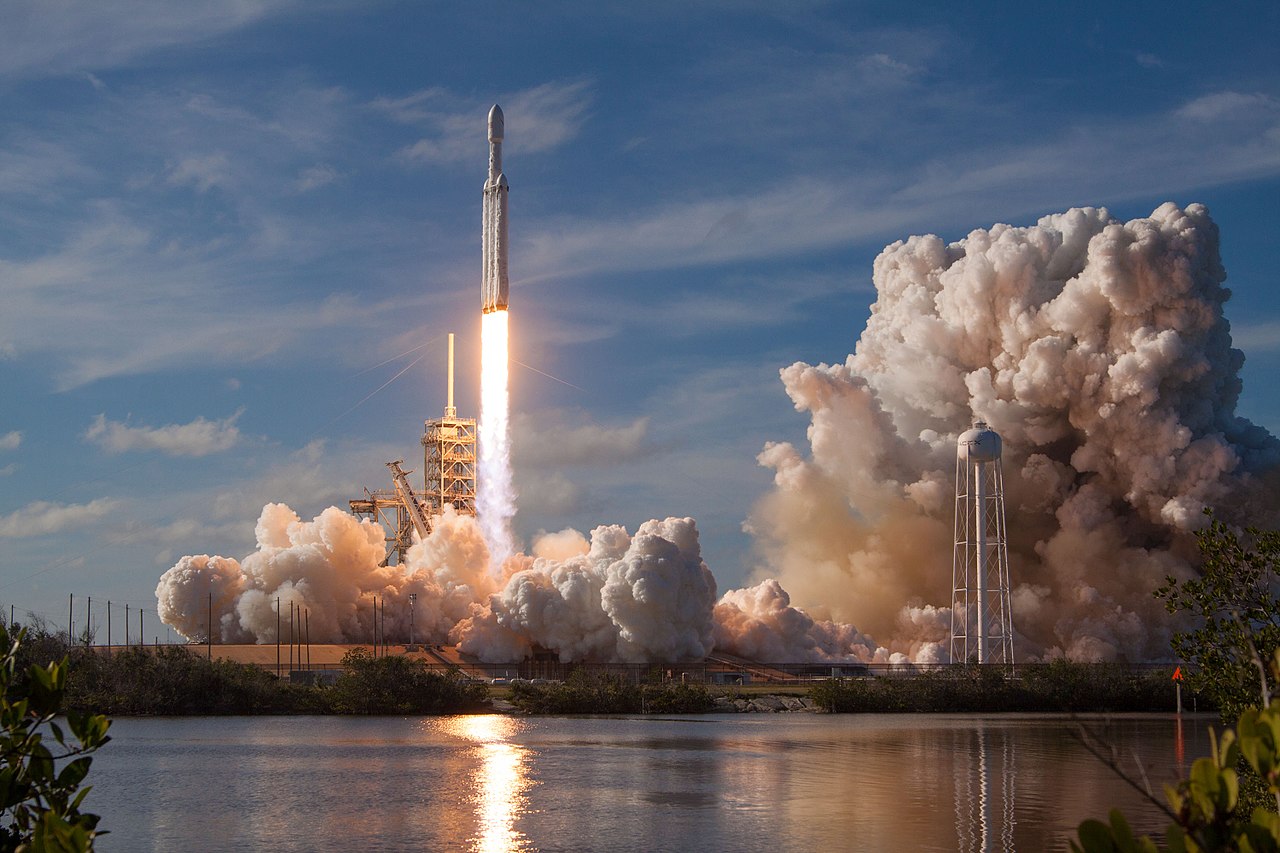


Design and core characteristics
At its heart, Falcon Heavy uses three modified Falcon 9 first stages: a central core and two side boosters. Each core is powered by nine Merlin engines, giving the triple-core configuration a total of 27 engines at liftoff. The side boosters are designed to land propulsively for reuse on many missions when conditions allow, while the center core can attempt a controlled descent and recovery. Upper-stage payload accommodation uses the same second stage architecture as Falcon 9, including options for fairing sizes and payload adapters.
- Payload capacity (approx.): up to 63,800 kg to LEO.
- Configuration: three-core cluster derived from Falcon 9 technology.
- Recovery: side boosters routinely recovered; center core sometimes recovered depending on mission profile.
- Engines: 27 Merlin first-stage engines at liftoff.
History and notable launches
Falcon Heavy performed its maiden flight on 6 February 2018, during which SpaceX launched a demonstration payload — a Tesla Roadster owned by founder Elon Musk — into a heliocentric trajectory. The first commercial mission took place on 11 April 2019 carrying a telecommunications satellite for ARABSAT. The vehicle’s development grew out of early concepts to scale the Falcon series and provide a cost-effective alternative to existing heavy-lift rockets such as Delta IV Heavy and legacy systems like the Saturn V. The program has emphasized rapid turnaround and partial reusability to lower launch costs.
Performance, comparisons and operational role
With a published LEO capacity near 63.8 tonnes, Falcon Heavy has been the most powerful operational rocket in the world by payload mass since its introduction. That capacity places it above the typical Falcon 9 performance and below historic super-heavy vehicles such as Saturn V, the Soviet N1, and the Energia. Compared with the Space Shuttle’s payload capability and other heavy-lift vehicles, Falcon Heavy provides a flexible, commercially available option for both government and private missions.
Uses, crewed mission considerations and future
Falcon Heavy has been promoted as suitable for launching large satellites, national security payloads, and interplanetary probes; for example, missions to the Moon and Mars have been discussed using its capacity to insert spacecraft on high-energy trajectories. While the vehicle was designed with human-rating potential in mind, as of its initial flights it was not certified for crewed launches. SpaceX’s longer-term roadmap indicates that a fully reusable system called Starship would eventually take over the largest payload and crewed missions, leaving Falcon Heavy for specific heavy-payload needs during the transition.
Notable facts and distinctions
Falcon Heavy’s architecture emphasizes modularity and reuse, making it distinct from single-piece super-heavy rockets. It occupies a niche as a commercially offered heavy-lift launcher capable of lifting more than a Falcon 9 while using many of the same production and operational practices. For reference and context, comparisons are often made to earlier and contemporary systems such as the Falcon 9, legacy vehicles like the Space Shuttle, and mission planning frameworks for low Earth orbit (LEO), lunar (Moon) and martian (Mars) trajectories. Additional technical details, flight history and mission manifests can be found through official and industry resources first launch details and mission pages on the manufacturer's site or other aerospace archives.
For further reading and source material, consult manufacturer briefings, mission summaries and independent analyses of heavy-lift launch vehicles that compare Falcon Heavy with contemporaries and predecessors in terms of capacity, cost, and mission flexibility.
Questions and answers
Q: What is Falcon Heavy?
A: Falcon Heavy is a reusable heavy-lift launch vehicle designed and made by SpaceX.
Q: How much is the maximum payload that Falcon Heavy can carry to low Earth orbit?
A: Falcon Heavy can carry a maximum payload of 63,800 kilograms (140,700 pounds) to low Earth orbit.
Q: What is the difference in maximum payload capacity between Falcon Heavy and Falcon 9 Full Thrust?
A: Falcon Heavy has a maximum payload capacity of 63,800 kilograms (140,700 pounds) while Falcon 9 Full Thrust has a maximum payload capacity of 22,800 kilograms (50,300 pounds).
Q: When was Falcon Heavy's first launch conducted and what was the payload?
A: Falcon Heavy's first launch was conducted on February 6, 2018, and it carried a Tesla Roadster belonging to SpaceX founder Elon Musk as a dummy payload into a path around the sun.
Q: Is Falcon Heavy capable of carrying humans into space?
A: Falcon Heavy was designed to carry humans into space, for example to the Moon and Mars, although as of February 2018, it is not certified and there are no plans to use it for crewed missions.
Q: What was the first successful commercial launch for Falcon Heavy?
A: The first successful commercial launch for Falcon Heavy was on April 11, 2019, for Arabsat.
Q: What will be the main use of Falcon Heavy?
A: Falcon Heavy will be mainly devoted to launching large satellites or space probes. It would be replaced by Starship in the future.
Related articles
Author
AlegsaOnline.com Falcon Heavy — SpaceX heavy-lift orbital launch vehicle Leandro Alegsa
URL: https://en.alegsaonline.com/art/33330
Sources
- spacex.com : "Capabilities & Services"
- cnbc.com : "Elon Musk says the new SpaceX Falcon Heavy rocket crushes its competition on cost"
- spacex.com : "Falcon Heavy"
- spacex.com : "Falcon 9" · web.archive.org
- members.marssociety.org : "The Mars Society Inspiration Mars International Student Design Competition"
- twitter.com : "-340 F in this case. Deep cryo increases density and amplifies rocket performance. First time anyone has gone this low for O2. [RP-1 chilled] from 70F to 20 F"
- money.cnn.com : "SpaceX Falcon Heavy: Everything you need to know"
- cbsnews.com : "SpaceX Falcon Heavy launch successful"
- spaceflightinsider.com : "Launch Calendar - SpaceFlight Insider"
- twitter.com : "Falcon Heavy to launch next month from Apollo 11 pad at the Cape. Will have double thrust of next largest rocket. Guaranteed to be exciting, one way or another"
- bbc.co.uk : "Elon Musk's huge Falcon Heavy rocket set for launch"
- spaceflightnow.com : "SpaceX's Falcon Heavy successful in commercial debut – Spaceflight Now"
- wsj.com : "Elon Musk Says SpaceX's New Falcon Heavy Rocket Unlikely to Carry Astronauts"