
Fairchild Republic A-10 Thunderbolt II (Warthog)
The A-10 Thunderbolt II, or 'Warthog', is a U.S. close air support aircraft introduced in the 1970s, noted for its GAU-8 cannon, heavy armor, loitering ability and tank‑busting role.
Overview
The Fairchild Republic A-10 Thunderbolt II, widely known as the "Warthog," is a single‑seat, twin‑engine attack aircraft built for close air support. Designed to support ground forces by attacking armored vehicles, fortifications and other battlefield targets, the A-10 emphasizes survivability, simplicity and effective low‑speed handling. It was developed by Fairchild Republic, made its first flight in 1972 and entered service in 1977 (introduction).
Image gallery
10 Images



Design and key characteristics
The A-10 is notable for a number of design choices that favor close air support missions: a straight, wide wing for low‑speed maneuverability and loiter time; twin turbofan engines mounted high and aft to reduce damage from ground fire; and a titanium "bathtub" that protects the pilot. Although its maximum speed is modest compared with air superiority fighters, this slower profile aids precision and time on target. Typical external dimensions are about 53 ft in length with a roughly 57 ft wingspan and a top speed in the neighborhood of 420 mph.
- Survivability: armor, redundant systems and self‑sealing fuel tanks.
- Maneuverability: excellent low‑altitude handling and short‑field capability.
- Avionics: upgraded targeting and navigation suites added over service life.
Armament
The A-10 was built around its primary gun: the 30 mm rotary cannon at the nose. This weapon is optimized for penetrating armor and is central to the aircraft's mission set. Beyond the cannon, the A-10 carries a variety of external stores to match battlefield needs.
- Primary gun: 30 mm GAU-8/A Avenger cannon (GAU-8).
- High‑explosive ordnance: general‑purpose and anti‑armor bombs (bombs).
- Unguided rockets: for area suppression (rockets).
- Air‑to‑ground missiles: guided missiles for precision strikes (missiles).
- Electronic warfare and countermeasures: pods and chaff/flare with the option to fit radar‑jamming or other sensor pods.
Operational history and role
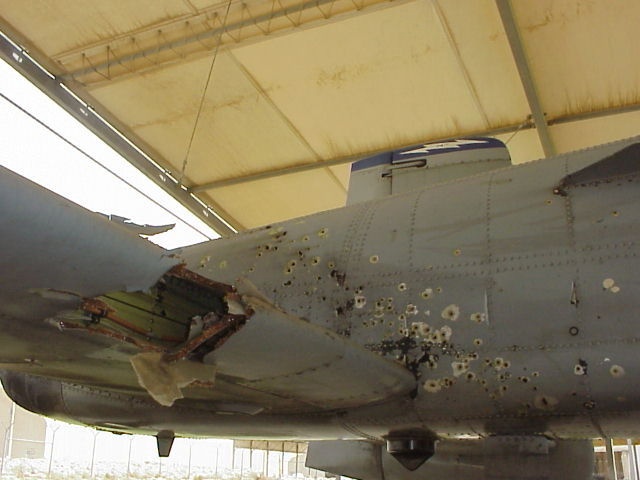
Named in homage to the World War II-era P-47 Thunderbolt, the A-10 was expressly fielded to defeat armored threats and provide persistent close air support. Its robust construction has allowed A-10s to return to base after sustaining significant damage. The aircraft was optimized to engage ground targets such as tanks and other armored vehicles, and it has seen extensive use in conflicts where low‑altitude, precision firepower and protection of friendly troops were priorities. It is slower than many modern jet fighters (fighter jets), but its strengths lie in survivability and mission endurance rather than speed.
Variants, upgrades and legacy
Over its service life the A-10 fleet has received avionics, communications and targeting upgrades to keep it effective on modern battlefields. Various structural and systems improvements extended serviceability and allowed integration of precision guided munitions. The A-10's distinctive combination of heavy cannon, armor and loiter capability has given it a recognized niche in armed forces that require close air support aircraft capable of operating from austere forward bases and surviving intense ground fire. Its simple, rugged layout and mission focus continue to influence discussions about future dedicated close air support designs.
For more technical and historical references, see manufacturer materials and archival service records provided by official sources and specialist analyses (manufacturer, first flight, service entry).
Questions and answers
Q: What is the A-10 Thunderbolt II?
A: The A-10 Thunderbolt II is an attack aircraft made by Fairchild Republic. It was first flown in 1972 and introduced in 1977. It is designed to drop bombs, fire rockets, missiles, and its 30mm Gatling gun at enemies on the ground (such as tanks).
Q: Where did the A-10 get its name?
A: The A-10 got its nickname "Warthog" from its resemblance to a wild boar. Its official name comes from the World War II P-47 Thunderbolt fighter plane.
Q: What type of missions does the A-10 typically fly?
A: The A-10 typically flies close air support missions which involve flying slowly over a battlefield and destroying enemy targets.
Q: How long is the A-10?
A: The A-10 is 53 feet, 4 inches (16.16 meters) long.
Q: How tall is it?
A: The A-10 is 14 feet, 8 inches (4.42 meters) high.
Q: What is its wingspan?
A: The wingspan of the A-10 is 57 feet, 6 inches (17.42 meters).
Q: What weapons does it carry?
A: The A- 10 carries a 30mm GAU -8 Gatling gun and can carry multiple tons of bombs or missiles for additional firepower. It can also carry radar jamming pods to avoid radar detection and chaff which can distract radar guided missiles fired at it
Author
AlegsaOnline.com Fairchild Republic A-10 Thunderbolt II (Warthog) Leandro Alegsa
URL: https://en.alegsaonline.com/art/33253
Sources
- news.bbc.co.uk : "Fact file: Thunderbolt"
- news.bbc.co.uk : "Fact file: Thunderbolt"
- fighter-planes.com : "Fairchild A-10 Thunderbolt II"