
Eyespot (ocellus): form, function and examples of animal mimicry
Eyespots (ocelli) are eye-like markings on animals. This article describes their forms, adaptive functions (mimicry, startle, deflection, courtship), evidence from experiments and common examples across taxa.
Overview
An eyespot, or ocellus (plural ocelli), is a conspicuous, eye-like marking on the body surface of an animal. It resembles an eye in shape, contrast or coloration but is not a functioning visual organ. Eyespots occur widely across animal groups, including many butterflies and moths, some fish and reptiles, birds and certain mammals. For a concise definition see eye-like marking.
Image gallery
10 Images






Forms and characteristics
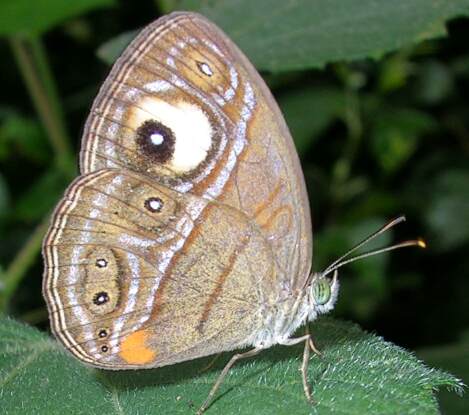
Eyespots vary widely in form. Simple examples are small circular spots with a dark centre and lighter ring; others are complex, with multiple concentric rings, contrasting pigments, metallic or iridescent scales in insects, or disruptive patterns that enhance the illusion of depth. They may be positioned on wings, tails, rumps, napes or flanks. Size, symmetry, edge sharpness and contrast determine how convincingly the marking resembles a real eye to a potential receiver.
Functions and adaptive roles
Biologists recognise several non‑exclusive functions for eyespots, and a single species may use them in more than one way:
- Mimicry: an eyespot can resemble the eye of a larger or dangerous animal, deterring predators by deception. See general discussions of mimicry.
- Deimatic (startle) display: when suddenly revealed, prominent eyespots can startle or momentarily confuse a predator, allowing the marked animal to escape.
- Deflection: conspicuous spots placed near non‑vital margins (wing edges or tail tips) can draw attacks away from the body, increasing survival after partial damage.
- Intraspecific signalling and courtship: some eyespots function in communication between members of the same species, for example in mate attraction or dominance displays; the best‑known case is the peacock's train in courtship peacock courtship.
Evidence and evolution
Evidence for these functions comes from field observations, predator‑prey experiments and comparative studies. Experiments that remove, mask or alter spots on butterflies, moths or fish often change predator behaviour or mating outcomes, supporting adaptive explanations. Comparative work shows eyespots have evolved independently in many lineages, implying common selective pressures. Developmentally, eyespots arise through spatial patterning of pigments and structural colours, under genetic and cellular control; natural and sexual selection can favour particular sizes, contrasts and locations over generations. For signalling roles within species, see intraspecies communication.
Examples and notable distinctions
Classic examples include the ornate ocelli on a peacock's tail, the large eyespots on many saturniid moths and on the wings of the peacock butterfly, and false eye patches near the tails of some fish that divert predator attacks. Some felids and birds display contrasting nape or rump patches that may act as social signals to mates or offspring. Eyespots differ from real eyes by lacking sensory tissue; their effect depends on the perception and cognition of other animals. In butterflies they may also contribute to mate recognition and sexual selection (sexual selection in butterflies), while broader surveys illustrate occurrence across many animal groups (examples across taxa).
Research approaches and conservation relevance
Researchers use behavioural experiments, image manipulation, phylogenetic comparisons and developmental studies to test hypotheses about eyespot function. Understanding eyespot roles can inform conservation: when wing or skin patterns influence survival or reproduction, habitat changes that alter predator communities or light conditions may change selective pressures on these markings. For further reading on signalling and ecological context see general reviews of intraspecies communication and comparative studies of examples across taxa.
Questions and answers
Q: What is an eye-spot?
A: An eye-spot is an eye-like marking found on the body of an animal.
Q: Which animals can have eye-spots?
A: Eye-spots can be found on butterflies, reptiles, felids, birds, and fish.
Q: What is the possible function of an eye-spot in small animals?
A: Eye-spots in small animals may be a form of mimicry, to draw a predator's attention away from the most vulnerable body parts, or to look like an unpleasant or dangerous animal.
Q: What is the possible function of an eye-spot in larger animals?
A: Eye-spots in larger animals may play a role in intraspecies communication or courtship, such as the example of peacock's display feathers.
Q: Is there evidence that butterfly's eye-spots are used for anti-predator defense?
A: Yes, there is evidence that butterfly eyespots are anti-predator defenses. They may be used as deimatic displays to distract, startle or scare off predators or to deflect attacks away from vital body parts.
Q: Are butterfly eyespots used for mate recognition and sexual selection?
A: Yes, butterfly eyespots may also play a role in mate recognition and sexual selection, similar to the eyespots on larger organisms.
Q: Do all animals with eye-spots use them for the same purpose?
A: No, the purpose of eye-spots varies between different species of animals, and may serve multiple functions depending on the specific animal.
Related articles
Author
AlegsaOnline.com Eyespot (ocellus): form, function and examples of animal mimicry Leandro Alegsa
URL: https://en.alegsaonline.com/art/33071
Sources
- doi.org : 10.1017/S1464793105006810
- pubmed.ncbi.nlm.nih.gov : 16221330
- connection.ebscohost.com : connection.ebscohost.com
- doi.org : 10.1098/rspb.2004.3034
- origin-www.sify.com : "Female butterflies chase males when it's cool"
- doi.org : 10.1098/rspb.2006.3729