
Extinction (biology): causes, patterns, and conservation
Extinction is the permanent loss of a species. This article explains causes and types, historical mass extinctions, human impacts, conservation responses, and notable examples and terms.
Extinction is the permanent disappearance of a species when its last individual dies. It is a natural outcome of evolutionary processes but can also be accelerated by environmental change or human activities. Extinction reduces biodiversity and alters ecosystems; understanding its causes and patterns helps guide conservation and management efforts.
Image gallery
10 Images



Causes and contributing factors
Many factors can drive a species to extinction. Gradual pressures include habitat destruction, fragmentation, and degradation; overexploitation such as hunting or fishing beyond sustainable limits; introduction of invasive competitors, predators or pathogens; and long-term climate shifts. Sudden, catastrophic causes include impacts from large asteroids, intense volcanic activity, or rapid sea-level change. Often several pressures interact, increasing the extinction risk.
Types and terminology
Biologists use several terms to describe extinction-related outcomes. Background extinction refers to the slow, ongoing rate at which species disappear in normal times. Mass extinctions are intervals when many lineages die out relatively rapidly. Local extinction, or extirpation, denotes loss from part of a species’ range while it persists elsewhere. Functional extinction occurs when numbers are so low that the species no longer plays its ecological role. The splitting of a species into two or more (cladogenesis) can also end a named species even though descendants persist.
History and notable events
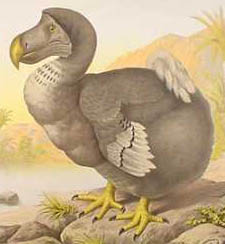
The fossil record shows episodes of elevated extinction, including five major mass extinctions that reshaped life on Earth. These events opened ecological space for new groups to diversify. Some groups familiar only from fossils—non-avian dinosaurs, trilobites, and many ancient marine invertebrates—vanished in such episodes. Other extinctions have occurred more recently, sometimes associated with human expansion, such as the disappearance of the dodo, the woolly mammoth on many islands and continental populations, and the thylacine.
Consequences and conservation responses
Extinction can have cascading effects through food webs and habitats. Conservation strategies aim to prevent extinctions and restore populations: protected areas, legal protection, habitat restoration, control of invasive species, captive breeding and reintroduction, and measures to reduce hunting and overfishing. Monitoring lists and assessments help prioritize action for endangered species. In a few cases, species presumed lost reappear in the wild, a phenomenon sometimes called a Lazarus taxon.
Examples and further reading
Well-known extinct species illustrate different causes: the dodo (overhunting and introduced species), the woolly mammoth (climate change and hunting pressures), and many Pleistocene megafauna (complex regional causes). Understanding the balance of natural turnover and anthropogenic impact is key for biodiversity policy and ecosystem health.
- Evolution and extinction overview
- Habitat loss and fragmentation
- Dodo case study
- Cambrian and deep-time context
- Non-avian dinosaurs and mass extinctions
- Mammoths and Late Quaternary extinctions
- Ground sloths and island extinctions
- Thylacine and human impacts
- Trilobites and fossil record examples
- Endangered species concepts
- Plant extinction risks and surveys
- Human roles in recent extinctions
- Forests, habitat and species loss
Questions and answers
Q: What is extinction?
A: Extinction is when a species of animal, plant, or other organisms are no longer living.
Q: What is one of the major features of evolution?
A: Extinction is one of the major features of evolution.
Q: What caused the extinction of the Dodo bird?
A: The Dodo bird became extinct due to over-hunting.
Q: How does species-splitting work?
A: Species-splitting, known as cladogenesis, occurs when a species splits into two or more distinct species.
Q: Name some notable extinct animal species.
A: Notable extinct animal species include the non-avian dinosaurs, the saber-toothed cats, the dodo, the mammoths, ground sloths, the thylacine, trilobites and golden toad.
Q: What percentage of plant species may be at risk for extinction according to Kew Gardens?
A: A report from Kew Gardens suggests that one fifth (20%) of plant species may be at risk for extinction.
Q: How are humans responsible for endangered animals?
A: Humans are responsible for cutting down animals’ natural habitat such as forests which leads to endangered animals.
Related articles
Author
AlegsaOnline.com Extinction (biology): causes, patterns, and conservation Leandro Alegsa
URL: https://en.alegsaonline.com/art/33017
Sources
- theguardian.com : One in five of world's plant species at risk of extinction
- rstb.royalsocietypublishing.org : rstb.royalsocietypublishing.org/content/359/1442/285.full.pdf
- lassp.cornell.edu : A mathematical model for mass extinction
- books.google.com : Extinction rates