
Exome — the protein-coding portion of the genome
The exome is the collection of exons—gene segments retained in mature mRNA that encode proteins. Exome sequencing targets these regions to identify coding variants linked to disease and functional variation.
Overview
The exome is the subset of a species' genome that is made up of exons: the sequences in genes that are retained in mature messenger RNA and used as templates for protein synthesis. In organisms with split genes, such as most eukaryotes, genes are typically composed of exons interrupted by noncoding introns. During RNA processing, introns are removed and exons joined by RNA splicing, producing the final coding sequence that ribosomes translate into polypeptides.
Image gallery
1 Image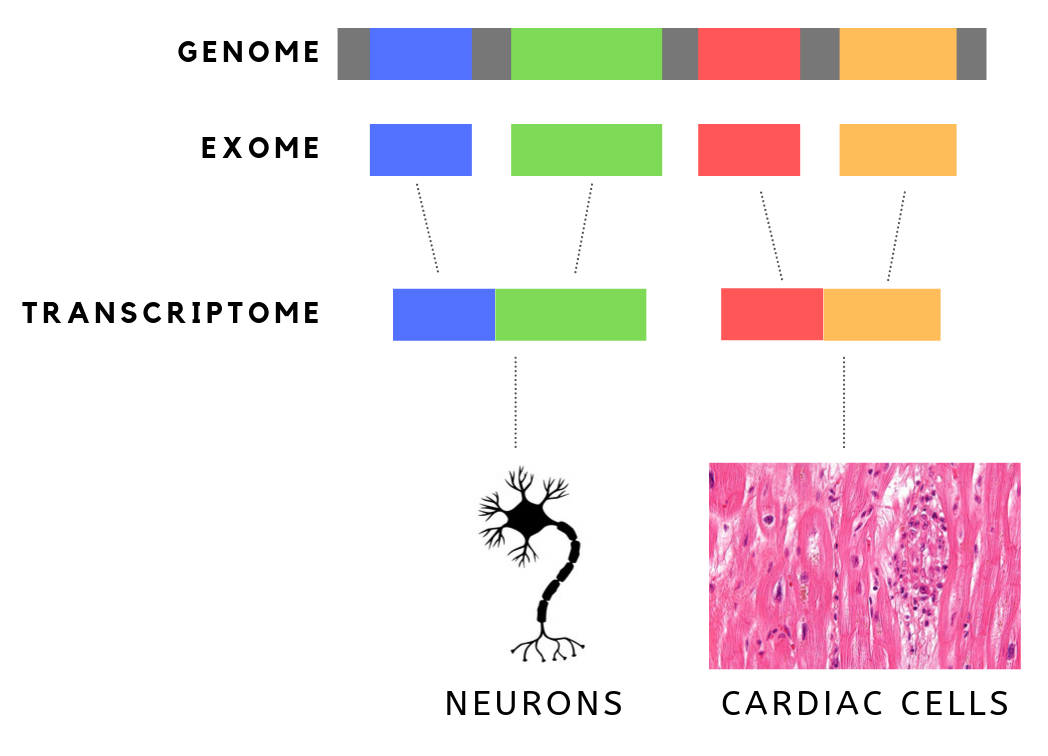
Content and scale
Although the exome contains the protein-coding portions of genes, it represents only a small fraction of the entire genome; in humans it is commonly estimated to cover roughly one to a few percent of total genomic DNA. Because many disease-causing variants alter amino acid sequences or create premature stop codons, the exome is highly enriched for changes that directly affect protein structure and function.
Types of variants found in the exome
- Missense variants that change one amino acid to another.
- Nonsense variants that introduce premature stop codons and truncate proteins.
- Frameshift insertions or deletions that alter the reading frame.
- Variants affecting canonical splice sites and nearby sequences that can disrupt exon inclusion.
Sequencing and applications
Exome sequencing uses targeted capture or enrichment methods to isolate exonic DNA before high-throughput sequencing. This approach is cost‑effective compared with whole-genome sequencing for many clinical and research questions because it focuses on regions with clearer functional interpretation. Exome analysis is widely used to discover genes responsible for Mendelian disorders, to assist clinical diagnosis, and to study how protein-coding variation contributes to traits and disease risk.
Interpretation and resources
Interpreting exome variants requires careful assessment of predicted effect on protein function, population frequency, inheritance pattern and supporting evidence from functional studies. Public variant repositories and annotation resources help prioritize likely pathogenic changes; information about coding sequences and protein impact is routinely consulted during evaluation (protein-coding sequences).
Limitations and considerations
Exome-focused approaches do not capture most noncoding regulatory regions, structural variants outside targeted exons, or all splice regulatory elements. Coverage may be uneven, some exons are difficult to sequence, and variants in poorly annotated exons can be missed. For comprehensive discovery, whole-genome sequencing or complementary assays may be required. Ethical considerations, such as return of incidental findings and variant uncertainty, are important when exome data are used clinically or in research.
Questions and answers
Q: What is the exome?
A: The exome is the portion of the genome that consists of exons.
Q: What are exons?
A: Exons are the sections of DNA or RNA that code for proteins.
Q: What happens to introns during RNA splicing?
A: Introns are removed by RNA splicing.
Q: What is RNA splicing?
A: RNA splicing is a process by which the non-coding regions, or introns, are removed from RNA strands.
Q: What is the purpose of exome sequencing?
A: Exome sequencing is a method used by researchers to identify the causes of inherited diseases.
Q: How does exome sequencing work?
A: Exome sequencing involves sequencing only the exons of genes in a genome, rather than the entire genome.
Q: Why is exome sequencing more efficient than whole genome sequencing?
A: Exome sequencing is more efficient than whole genome sequencing because it only sequences the exonic regions of genes, which make up only about 1-2% of the genome.
Related articles
Author
AlegsaOnline.com Exome — the protein-coding portion of the genome Leandro Alegsa
URL: https://en.alegsaonline.com/art/32953
Sources
- nature.com : nature.com/articles/nrg3031
- ncbi.nlm.nih.gov : PMID 21946919