
Exeter Cathedral (Cathedral Church of Saint Peter, Exeter)
Anglican cathedral in Exeter, Devon, noted for its medieval Gothic architecture, longest uninterrupted vaulted ceiling in England, medieval manuscripts and civic role as the bishop's seat.
Exeter Cathedral, formally the Cathedral Church of Saint Peter, stands at the heart of the city of Exeter in Devon. It serves as an Anglican cathedral and is the seat of the Bishop of Exeter. The present church largely reflects the Gothic rebuilding carried out during the 13th and 14th centuries and was essentially complete by about 1400. The building is widely admired for its long, uninterrupted stone vaulting and for the survival of many medieval fittings and manuscripts.
Image gallery
10 Images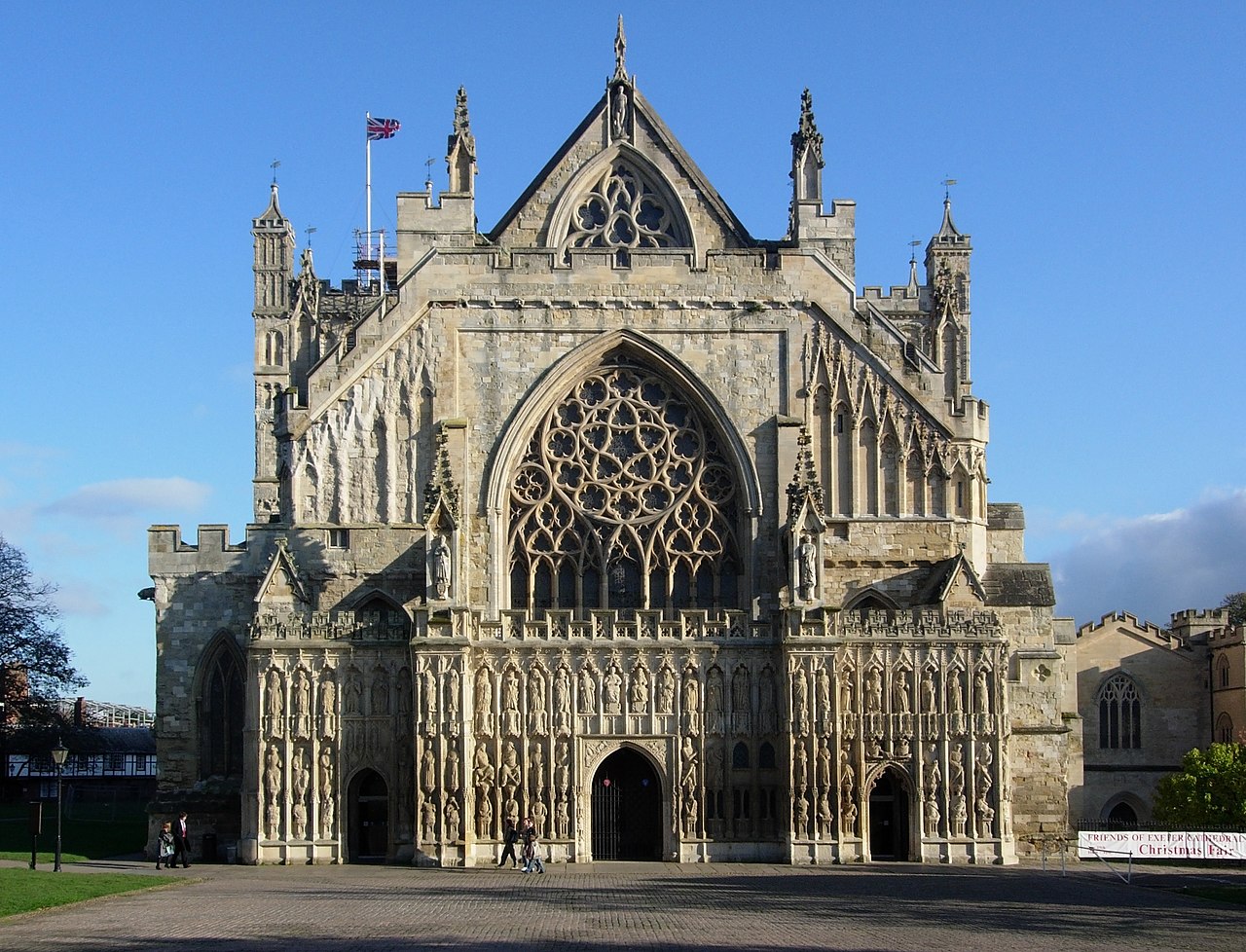


Architecture and principal features
The cathedral is predominantly Gothic in character, with an extended nave, aisles and a choir arranged on the conventional cruciform plan. One of its most distinctive engineering achievements is the uninterrupted vaulted ceiling that runs the length of the nave and choir; this continuous stone rib-vault is among the longest such ceilings in England. Visitors can also notice richly carved bosses, medieval misericords and intricately worked choir stalls that demonstrate the skill of late medieval carvers. The west front and towers present a landmark profile within the urban fabric of Exeter, while the crypt and earlier masonry preserve traces of the cathedral's Norman past.
History and development
The origins of the cathedral community go back to the 11th century when the episcopal seat was established in the town now called Exeter, part of the wider Diocese in England. A Norman cathedral occupied the site before a campaign of rebuilding in the later Middle Ages replaced much of the earlier fabric with the current Gothic structure. Like many ancient churches, the fabric has been maintained and restored at various times since the medieval period so that original features survive alongside later repair work and Victorian-era conservation.
Library, art and artifacts
The cathedral's archival collections and library are notable. Among the most important items associated with the cathedral is the "Exeter Book", a major collection of Old English poetry and riddles dating from the Anglo-Saxon period; it is one of the key manuscripts for the study of early English literature. The church also houses historic liturgical objects, carved woodwork and examples of medieval and post-medieval stonework that attract scholars as well as visitors.
Function, community role and visiting
As the diocesan seat the cathedral continues to be a focus for regular worship, diocesan services and civic occasions. It supports a choral tradition, educational activities, concerts and community events, and is an important destination for cultural tourism in the southwest of England. Conservation and interpretation work help to make the building accessible to the public while protecting its historic fabric.
Notable facts
- Vaulting: the cathedral is famous for a long, largely uninterrupted medieval stone vault that extends the length of the nave and choir.
- Manuscripts: the cathedral library contains one of the most important surviving Anglo-Saxon manuscripts, the Exeter Book, central to the study of Old English poetry.
- Medieval furnishings: misericords, carved bosses and choir stalls are important examples of late medieval carving.
- Civic role: it remains the seat of the Bishop of Exeter and a center for diocesan worship and local events.
For practical visitor information, music and service times, or to learn more about conservation and research projects connected with this historic church, consult the cathedral's official resources and local heritage material for the region of southwest England and England.
Questions and answers
Q: Where is Exeter Cathedral located?
A: Exeter Cathedral is located in the city of Exeter, Devon, in the southwest of England.
Q: Who is the seat of Exeter Cathedral?
A: The seat of Exeter Cathedral is the Bishop of Exeter.
Q: When was the present building completed?
A: The present building was completed by about 1400.
Q: What does it have that makes it notable?
A: It has the longest uninterrupted vaulted ceiling in England and other notable features.
Q: What style is Exeter Cathedral built in?
A: Exeter Cathedral is built in Gothic style.
Related articles
Author
AlegsaOnline.com Exeter Cathedral (Cathedral Church of Saint Peter, Exeter) Leandro Alegsa
URL: https://en.alegsaonline.com/art/32916