
Executive Order 13769 — Protecting the Nation from Foreign Terrorist Entry (2017)
A 2017 U.S. presidential executive order that restricted entry from several countries and paused parts of refugee admissions; it produced immediate enforcement actions, mass protests and extensive litigation.
Overview
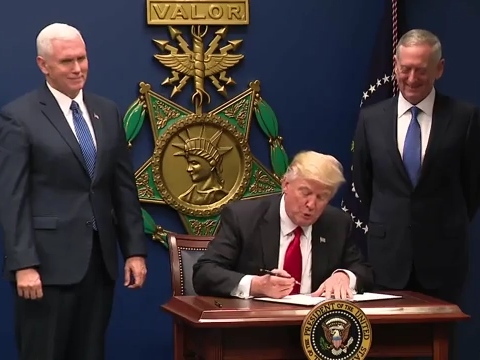
Executive Order 13769, titled "Protecting the Nation from Foreign Terrorist Entry into the United States," was signed by the President of the United States on January 27, 2017. The order directed a temporary pause in parts of the U.S. refugee admissions program and placed global restrictions on entry by nationals of certain countries, which the administration framed as measures to improve travel screening and national security. The Department of Homeland Security and other federal agencies were assigned roles in implementing and clarifying the order's provisions, and subsequent agency guidance influenced how the policy operated in practice (DHS).
Image gallery
6 Images


Key provisions
The executive order set several immediate, time-limited measures: a 120-day suspension of the U.S. Refugee Admissions Program (USRAP) pending a review of screening procedures; a cap of 50,000 refugee admissions for the fiscal year pending a determination that lifting the pause would be in the national interest; and an entry restriction covering nationals of specified countries that the order identified for additional vetting. The text specifically imposed indefinite restrictions on refugees from Syria and named other countries of concern, which were later identified in agency guidance as Iran, Iraq, Libya, Somalia, Sudan, and Yemen.
Implementation guidance issued after the order addressed the status of lawful permanent residents and travelers with multiple nationalities. The Department of Homeland Security and other agencies clarified that many holders of permanent resident cards (often called green card holders) would be treated differently from nonimmigrant visitors, while indicating that travelers must generally present valid travel documents such as a passport (passport) from an eligible country to be admitted.
Immediate effects and public response
The order produced significant operational disruption in the days after it was signed. Reports from major international airports described travelers detained for hours, families separated from arriving relatives, and some visas revoked or placed on hold. Media and government summaries estimated that a substantial number of visa decisions and refugee cases were affected, and that up to tens of thousands of travel authorizations or related processes were disrupted (visas, refugee cases).
Public reaction was widespread and immediate. Protests and vigils were held at airports and in cities across the country, with volunteers and legal aid groups mobilizing to assist travelers. Numerous public institutions, including universities and employers, issued statements expressing concern about the order's impacts on students, faculty, employees and business travel.
Legal challenges and litigation
The order became the subject of multiple lawsuits filed by states, civil-rights organizations and affected individuals. A prominent challenge, State of Washington v. Trump, led a federal judge to issue a temporary restraining order (TRO) that suspended major parts of the order's enforcement while courts considered the legal claims. Litigation raised questions about statutory authority, the scope of presidential power over immigration, due process, and equal protection under the Constitution. Courts at multiple levels reviewed the order and related presidential actions; some rulings narrowed or stayed enforcement, and appellate courts considered many of the constitutional and statutory issues raised by the challengers.
Revisions and later developments
Following the initial litigation and public controversy, the administration issued revised orders and presidential proclamations that modified the list of countries and the structure of restrictions. These subsequent actions were also challenged in court and reviewed by appellate courts. The dispute over the legal and constitutional validity of travel restrictions drew sustained attention and was resolved in stages through a combination of district court rulings, appellate review, and later decisions by higher courts. Government agencies such as DHS continued to issue guidance to clarify implementation for travelers, refugees and admission officials.
Reactions, debate and legacy
The order prompted strong reaction across the political spectrum and from many civil society actors. Elected officials from both parties voiced concerns or support: some Democrats criticized the order on civil liberties and humanitarian grounds, while some Republicans questioned aspects of its legality or implementation. Leaders in faith communities, including Catholic bishops and other religious organizations, criticized the humanitarian impact. Business leaders, universities and advocacy groups also weighed in, citing effects on students, employees and global operations.
Beyond the immediate enforcement and litigation, the order catalyzed debate over the proper balance between national security and immigration policy, the limits of executive authority in immigration matters, and procedures for vetting refugees and visa applicants. For further details, readers may consult the original order text, government guidance from DHS, and summaries of major court decisions such as significant cases and issued orders. Additional practical information about affected travel categories and refugee processing is available through official resources on travel and immigration policy, and through reporting on the impacts to visas and refugee admissions.
Key terms and topics related to this episode include the executive order itself (text), the named countries such as Iran, Iraq, Libya, Somalia, Sudan, Syria and Yemen, how dual nationals and passport requirements were handled, and the sequence of litigation represented by cases such as State of Washington v. Trump and the resulting TRO. Reactions from political groups and institutions varied across Democratic and Republican leaders and from religious communities including Catholic authorities.
Questions and answers
Q: What is Executive Order 13769?
A: Executive Order 13769, also called Protecting the Nation from Foreign Terrorist Entry into the United States, is an executive order signed by United States President Donald Trump on January 27, 2017. It limits travel to the United States from some countries and by all refugees.
Q: How many refugees were allowed into the U.S in fiscal year 2017?
A: The order said that no more than 50,000 refugees could be let into the United States in fiscal year 2017 until it was deemed to be in the national interest by President Trump.
Q: What countries are listed under Immigration and Nationality Act?
A: The United States Department of Homeland Security lists these countries as Iran, Iraq, Libya, Somalia, Sudan, Syria and Yemen.
Q: How long did USRAP stop for?
A: USRAP stopped for 120 days (about four months). After that 120 days, the program would start again for individual countries.
Q: When was a temporary restraining order issued against Executive Order 13769?
A: A temporary restraining order (TRO) was issued on February 3rd ,2017 which stopped much of the executive order.
Q: How many visas were taken away due to this executive order?
A: Up to 60,000 visas were taken away due to this executive order.
Q: What type of reactions did this executive order receive ?
A: This executive order received criticism from Democratic and Republican members of U.S Congress , Catholic bishops , business leaders and universities .
Related articles
Author
AlegsaOnline.com Executive Order 13769 — Protecting the Nation from Foreign Terrorist Entry (2017) Leandro Alegsa
URL: https://en.alegsaonline.com/art/32906
Sources
- federalregister.gov : "Protecting the Nation from Foreign Terrorist Entry into the United States"