
Evangelical Church in Germany (Evangelische Kirche in Deutschland, EKD)
A federation of 20 regional Protestant churches in Germany—Lutheran, Reformed and United—coordinating worship, social work and ecumenical relations while each member church retains its own identity.
Overview
The Evangelical Church in Germany (German: Evangelische Kirche in Deutschland, abbreviated EKD) is a national federation that brings together regional Protestant churches across Germany. It serves as a common public voice, a platform for cooperation and a facilitator of shared programs in theology, education and social outreach. The EKD does not operate as a single denomination with one uniform doctrine; rather, it is a union of churches that preserve their own traditions, liturgies and legal identities.
Image gallery
7 Images



Composition and governance
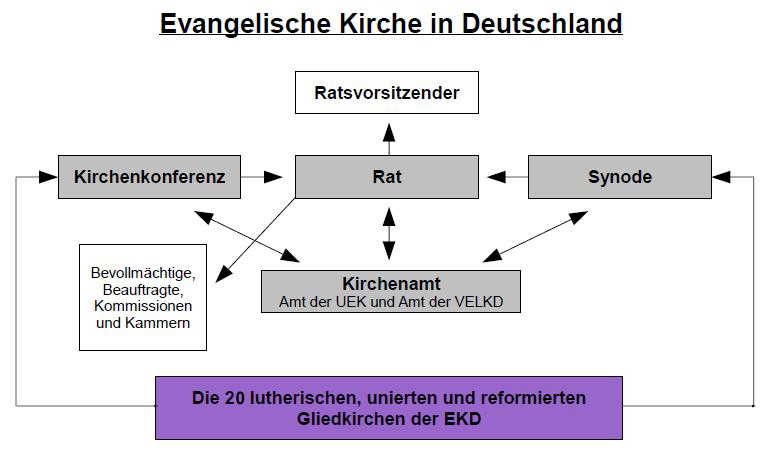
The EKD consists of 20 regional member churches. Those member churches represent three main confessional traditions: Lutheran, Reformed (Calvinist), and United (churches that combine Lutheran and Reformed heritage). The composition can be summarized as:
- 9 Lutheran regional churches
- 2 Reformed (Calvinist) regional churches (Reformed)
- 9 United regional churches (Lutheran–Reformed unions)
In addition to full members, several smaller bodies participate in EKD work in associate status, including the Moravian Church and the Federation of Evangelical Reformed Congregations. Governance in the EKD combines conciliar and synodal elements: member churches elect their own synods and leadership and send delegates to the EKD council and synod, while a presiding bishop or chair acts as a public representative of the federation.
Historical background
The EKD has its roots in the Protestant Reformation of the 16th century and in the regional church structures that developed in the German lands over subsequent centuries. After the upheavals of the 20th century, the modern EKD was formed to coordinate Protestant witness and service across the whole of Germany. It grew out of earlier national Protestant bodies and was shaped by efforts to restore church life after World War II. The diversity of Lutheran, Reformed and united traditions within the EKD reflects centuries of theological development and regional practice.
Activities and social role
Member churches of the EKD are active in a wide range of ministries. They conduct regular worship, pastoral care and theological education; run hospitals, retirement homes, schools and social-welfare agencies; and provide chaplaincy in prisons, hospitals and the armed forces. The EKD also engages in ecumenical relations with other Christian communions, public ethical debate, and international development and humanitarian relief. In Germany, churches commonly collect contributions and participate in the state-administered church tax system to support these activities.
Distinctive features and contemporary issues
A defining characteristic of the EKD is its federal structure: member churches retain autonomy over doctrine, ordination and liturgy, so policies on matters such as ordination of women, same-sex partnerships, and liturgical language can vary by region. This contrasts with single, centralized churches such as the Church of England (Church of England) or the Roman Catholic Church, where authority and discipline are more uniformly organized. The EKD functions as a forum for dialogue that seeks common positions while respecting regional diversity.
Significance
As one of Germany's principal Protestant bodies, the EKD plays a major role in public life, cultural memory and social welfare. It represents a broad spectrum of Protestant conviction and practice, and its federative model is an important example of how historically distinct churches can cooperate nationally without dissolving their regional identities.
Questions and answers
Q: What is the Evangelical Church in Germany (EKD)?
A: The Evangelical Church in Germany is a group of 20 regional churches made up of two Reformed (Calvinist), 9 Lutheran and 9 United (Lutheran-Reformed) churches.
Q: What are the associate members of the EKD?
A: The associate members of the EKD are the Moravian Church and the Federation of Evangelical Reformed Congregations.
Q: How does the EKD differ from the Church of England or the Catholic Church?
A: The EKD is not a church like the Church of England or the Roman Catholic Church because it is not one big church which shares the same system of beliefs, instead it is a collection of churches which allow its members to share in church services and worship.
Q: How many regional churches make up the EKD?
A: The EKD is made up of 20 regional churches.
Q: What denominations make up the EKD?
A: The EKD is made up of two Reformed (Calvinist), 9 Lutheran and 9 United (Lutheran-Reformed) churches.
Q: What is the purpose of the EKD?
A: The purpose of the EKD is to allow members of different Protestant denominations in Germany to share in church services and worship.
Q: Which churches are associate members of the EKD?
A: The associate members of the EKD are the Moravian Church and the Federation of Evangelical Reformed Congregations.
Related articles
Author
AlegsaOnline.com Evangelical Church in Germany (Evangelische Kirche in Deutschland, EKD) Leandro Alegsa
URL: https://en.alegsaonline.com/art/32713