
European Union member state
Overview of what defines an EU member state: rights and obligations, accession criteria and procedures, history of enlargement, and distinctions such as the Eurozone and Schengen areas.
A European Union member state is a sovereign country that has joined the European Union (EU) and accepted the obligations and benefits of membership. Membership means participation in the EU's legal order, institutions and policies, and—depending on declarations and treaties—access to the single market, the customs union, and common regulatory frameworks. The current union comprises twenty-seven countries; for a full list see the member states reference.
Image gallery
4 Images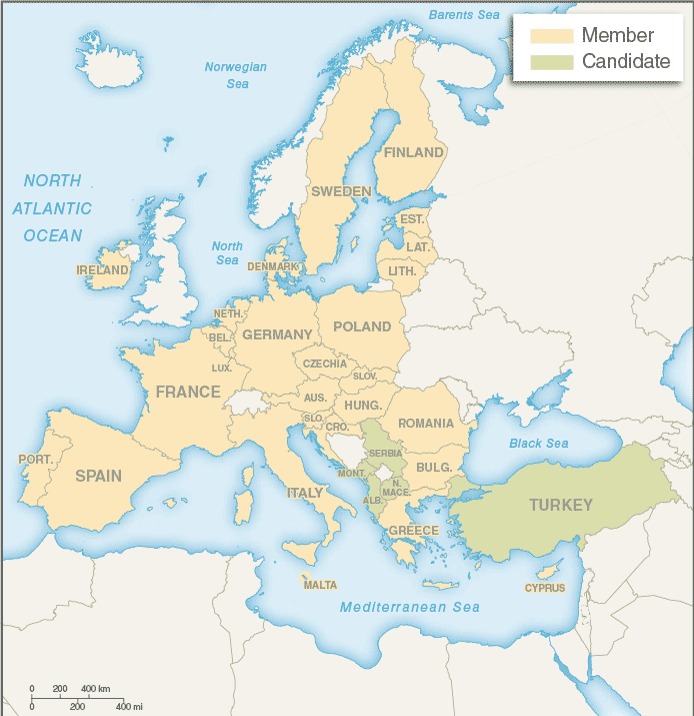


Core characteristics and rights
Being an EU member state typically involves sharing or harmonising many national policies with those set at the European level. Common features include: the right of citizens to move, work and live freely across member states; participation in EU decision-making through representation in the Council and the European Parliament; and access to EU programmes for research, regional development and agriculture. Monetary arrangements vary: some members use the euro and participate in the Eurozone, while others keep national currencies. Likewise, border-controls differ because Schengen participation is distinct from EU membership.
Accession requirements and process
Prospective members must satisfy a set of political and economic conditions commonly known as the Copenhagen criteria: stable democratic institutions, protection of human rights and minorities, a functioning market economy, and the ability and willingness to adopt the EU acquis—the body of rights and obligations that bind members. Formal accession requires negotiation and alignment with existing EU rules, agreement by all existing member state governments, and ratification by the European Parliament (EP) and national procedures. The institutional foundation for enlargement traces back to the original European Economic Community (EEC), and continues under the Treaties that govern the modern union.
History of enlargement
The EU began with six founding members and has expanded through a number of accession rounds. Enlargement rounds in the 1970s, 1980s and 1990s brought in countries from northern, southern and central Europe. A major enlargement on 1 May 2004 added ten states from central and eastern Europe. Subsequent accessions included Bulgaria and Romania in 2007; later, Croatia joined in 2013. Accession treaties are often signed and ratified in formal ceremonies and must be enacted according to each party's constitutional requirements—for example, some enlargement instruments were finalised in venues such as Luxembourg where negotiations and signings have historic precedents.
Uses, importance and examples
Membership has significant economic, political and social consequences. Economically, access to the single market lowers trade barriers and encourages cross-border investment. Politically, members share sovereignty in specified policy areas to pursue collective goals such as environmental standards, consumer protection or competition policy. Citizens benefit from programmes in education, health and research, and from simpler cross-border travel and residence. At the same time, national governments carry responsibilities to implement EU law and contribute to common budgets and policies.
Distinctions and notable facts
- EU membership vs. Eurozone: Not all EU members use the euro; adopting the single currency involves meeting additional criteria and political decisions.
- Schengen area: Some EU members participate in passport-free travel, while others maintain border controls; Schengen is separate from formal EU membership.
- Decision rules for enlargement: Enlargement requires unanimity among member states and the consent of EU institutions; the European Parliament and national ratifications play essential roles.
- Reversibility: Treaties allow a member to withdraw from the union; the United Kingdom is a recent example of a country that left the EU after joining in the 1970s.
Beyond the formal mechanics of joining, membership remains a dynamic political choice for states balancing national sovereignty with collective benefits. Several countries in Europe continue to pursue or consider accession, and debates about the scope of integration, enlargement and institutional reform are a recurring feature of the EU's public and diplomatic life.
For further introductory material and authoritative references consult official summaries and country profiles provided by EU institutions and accession reporting bodies: see the member state overview (list of member states) and fundamental EU resources (European Union, EEC historical framework, European Parliament). For information on recent accessions and treaty signings, including the enlargements that included Bulgaria, Romania and Croatia, consult the accession archives and official communiqués often preserved in venues associated with the treaties (for example, documents held in Luxembourg).
Questions and answers
Q: What is a European Union member state?
A: A European Union member state is any one of the twenty-seven countries that have joined the European Union (EU) since it was found in 1958 as the European Economic Community (EEC).
Q: How many countries were originally part of the EU?
A: The original membership of the EU was six states.
Q: When did Bulgaria and Romania join the EU?
A: Bulgaria and Romania joined the EU on 1 January 2007.
Q: When did the UK join the EEC?
A: The UK joined the European Economic Community on 1 January 1973.
Q: What percentage of voters chose to leave the EU in 2016?
A: In 2016, 51.9% of voters chose to leave the EU.
Q: When did Britain officially withdraw from the EU?
A: Britain formally withdrew from the EU on 31 January 2020.
Q: What are known as 'The Copenhagen Criteria'?
A: The Copenhagen criteria are economic and political conditions that must be fulfilled by a candidate member state before being allowed to join the European Union; these basically require that a candidate member state must enjoy a secular, democratic system of government, together with corresponding freedoms and institutions, and respect for rule of law.
Related articles
Author
AlegsaOnline.com European Union member state Leandro Alegsa
URL: https://en.alegsaonline.com/art/32631