
Euglena: biology, ecology, and uses of the flagellate protist
Euglena are single-celled, flagellated protists that combine plant-like photosynthesis and animal-like mobility. This article covers their form, life cycle, ecology, origin, and uses in research and biotechnology.
Overview
Euglena is a diverse genus of single-celled eukaryotes notable for having both photosynthetic and motile traits. Members of this group are usually found in freshwater and brackish habitats, where they swim using one or more whip-like flagella. They are commonly described in works on genus classification and broader treatments of protists. More than a thousand species have been named, and taxonomic relationships remain an active area of study.
Image gallery
8 Images




Anatomy and behavior
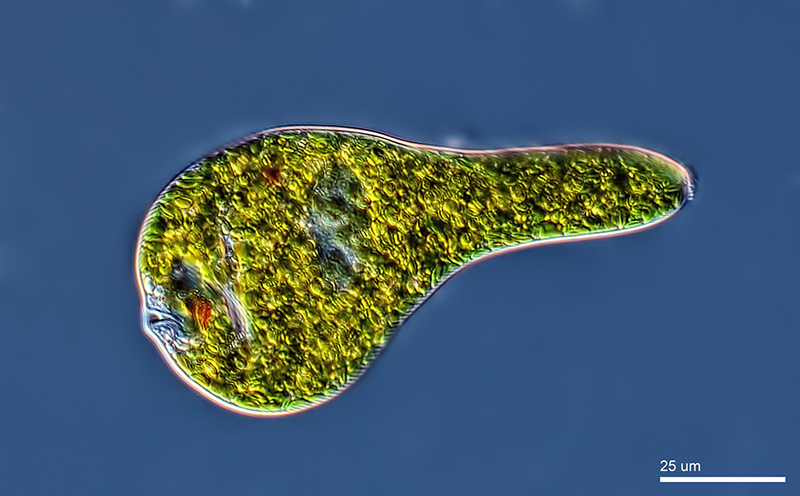
Euglena cells typically have an anterior flagellum that provides propulsion; this structure is discussed in many sources about the flagellum. The cell surface is often flexible due to a protein-rich pellicle, enabling shape changes not seen in many algae. Most species possess chloroplasts for light-driven carbon fixation, a characteristic of chloroplasts commonly associated with algae and plants. Many also carry a red eyespot (stigma) that helps them detect light direction.
Nutrition and origin
Euglena are frequently mixotrophic: they photosynthesize when light and nutrients are available but can ingest or absorb organic matter under other conditions. Their chloroplasts are believed to derive from a green algal ancestor by secondary endosymbiosis, a process in which an ancestral host cell incorporated a green alga and retained its plastids. This evolutionary history explains many molecular and structural features found in modern euglenids.
Reproduction, taxonomy, and life cycle
Reproduction in Euglena is mainly asexual, by longitudinal binary fission. Sexual stages have not been clearly demonstrated across the group. Classification relies on morphology, chloroplast structure, and increasingly on DNA sequence data; as a result, species boundaries and higher-level relationships continue to be revised by researchers.
Ecology, importance, and uses
Ecologically, Euglena can form blooms in nutrient-rich waters and contribute to primary production. They are used as model organisms in cell biology, photosynthesis research, and studies of light perception. Applied research explores their potential in wastewater treatment, bioindicator monitoring, and as a source of biomass for biotechnology. Their flexible metabolism and simple culture requirements make them convenient for laboratory and pilot-scale work.
Key characteristics (summary)
- Flagellated, motile single cells with a pellicle
- Often contain chloroplasts and can perform photosynthesis
- Mixotrophic nutrition and adaptable metabolism
- Predominantly reproduce by binary fission
- Origin linked to secondary endosymbiosis with green algae
For introductory and taxonomic resources, see the general genus entry and overviews of protists: genus page, protist references. For structures and organelles: flagellum, chloroplasts, and discussions of algal relationships: algae and plants, green algae, and secondary endosymbiosis.
Questions and answers
Q: What kind of organism is Euglena?
A: Euglena is a unicellular protist.
Q: Does Euglena have both plant and animal characteristics?
A: Yes, Euglena has both plant and animal characteristics.
Q: How do Euglena move?
A: Euglena move by means of a flagellum.
Q: What is chloroplast?
A: Chloroplast is a cell organelle that is characteristic of algae and plants.
Q: Do most Euglena have chloroplasts?
A: Yes, most Euglena have chloroplasts.
Q: How is Euglenids believed to descend?
A: Euglenids are believed to descend from an ancestor that took up green algae by secondary endosymbiosis.
Q: How many species of Euglena have been described so far?
A: Over 1,000 species of Euglena have been described so far.
Related articles
Author
AlegsaOnline.com Euglena: biology, ecology, and uses of the flagellate protist Leandro Alegsa
URL: https://en.alegsaonline.com/art/32504
Sources
- doi.org : 10.1111/j.1550-7408.2008.00371.x
- pubmed.ncbi.nlm.nih.gov : 19335769
- onlinelibrary.wiley.com : onlinelibrary.wiley.com/doi/abs/10.1111/j.0022-3646.1997.00512.x
- euglena.jp : euglena.jp
- blogs.wsj.com : "Is the Future of Food in Tokyo?"