
Eugène Boudin: Pioneer of Plein Air Seascapes
French painter Eugène Boudin (1824–1898) is remembered for his outdoor studies of skies, beaches and harbors, his influence on early Impressionists, and his role in developing modern landscape painting.
Overview
Eugène Boudin (12 July 1824 – 8 August 1898) was a French artist best known for his landscapes and seascapes. He is widely regarded as an early practitioner of painting outdoors — often called en plein air — and for his sensitive depictions of sky, light, and coastal life. Boudin's work helped open new directions for the generation of painters who became known as the Impressionists.
Image gallery
10 Images
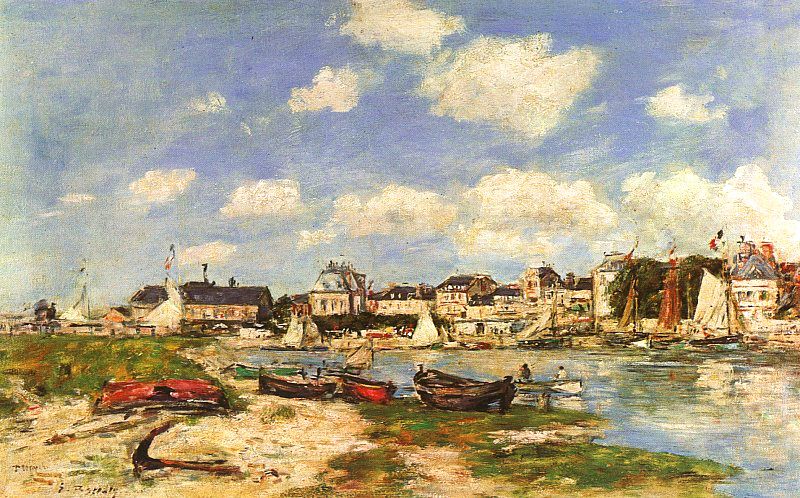


Style and subjects
Boudin specialized in maritime scenes: beaches, promenades, fishing boats and ports. He favored quick oil sketches made from life to capture changing atmospheres and cloud formations. His brushwork could be brisk and economical, aiming to record the transient effects of light rather than finish every detail. These studies informed larger studio pieces, but many of his small canvases are admired for their spontaneity and freshness.
Typical subjects include the sands and promenades of Normandy, crowded fashionable beaches, and the working harbors of the French coast. Through careful observation of reflections, wind-driven water, and the movement of figures, Boudin created compositions that balanced human activity with the broader moods of weather and sea.
Career and influence
Born in the port town of Honfleur in France, Boudin spent part of his youth in Le Havre, where his family ran a shop that brought him into contact with visiting artists and paintings. He learned from these encounters and later traveled and exhibited his work in Paris and elsewhere. He is often cited as one of the first landscape painters to move away from working exclusively in a studio to painting directly outdoors rather than producing finished works only from memory or sketches in the studio studio.
In 1856 he met Claude Monet, then a young artist, and encouraged him to paint outdoors. Monet and other young painters acknowledged Boudin's role in developing their approach to light and color; the group that came to be associated with the Impressionist movement regarded him as an important precursor Impressionists. One contemporary master of landscape praised Boudin for his skies, reflecting how his work concentrated on atmospheric effects rather than purely narrative content.
Legacy and recognition
- Boudin's paintings are valued for their directness and atmospheric precision; they form a bridge between academic marine painting and later Impressionist experiments.
- His belief in sketching outdoors influenced techniques that became central to modern landscape painting, particularly attention to momentary light and weather.
- The artist's name is commemorated through awards and exhibitions, and his works are held in museums and public collections that study the development of 19th‑century French art landscapes.
Although often remembered foremost for coastal scenes, Boudin's output also includes quieter inland views and studies that demonstrate the same concern for atmosphere. His reputation rests on both his accomplished paintings and on his quieter, formative influence on younger painters, helping to shift the priorities of French art toward direct observation and the depiction of modern life.
For further reading on his life, technique and exhibitions see specialist catalogues and museum entries that survey 19th‑century landscape painting and the networks of artists working along the French coast.
France | Le Havre | Claude Monet | studio | landscapes | Impressionists | Honfleur
Questions and answers
Q: Who was Eugène Boudin?
A: Eugène Boudin was a French painter who specialized in landscapes and seascapes.
Q: What was Boudin known for?
A: Boudin was known for being one of the first landscape painters to paint outdoors, rather than in a studio.
Q: Where was Boudin born?
A: Boudin was born in Honfleur, France.
Q: What did Boudin do as a young man?
A: As a young man, Boudin worked with his father in a small shop in Le Havre, selling stationery and making picture frames.
Q: Who did Boudin meet in Paris?
A: In Paris, Boudin met Claude Monet, who spent several months working with him in his studio.
Q: How did Boudin influence Monet?
A: Monet later said that Boudin had been a major influence on him, teaching him to paint outdoors.
Q: What is the Eugene Boudin Prize?
A: The Eugene Boudin Prize is an award given by the Société Nationale des Beaux-Arts of France.
Related articles
Author
AlegsaOnline.com Eugène Boudin: Pioneer of Plein Air Seascapes Leandro Alegsa
URL: https://en.alegsaonline.com/art/32479