
Amargasaurus — small crested sauropod of the Early Cretaceous
Amargasaurus, a relatively small dicraeosaurid sauropod from Early Cretaceous Argentina, is notable for paired elongated neural spines along its neck and back and well-preserved fossils from La Amarga.
Overview
Amargasaurus was a distinctive member of the long-necked sauropod dinosaurs. It lived in what is now Argentina during the Early Cretaceous, and its remains were recovered from deposits near the La Amarga area in Neuquén Province. Smaller than many of its relatives, Amargasaurus is known from relatively complete material that preserves the skull, much of the vertebral column, and limb bones, allowing detailed study of its unusual anatomy.
Image gallery
10 Images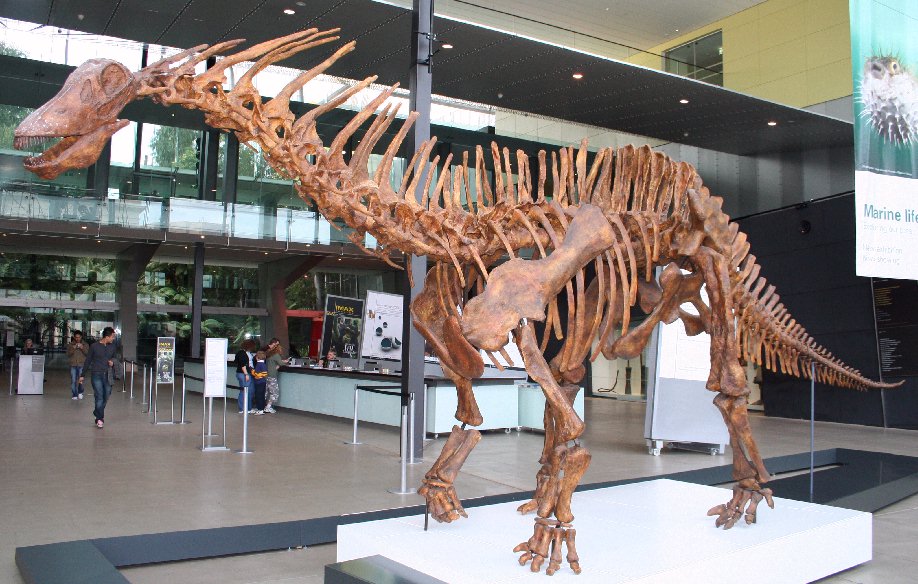


Discovery and naming
Fossils of Amargasaurus were discovered in sediments that preserve floodplain and channel deposits. The genus name refers to the La Amarga locality where the best-known specimens were found. The animal was described and named from these Argentine remains in the early 1990s, and the quality of preservation has made it an important taxon for understanding dicraeosaurid anatomy.
Physical characteristics
Amargasaurus measured roughly ten meters in length, modest for a sauropod. It was a quadrupedal herbivore with a long neck and relatively short tail compared with some diplodocoids. The skull was low and elongated, typical of dicraeosaurids, and the limbs indicate a sturdy, ground-level browsing posture.
Neural spines and their function
The most striking feature is a double row of tall, paired neural spines running along the neck and anterior back. These paired elongate spines produced a comb- or sail-like profile and have prompted several hypotheses: display for species recognition or sexual selection, passive thermoregulation, or support for a fleshy crest or fatty hump. Evidence remains equivocal and different spines along the column may have had different roles.
Relationships
Amargasaurus belongs to the family Dicraeosauridae within the diplodocoid clade and shows affinities with genera such as Dicraeosaurus. Dicraeosaurids are generally smaller and possess shorter necks than some other diplodocoids, a pattern reflected in Amargasaurus.
Paleoecology and significance
The La Amarga environment likely supported conifers, cycads and ferns that provided fodder for herbivores. As a relatively short-necked sauropod, Amargasaurus may have browsed at lower heights than high-browsing relatives, occupying a distinct ecological niche. Its unusual spinal anatomy makes it a key taxon for studies of sauropod diversity, biomechanics and display.
Quick facts
- Taxonomic group: sauropod (Dicraeosauridae).
- Geological age: Early Cretaceous.
- Discovery site: La Amarga, Neuquén Province, Argentina.
- Diet: quadrupedal herbivore, likely low- to mid-level browser.
- Distinctive trait: paired elongate neural spines along neck and back, likely important for display or soft-tissue structures.
Amargasaurus continues to be studied to clarify the evolution of dicraeosaurids and the functional implications of extreme vertebral modifications in sauropods.
Questions and answers
Q: What is Amargasaurus?
A: Amargasaurus is a sauropod dinosaur.
Q: During which period did Amargasaurus live?
A: Amargasaurus lived during the early Cretaceous period.
Q: How long was Amargasaurus?
A: Amargasaurus was 10 meters (33 feet) long.
Q: Was Amargasaurus a large dinosaur?
A: No, Amargasaurus was relatively small for a sauropod dinosaur.
Q: What was Amargasaurus' diet?
A: Amargasaurus was a herbivore.
Q: Where was Amargasaurus found?
A: Amargasaurus was found in La Amarga, a canyon in Neuquén Province, Argentina.
Q: How was Amargasaurus' skull and neck like?
A: Amargasaurus had a long, low skull on the end of a long neck, similar to its relative Dicraeosaurus.
Related articles
Author
AlegsaOnline.com Amargasaurus — small crested sauropod of the Early Cretaceous Leandro Alegsa
URL: https://en.alegsaonline.com/art/3227