
Kingdom of the East Saxons (Essex)
An overview of the Anglo-Saxon Kingdom of Essex: territory, rulers, society, conversion to Christianity, relations with neighbouring powers, and its legacy in later England.
Overview
The Kingdom of the East Saxons, commonly called Essex (Old English: Ēast Seaxna Rīce), was an Anglo-Saxon polity established in the early medieval period. It formed part of the group of early English kingdoms traditionally called the Heptarchy. The kingdom arose in the period following the end of Roman rule in Britain and is usually dated to the 6th century, when Saxon groups settled in the east of what is now England.
Image gallery
4 Images


Territory and centres
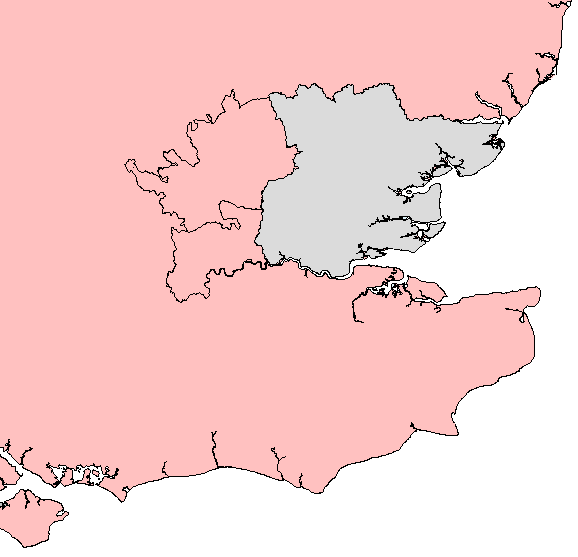
At its greatest extent Essex covered much of the modern counties now known as Essex, Hertfordshire and Middlesex, and at times exercised influence as far as parts of Kent. The kingdom included important Roman towns and their infrastructure: the former Roman provincial centre of Colchester (Camulodunum) and, for periods, the city of London played central roles in administration, commerce and communications. The legacy of Roman roads and towns shaped settlement and economic life for centuries.
Political development and rulers
Essex never sustained the continuous independence of some larger neighbours. Its kings often operated under the overlordship of stronger Anglo-Saxon powers, moving between semi-independence and subordination to kingdoms such as Mercia and Wessex. Christianisation reached the East Saxons in the early 7th century: a prominent early ruler, usually named Sæberht in later sources, accepted baptism and the kingdom saw the establishment of bishops and churches, though pagan reaction and political change complicated the process. Over the following centuries local dynasties, alliances and external domination altered the kingdom's autonomy until it was gradually integrated into the emerging kingdom of England.
Society, economy and assessment
The economy combined mixed agriculture, animal husbandry and trade, exploiting Roman urban sites and river access to the Thames estuary. Continental contacts and coastal trade remained important. Administrative records and contemporary lists place the East Saxons among the smaller Anglo-Saxon polities: in the medieval assessment called the Tribal Hidage the East Saxons were allotted 7,000 hides, a notional measure of land and resources used for raising tribute or assessing military obligations. Archaeology across former Roman towns shows continuity and adaptation rather than simple replacement.
Legacy and distinctions
Elements of Essex's identity survived into later medieval and modern times. County boundaries, place-names, and church foundations reflect the kingdom's territorial imprint. Historians stress that the neat picture of seven equal kingdoms is a later simplification: the reality was fluid, with shifting borders, overlapping authorities and frequent changes of dominance. For those seeking primary sources or further summaries, modern summaries and reference entries offer accessible introductions and detailed bibliographies on governance, conversion and material culture. See general surveys of the Essex region, county histories such as those for Hertfordshire and Middlesex, and specialised studies of early medieval Roman-to-Saxon transitions.
Notable facts
- The East Saxons are recorded in early administrative lists and tribute assessments.
- Key urban centres included Colchester and, at times, London, reflecting the reuse of Roman infrastructure.
- Conversion to Christianity occurred in the early 7th century but experienced setbacks and political entanglement.
- Later medieval county structures preserved much of the kingdom's geographic identity.
For overviews, primary sources and archaeological summaries consult introductory resources and regional studies: general treatments of the Heptarchy, archaeological syntheses of the Roman legacy, county surveys for Essex, and focused essays on conversion and kingship. Further reading and digitised documents can be found via library guides and specialist projects that collect the early medieval evidence and historical commentaries (chronological summaries, administrative lists, and regional archaeology portals).
Because much of the early record is fragmentary, reconstructions of Essex's institutions and chronology are provisional and often debated; careful use of archaeological data combined with contemporary documentary evidence yields the most reliable picture of this influential, if frequently overshadowed, Anglo-Saxon kingdom.
Questions and answers
Q: What was the Kingdom of the East Saxons also known as?
A: The Kingdom of the East Saxons was also known as the Kingdom of Essex.
Q: When was the Kingdom of Essex founded?
A: The Kingdom of Essex was founded in the 6th century.
Q: What modern English counties did the kingdom of Essex cover?
A: The kingdom of Essex covered the area of the modern English counties of Essex, Hertfordshire, Middlesex and (for a short while) Kent.
Q: Did the Kings of Essex sometimes fall under the control of other Anglo-Saxon overlords?
A: Yes, Kings of Essex frequently found themselves under the control of other Anglo-Saxon overlords.
Q: What cities were included in the territory of the East Saxons?
A: The territory of the East Saxons included the two Roman provincial capitals of Colchester and, for a time, London.
Q: How many hides were the East Saxons listed at in the Tribal Hidage?
A: In the Tribal Hidage, the East Saxons were listed at 7,000 hides.
Q: What was the Heptarchy?
A: The Heptarchy was a collective name for the seven kingdoms of Anglo-Saxon England.
Related articles
Author
AlegsaOnline.com Kingdom of the East Saxons (Essex) Leandro Alegsa
URL: https://en.alegsaonline.com/art/32250