
Esociformes: pikes, mudminnows and their freshwater relatives
Esociformes are a small order of freshwater ray-finned fishes including pikes (Esox) and mudminnows (Umbridae), found across northern continents; notable as ambush predators with distinctive body shapes and life histories.
Overview
Esociformes are a compact order of ray-finned fishes often recognized by anglers and ichthyologists for their distinctive, predatory members. The order is discussed in taxonomic sources as an order within Actinopterygii, or ray-finned fishes. Living representatives fall into two principal families: the mudminnows (Umbridae) and the pike family (Esocidae), the latter anchored by the familiar genus Esox.
Image gallery
5 Images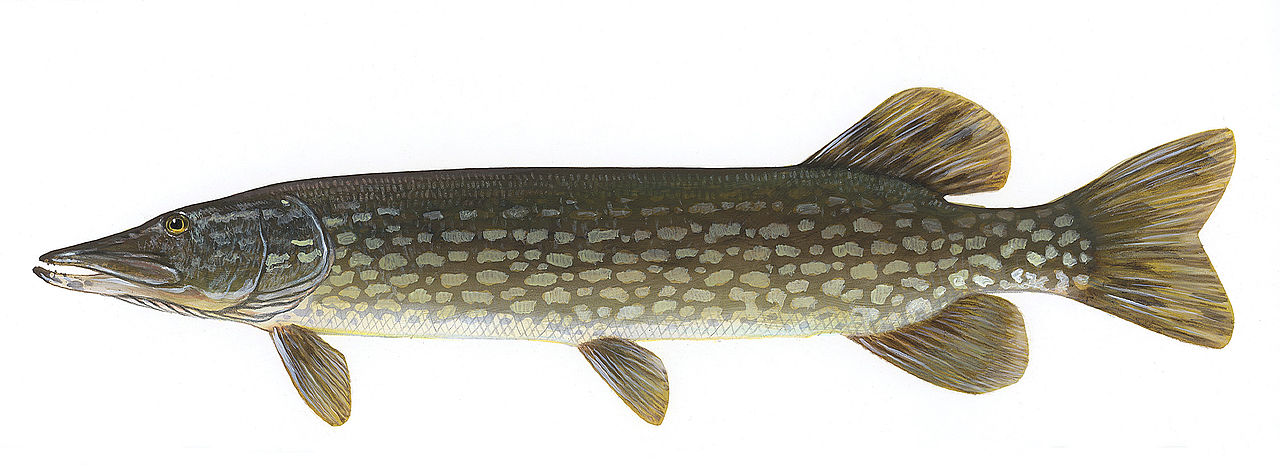


Characteristics
Members of Esociformes share several visible traits that suit an ambush lifestyle. They typically have elongated, torpedo-shaped bodies, flattened heads, and many sharp teeth for seizing prey. Fins—especially dorsal and anal fins—are located toward the rear, improving sudden bursts of speed. While individual species vary in size from small mudminnows to large pikes, the overall bauplan emphasizes stealth and rapid lunges rather than prolonged pursuit.
Families, genera and notable species
The two extant families differ markedly in appearance and ecology. Umbridae includes small, often secretive fishes referred to as mudminnows; they tolerate a range of freshwater conditions and are adapted to vegetated, slow waters. Esocidae contains the pikes and their close relatives, the best-known being the northern pike (Esox lucius), a widespread and ecologically important predator. Paleontological work has also identified extinct lineages such as the Palaeoscidae that illuminate the group's past diversity.
Distribution and habitat
Esociform fishes inhabit freshwater systems across much of the temperate Northern Hemisphere. Their range includes large parts of North America and northern Eurasia, where they occupy lakes, rivers, marshes and vegetated shallows. Habitat preferences vary by species: some prefer clear, open water while others occupy low-oxygen or tannin-stained waters and dense aquatic vegetation.
Evolutionary context and relationships
Fossil and comparative anatomical studies place Esociformes as a distinct lineage within the ray-finned fishes with affinities sometimes compared to the Salmonidae group; casual comparisons are drawn in literature noting shared primitive features with salmonids, while important anatomical and ecological differences remain. Fossils show that relatives of modern pikes and mudminnows were more widespread in previous geological periods.
Importance and human interactions
Pike species are important both ecologically—as apex or mesopredators that structure freshwater food webs—and recreationally, sought by anglers for sport. Mudminnows, although less prominent, are of interest in studies of tolerance to environmental stressors and local biodiversity. Management of Esociform populations often involves habitat conservation, angling regulations, and attention to invasive introductions, because their presence can significantly affect aquatic communities.
- Key traits: elongated body, rear-positioned fins, ambush predation.
- Major groups: Umbridae (mudminnows), Esocidae (pikes).
- Range: temperate freshwater systems across North America and northern Eurasia.
Further reading and authoritative species accounts are available through taxonomic databases and regional fish guides (order overview, genus pages), which provide updates on classification and conservation status.
Questions and answers
Q: What are Esociformes?
A: Esociformes are a small order of ray-finned fish.
Q: How many families do Esociformes have?
A: Esociformes have two families.
Q: What are the names of the families of Esociformes?
A: The names of the families of Esociformes are Umbridae (mudminnows) and Esocidae (pikes).
Q: What is the successful species of Esocidae?
A: The successful species of Esocidae is Esox lucius or northern pike.
Q: Where do Esociform fishes live?
A: Esociform fishes live in freshwater in North America and northern Eurasia.
Q: What is the extinct family of Esociformes called?
A: The extinct family of Esociformes is called Palaeoscidae.
Q: How similar is Esociformes to Salmonidae?
A: Esociformes is very similar to Salmonidae.
Related articles
Author
AlegsaOnline.com Esociformes: pikes, mudminnows and their freshwater relatives Leandro Alegsa
URL: https://en.alegsaonline.com/art/32187
Sources
- helsinki.fi : "Esociformes – pikes, pickerels, mud minnows and blackfishes"
- cabi.org : "Esox lucius (pike)"
- naturalista.mx : "Orden Esociformes-NaturaLista"