
Eryops: a Permian temnospondyl amphibian
Eryops was a large, semi‑aquatic temnospondyl amphibian from the Permian of North America, known for its heavy skull, sturdy limbs and numerous fossils found in red beds and other deposits.
Overview
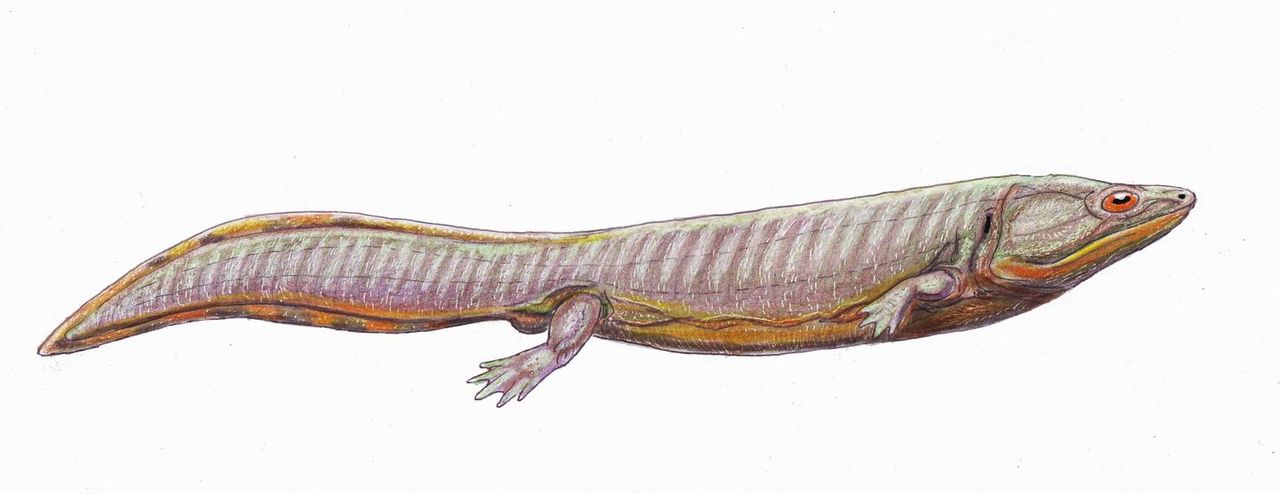
Eryops is an extinct genus of temnospondyl amphibian that lived primarily during the early Permian period. It is best known from North American deposits and is frequently reconstructed as a large, robust predator that spent time both in water and on land. Adults reached roughly 1.5–2.0 m in length and had broad, deep skulls with many conical teeth suited for capturing prey.
Image gallery
9 Images



Key characteristics
The anatomy of Eryops combined primitive amphibian traits with features adapted for life partly on land. Important diagnostic features include:
- Large, flattened skull with strong jaw musculature and numerous teeth for seizing fish and smaller vertebrates.
- Stout, well‑ossified limb bones and a reinforced pectoral girdle to support the body when out of water.
- Relatively short trunk and strong vertebral column that provided support for terrestrial locomotion.
- Robust ribs and dermal ornamentation on skull bones typical of many temnospondyls.
Fossil record and geographic distribution
Most Eryops remains come from Lower Permian red beds of the southwestern United States, especially Texas, but fossils have also been reported from New Mexico and parts of the eastern United States. Skull bones and teeth are the most commonly recovered elements, though several relatively complete skeletons have been found in Permian deposits. Some older rock units have yielded material that suggests the genus or closely related forms may extend into earlier Carboniferous (Pennsylvanian) strata in limited occurrences.
Ecology and behavior
Eryops is interpreted as a semi‑aquatic predator, occupying rivers, floodplains and ponds. Its body plan indicates an animal capable of powerful lung‑based respiration and terrestrial movement, but it likely hunted at the water's edge or in shallow water, ambushing fish and invertebrates and possibly scavenging. Reproductive biology is not preserved directly for Eryops, but as a temnospondyl it was probably tied to aquatic larval stages, similar to modern amphibians in broad outline.
History, classification and scientific importance
Described from Permian strata in North America, Eryops has long been an important taxon for understanding early tetrapod evolution and the transition from aquatic to more terrestrial lifestyles. It is placed among the temnospondyl amphibians, a diverse group of early tetrapods that dominated many freshwater ecosystems in the Paleozoic and early Mesozoic. Studies of Eryops skeletons and limb mechanics have informed interpretations of locomotion and functional anatomy in early land vertebrates.
Notable distinctions and facts
Although not the largest vertebrate of its time, Eryops was one of the largest amphibious animals in its ecosystems and had relatively few predators as an adult. Contemporaneous large synapsid predators, such as Dimetrodon, occupied different ecological niches and sometimes would have been the top carnivores in the same faunal communities. Eryops remains continue to be valuable for reconstructing Permian environments and food webs.
Selected resources
- Taxonomic overview of Eryops
- Introduction to temnospondyls
- Lower Permian age and context
- Red bed deposits and preservation
- Fossil localities in Texas
- General fossil records
- New Mexico occurrences
- Finds in the eastern United States
- Pennsylvanian (Carboniferous) context
- Stratigraphic units with Eryops material
- Apex predators of the Permian
- Synapsid overview
- Dimetrodon and contemporaries
- Reports of complete skeletons
- Skull anatomy and teeth
- Terrestrial adaptations in early tetrapods
Questions and answers
Q: What is Eryops?
A: Eryops is a genus of extinct, semi-aquatic temnospondyl.
Q: Where are Eryops fossils found?
A: Eryops fossils are found mostly in the Lower Permian-aged red beds of Texas, as well as in New Mexico and parts of the eastern United States.
Q: In which strata of West Virginia are Eryops fossils found?
A: Eryops fossils are found in the older Pennsylvanian strata of the Conemaugh Group in West Virginia.
Q: How long was an average Eryops?
A: An average Eryops was a little over 1.5-2.0 meters (5–6.5 ft) long, making it one of the largest land animals of its time.
Q: How much did Eryops weigh?
A: Eryops weighed about 90 kilograms (200 lb).
Q: Who was the apex predator of the time, and how did it compare to Eryops in size?
A: The apex predator of the time was the synapsid Dimetrodon, which was even larger than Eryops.
Q: How was Eryops better adapted to a terrestrial environment than its ancestors?
A: Eryops was better adapted to a terrestrial environment than its ancestors due to its sturdy limbs and strong spine that supported the body while out of water.
Related articles
Author
AlegsaOnline.com Eryops: a Permian temnospondyl amphibian Leandro Alegsa
URL: https://en.alegsaonline.com/art/32084