
Erwin Schrödinger: physicist, wave mechanics pioneer and thinker on life
Austrian theoretical physicist (1887–1961) who formulated wave mechanics and the Schrödinger equation, won the 1933 Nobel Prize, and influenced molecular biology with his book What Is Life?.
Erwin Rudolf Josef Alexander Schrödinger was born on 12 August 1887 in Vienna and died there on 4 January 1961. Trained as a theoretical physicist, he became one of the central figures in early quantum physics. His work established a new mathematical framework—wave mechanics—that offered an alternative formulation to matrix mechanics and remains foundational to modern quantum theory.
Image gallery
8 Images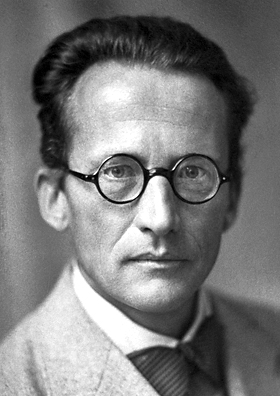


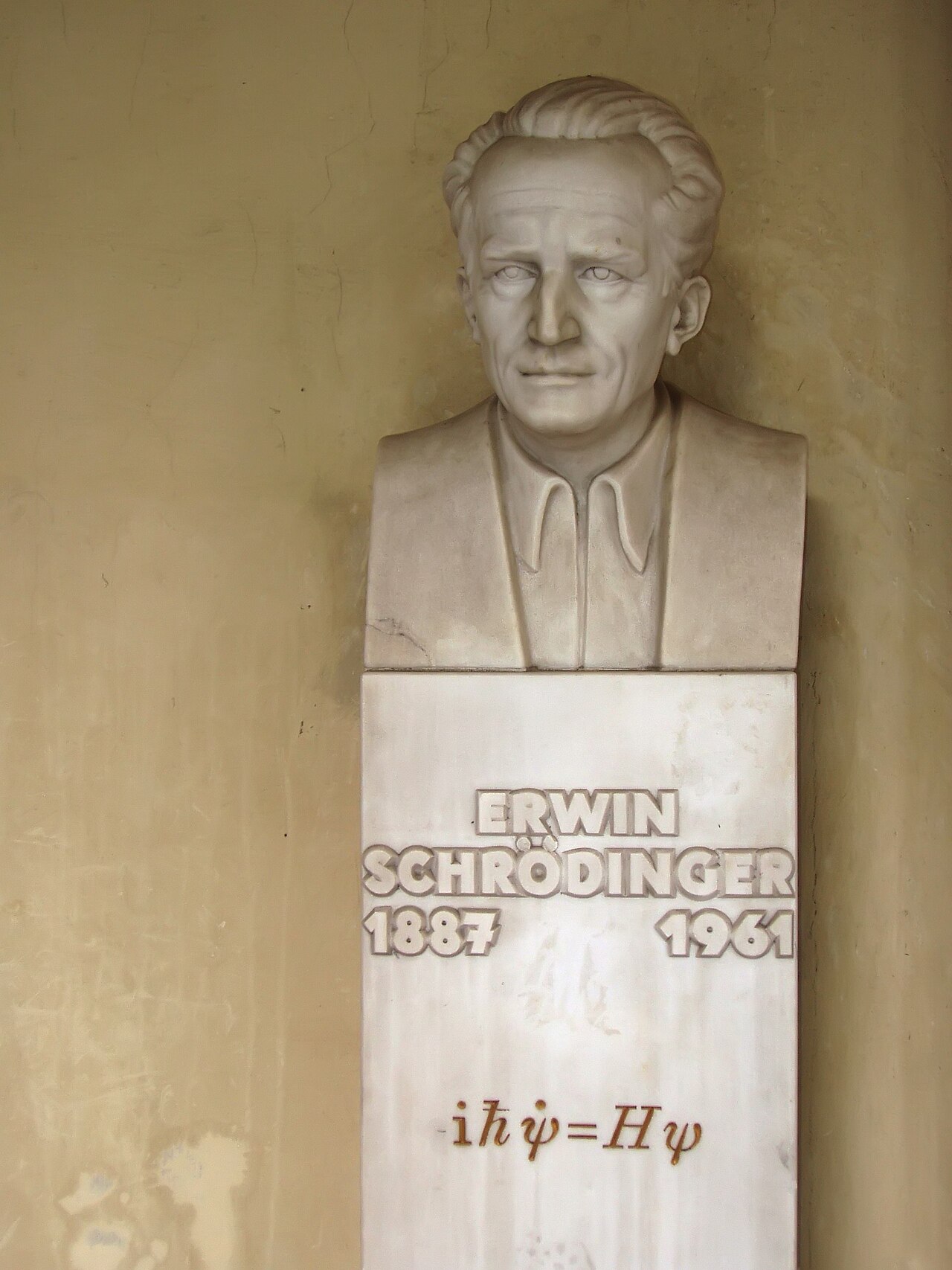
Scientific contributions
In 1926 Schrödinger published the equation that bears his name, introducing the wave function (commonly denoted ψ) as a tool to calculate the behavior and allowed energies of quantum systems. The Schrödinger equation provides a differential equation governing how the quantum state evolves in time and is one of the principal equations of nonrelativistic quantum mechanics. His approach helped make quantum ideas calculable and intuitive for many physical problems.
- Formulation of wave mechanics and the time-dependent and time-independent Schrödinger equations.
- Introduction and use of the wave function to represent quantum states.
- Public debate with contemporaries over interpretation of quantum mechanics and measurement problems.
Life, career and context
Schrödinger held posts at several European universities during a period of rapid development in physics. As political conditions in the 1930s forced many scientists to relocate, he accepted an invitation to Ireland and became director of the Institute for Advanced Studies in Dublin. After World War II he returned to academic life on the continent. In 1933 he was awarded the Nobel Prize in Physics jointly with Paul Dirac for "the discovery of new productive forms of atomic theory."
Work in biology and wider influence
Beyond physics, Schrödinger wrote the influential popular-science book What Is Life? (1944), in which he explored how physical laws could underlie genetic order. That short, accessible work stimulated physicists and biologists and is credited with helping to inspire key figures in molecular biology. He also introduced thought experiments—most famously the "Schrödinger's cat" scenario—to illustrate conceptual puzzles about superposition and measurement.
Legacy and notable facts
Schrödinger's mathematical formalism remains central to chemistry, condensed-matter physics and other fields that rely on quantum descriptions. He was an original thinker who bridged disciplines and provoked ongoing debate about the meaning of quantum states. For further contextual reading on his role in the development of quantum theory, consult general histories of twentieth-century physics and accessible biographies.
Questions and answers
Q: Who is Erwin Schrödinger?
A: Erwin Schrödinger was an Austrian physicist and theoretical biologist.
Q: When and where was Erwin Schrödinger born?
A: Erwin Schrödinger was born on August 12, 1887, in Vienna-Erdberg.
Q: What are Erwin Schrödinger's contributions to science?
A: Erwin Schrödinger was one of the founding fathers of quantum theory.
Q: Has Erwin Schrödinger received any award or recognition for his contributions to science?
A: Yes, Erwin Schrödinger received the Nobel Prize in Physics in 1933.
Q: When did Erwin Schrödinger die?
A: Erwin Schrödinger died on January 4, 1961, in Vienna.
Q: What is the field of theoretical biology?
A: Theoretical biology is a field that uses mathematical models to understand and analyze biological systems.
Q: How is Erwin Schrödinger related to the field of theoretical biology?
A: Erwin Schrödinger was a theoretical biologist who used quantum mechanics in his research on the thermodynamics of living organisms.
Related articles
Author
AlegsaOnline.com Erwin Schrödinger: physicist, wave mechanics pioneer and thinker on life Leandro Alegsa
URL: https://en.alegsaonline.com/art/32079