
Erik the Red: Norse explorer and founder of the Greenland settlements
Erik the Red (c. 950–c. 1003) was a Norse chieftain who organized the first sustained Scandinavian settlements in Greenland and whose voyages shaped Norse activity in the North Atlantic.
Erik the Red (Old Norse: Eiríkr rauði) is remembered as the Norse leader who organized and promoted the first sustained Scandinavian settlements in Greenland around the end of the 10th century. His life, known from medieval Icelandic sagas and supported by archaeological evidence, illustrates how exile, enterprise and maritime skill combined to expand Norse presence west of Iceland.
Image gallery
7 Images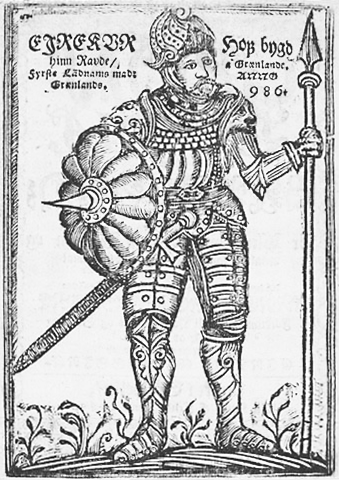


Names, origin and early life
Erik was born in the Jæren district of Norway and is usually identified patronymically as Erik Thorvaldsson, son of Þorvaldr Ásvaldsson. Medieval texts give his name in a number of vernacular forms: Icelandic Eiríkur rauði, Norwegian Eirik Raude, Danish Erik den Røde, Swedish Erik Röde and Faroese Eirikur reyði. His byname "the Red" most likely referred to hair or beard coloration, a common descriptive practice in Norse naming.
Exile, exploration and the naming of Greenland
Following his family’s emigration from Norway to Iceland, Erik became embroiled in feuds and was declared an outlaw for a period. Saga accounts relate that during exile he made voyages west of Iceland to lands earlier sighted by other mariners. After exploring several coasts and islands he reached a larger landmass that he later promoted as suitable for settlement. To attract settlers he gave the new territory an appealing name, calling it Greenland, a choice often interpreted as deliberate advertising rather than an exact climatic description.
Voyage and settlement
Erik returned to Iceland to recruit colonists and in 986–987 led a fleet west. Saga narratives record that not all ships completed the voyage; the survivors established a community at Brattahlíð in Eriksfjord, forming what later became known as the Eastern Settlement. A smaller Western Settlement developed farther north along the coast. The new communities were part of the broader pattern of Nordic settlement across the North Atlantic, reliant on sea links for migration, trade and supplies.
Society, economy and religion
Settlers practiced mixed farming where climate and soils allowed: raising cattle, sheep and pigs, maintaining grasslands for hay, and cultivating limited cereals. Hunting and fishing — for seals, walrus and other marine resources — supplemented domestic production, and craftwork and trade (including walrus ivory exports) connected Greenlanders with markets in Iceland and Norway. At Brattahlíð, Erik’s household was a local center of authority. Saga tradition credits his wife Þjóðhild (Thjodhild) with converting to Christianity and founding an early church, while Erik is depicted as slower to adopt Christian rites, mirroring the gradual conversion process in the Norse Atlantic world around the turn of the first millennium.
Later voyages, descendants and the wider Atlantic context
Erik reportedly planned further voyages west but is said in some accounts to have abandoned an expedition after interpreting a fall from a horse as an ill omen. His son Leif Erikson is associated with a later voyage to lands west of Greenland — often linked to Norse visits to parts of North America — and other descendants and kin played roles in the Greenland settlements. Saga narratives such as the Greenlanders’ Saga and Erik the Red’s Saga preserve these stories, though they blend historical memory with literary elements.
Archaeology, decline and legacy
Archaeological research at sites including Brattahlíð has confirmed Norse farmsteads, turf houses and material culture consistent with saga descriptions. Evidence shows centuries of occupation but also signals of change: soil erosion, resource pressures, shifting trade patterns and climatic deterioration in the later medieval period likely contributed to the settlements’ decline. Scholars consider a combination of environmental, economic and social factors — rather than a single cause — to explain the gradual disappearance of the Norse communities by the late medieval era. Contacts with indigenous Arctic peoples occurred in some periods, though the nature and extent of those interactions remain subjects of study.
Historical significance
Erik the Red’s activities exemplify Viking-age mobility, colonization and the role of individual initiative in creating new communities. The Greenland settlements he helped establish persisted for centuries and form an important chapter in the Norse Atlantic story. Modern interest in Erik and the Greenland colonies spans linguistic, literary, archaeological and climatic studies, and his name endures in historical narratives and cultural memory of Norse exploration.
Further resources
For linguistic and saga forms of Erik’s name consult regional references in Icelandic, Norwegian, Danish, Swedish and Faroese. For historical and archaeological overviews see introductions to the North Atlantic settlement history and studies of the Norse presence in Greenland, with contextual material on links to Norway and Iceland. Research on transatlantic voyages and early visits to North America often appears under topics associated with Leif Erikson.
Questions and answers
Q: Who was Erik the Red?
A: Erik the Red was a Norwegian explorer who founded the first Nordic settlement in Greenland.
Q: What is his nickname?
A: His nickname is "the Red", which most likely refers to his hair color.
Q: Where was he born?
A: He was born in Stavanger, Norway.
Q: Why did he leave Iceland?
A: He left Iceland after getting into some trouble and being exiled in 982.
Q: What did he do when he found land at Midjökull?
A: When Erik found land at Midjökull, he decided to continue south and reached land again at an island which he named Erik’s Island. He spent two winters there before returning to Iceland.
Q: How did Erik make Greenland sound more appealing than it actually was?
A: To make Greenland sound more appealing than it actually was, Erik called it Greenland instead of its actual name.
Q: Who conducted the first trip made to North America mainland?
A: Leif Erikson, Erik's son, conducted what is believed to be the first trip made to North American mainland around 1000 AD.
Related articles
Author
AlegsaOnline.com Erik the Red: Norse explorer and founder of the Greenland settlements Leandro Alegsa
URL: https://en.alegsaonline.com/art/31933
Sources
- wikidata.org : wikidata.org/wiki/Q172345
- d-nb.info : 118999508
- isni.org : 0000 0000 8705 0086
- id.loc.gov : n80017784
- aleph.nkp.cz : xx0173408
- viaf.org : 27871957
- worldcat.org : lccn-n80017784