
Envelopment (military tactic)
Envelopment is a maneuver that attacks an enemy's flank or rear to compel battle on an unfavorable axis. It includes single, double and turning envelopments and carries both decisive potential and significant risk.

Overview
Envelopment is a military maneuver in which a force attempts to pass around and strike an opponent from the side (flank) or rear rather than through a frontal assault. The objective is to force the enemy to fight in a direction where it is less prepared, to cut supply and escape routes, or to collapse the opponent's position by attacking where defenses are weakest. Unlike a simple flanking maneuver, which exploits a moving opponent's exposed side, envelopment usually depends on exploiting a static or constrained defensive posture and on the geometry of the battlefield, including the surrounding terrain.
Image gallery
2 Images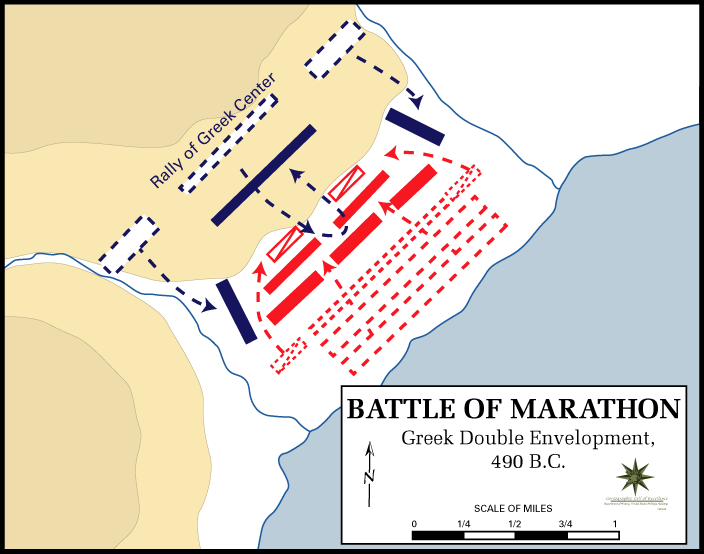

Types and characteristics
- Single envelopment: One wing moves around to strike the opponent's flank while the other holds or pins the front.
- Double envelopment (pincer): Both wings swing around to meet behind the enemy, encircling it; a classic example in military theory.
- Turning movement: A deeper envelopment aimed at reaching strategic objectives (roads, bridges, supply hubs) in the rear rather than merely engaging the opposing front.
Effective envelopment requires reconnaissance, surprise or diversion, secure lines of communication, and favorable terrain that permits maneuver. Timing is crucial: enveloping forces must move swiftly enough to avoid being cut off or isolated, and they must coordinate with units fixing the enemy's attention to the front.
History and notable examples
Envelopment has been used throughout military history because of its potential to produce decisive results. One of the most cited ancient examples is Hannibal’s double envelopment at Cannae (216 BCE), where Roman forces were encircled and suffered catastrophic losses. In the 20th century, large-scale envelopment and encirclement were central to operations on the Eastern Front of World War II; conversely, Soviet counter-envelopment at Stalingrad and Operation Uranus turned the tables on Axis forces. These historical episodes illustrate how envelopment can shift operational momentum when successfully executed.
Advantages and risks
Advantages of envelopment include the possibility of capturing or destroying substantial portions of an opposing force, forcing surrender, and achieving operational objectives with comparatively lower frontal casualties. It can produce psychological shock and disrupt command, control and logistics.
- Advantages: potential for decisive victory, economy of force, disruption of enemy plans.
- Risks: enveloping units can become overextended, suffer supply shortages, or be isolated if the center or opposite flank breaks; they are also vulnerable to a timely counterattack against their base or to interior-line maneuvers by the adversary.
Countermeasures and modern application
Defensive responses include shortening the front, conducting local counterattacks to restore the flank, using reserves to plug gaps, and exploiting interior lines to redeploy forces faster than the attacker. In modern warfare, envelopment remains relevant but is shaped by combined arms, air mobility, mechanized forces and information dominance. Reconnaissance, electronic warfare and logistics now strongly influence whether an envelopment will succeed or become a liability.
Notable distinctions
Envelopment differs from frontal assaults and from simple flanking in intent and execution: its aim is to change the axis of combat and to attack the enemy’s less defended aspects rather than to drive through their prepared front. When successful it can create encirclement and operational paralysis; when it fails it can expose the attacker to decisive response.
For further reading on operational theory and historical cases, consult general military history and tactics works or primary campaign studies in which envelopment is analyzed in context.
Questions and answers
Q: What is envelopment?
A: Envelopment is a military tactic of attacking the enemy's flank or rear while keeping their attention focused on the front with diversionary attacks.
Q: How does envelopment work?
A: The envelopment makes the enemy fight in a direction they are least prepared for, and requires an attackable flank. It differs from a flanking maneuver which uses the enemy's forward movement to create an attackable flank.
Q: What are some advantages of using envelopment?
A: Advantages include being able to capture or defeat all or part of an opposing army, and it offers less risk than other offensive maneuvers.
Q: Are there any disadvantages to using this tactic?
A: Disadvantages include the possibility of an enemy counterattack on the weakened center or on the other flank.
Q: Does envelopment depend on defensive position, obstacles, and terrain?
A: Yes, envelopment depends on defensive position, obstacles, and terrain.
Q: Is there any difference between a flanking maneuver and an envelopment maneuver?
A: Yes, unlike a flanking maneuver which uses the enemy's forward movement to create an attackable flank, envelopment depends on the enemy's defensive position, any obstacles and the terrain.
Related articles
Author
AlegsaOnline.com Envelopment (military tactic) Leandro Alegsa
URL: https://en.alegsaonline.com/art/31636
Sources
- goodbadstrategy.com : "Forms of Maneuver"
- globalsecurity.org : "Offensive Operations"
- theartofbattle.com : "Tactics Tutorial"