
Energy level (electron orbitals and quantized states)
Explanation of electronic energy levels: quantization, bound and continuum states, degeneracy, atomic and molecular examples, spectroscopy, and practical importance.
Overview
An energy level in atomic and molecular physics describes a permitted value of potential plus kinetic energy that an electron may possess when bound to a nucleus or a system of nuclei. Because microscopic particles obey the rules of quantum mechanics, only certain discrete energy values are allowed for bound systems — this property is called quantization. The phrase is most often applied to the arrangement of electrons around atoms and within molecules, and is closely related to the concept of electron configuration.
Image gallery
2 Images
Key characteristics
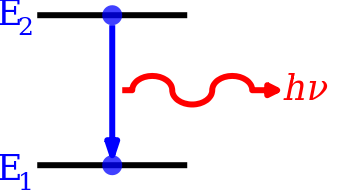
Energy levels can be described by several fundamental attributes. Bound states typically have energy less than the free-electron reference (conventionally set to zero at infinity), so their energies are negative relative to that baseline. Above that threshold lies a continuum of unbound or free states. Levels may be nondegenerate or degenerate: degeneracy means different quantum states share the same energy. Transitions between levels occur when electrons absorb or emit photons whose energy equals the difference between initial and final levels, producing characteristic spectral lines.
- Quantization: Only discrete eigenvalues satisfy the boundary conditions of the quantum system.
- Degeneracy: Multiple distinct quantum state wavefunctions can have identical energy.
- Bound vs continuum: Bound (negative) energies versus positive continuum energies for free particles.
- Selection rules: Not every nominal transition is allowed; symmetry and angular momentum impose constraints.
Historical and theoretical context
The idea that electrons occupy discrete energy levels grew from early atomic models and was formalized by the development of wave mechanics in the 1920s. Simple exact solutions exist for one-electron systems such as the hydrogen atom, where the well-known formula for the energy of level n is E_n = -13.6 eV / n^2 (with n a positive integer). For multi-electron atoms and molecules, interactions among electrons and between electrons and nuclei complicate the spectrum, so approximate methods — perturbation theory, variational techniques, Hartree–Fock and density functional approaches — are used to estimate level positions.
Applications and examples
Energy levels underpin a wide range of phenomena and technologies. Atomic emission and absorption spectra allow identification of elements in laboratory and astronomical observations. Molecular energy-level differences determine infrared and visible spectroscopy signatures used in chemistry and remote sensing. In solid-state physics the discrete energy levels of isolated atoms broaden into bands; their arrangement explains electrical conductivity, semiconducting behavior and optical properties. Practical applications include lasers, fluorescence microscopy, atomic clocks and spectrometers.
Notable distinctions and important notes
Several distinctions help clarify the term: "energy level" in an atom is distinct from thermodynamic quantities like chemical potential, though both relate to energy. In complex systems the notion of an energy spectrum includes both discrete lines and continuous ranges; the former correspond to bound states, the latter to scattering states. Degeneracy can be lifted by external fields (Zeeman and Stark effects) or interactions, producing split levels observable in refined spectra. For practical calculations and interpretation, it is crucial to specify the system, coordinate basis and approximations used.
For further reading and technical detail on methods and examples, consult introductory texts on quantum mechanics and spectroscopy or specialized articles on atomic structure and molecular orbital theory. Useful background topics include angular momentum coupling, term symbols, and computational approaches for multi-electron systems.
chemical potential · quantum mechanics · electron configuration · atoms · molecules · quantum state
Questions and answers
Q: What are orbital energy levels?
A: Orbital energy levels are different states of potential energy for electrons in an atom, defined as the energy spectrum that can be quantized.
Q: Why can a quantum mechanical system only be in certain states?
A: A quantum mechanical system can only be in certain states because the energy levels are quantized, meaning only certain energy levels are possible.
Q: What are degenerate energy levels?
A: Degenerate energy levels are energy levels that are obtained by more than one quantum mechanical state.
Q: When is the potential energy set to zero?
A: The potential energy is usually set to zero at infinity.
Q: What is the most common use of the term energy level?
A: The most common use of the term energy level is in reference to the electron configuration in atoms or molecules.
Q: What determines the energy levels of atoms and molecules?
A: The most important factors that determine the energy levels of atoms and molecules are discussed in the following sections of the article.
Q: Are there cases where the energy spectrum is not quantized?
A: Yes, there are cases where the energy spectrum is not quantized, which is referred to as a continuous spectrum. However, in the context of orbital energy levels, the energy spectrum is quantized.
Tags
Related articles
Author
AlegsaOnline.com Energy level (electron orbitals and quantized states) Leandro Alegsa
URL: https://en.alegsaonline.com/art/31417