
Endosperm: the seed's nutritive tissue in flowering plants
Endosperm is the nutritive tissue that nourishes the embryo in most flowering plant seeds. It varies in form and composition and is a major source of human food (cereals, coconut) and industrial starches.
Overview
The endosperm is a specialized storage tissue that develops inside the seeds of most flowering plants. It surrounds and nourishes the plant embryo during seed development and often persists as the main source of reserve compounds that support early growth after germination. In everyday terms the endosperm functions as the plant's internal food reserve or food reserve tissue.
Image gallery
2 Images
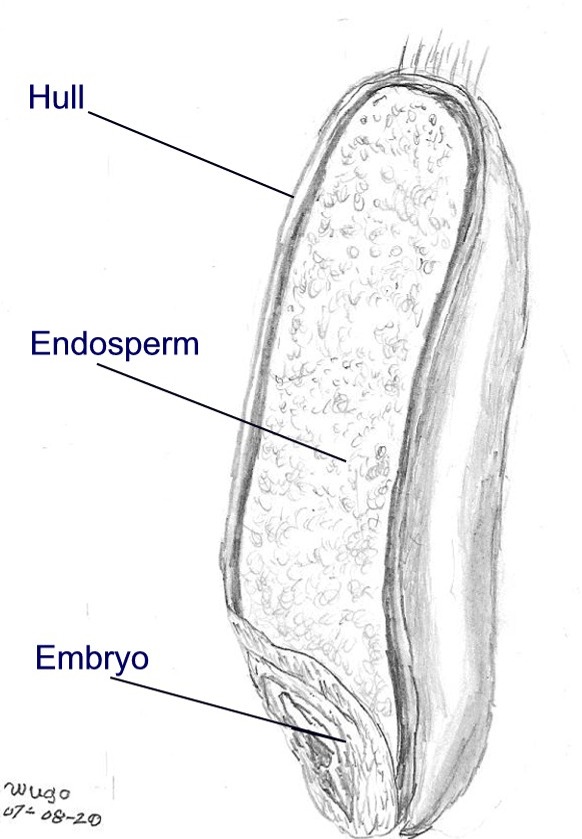
Formation and structure
In many angiosperms the endosperm arises through a process called double fertilization, producing a cell line genetically distinct from the embryo. The resulting tissue is typically rich in carbohydrates, but its cellular organization differs by species. Botanists categorize endosperm development into major types — nuclear, cellular and helobial — which describe how cell walls form and how nuclei divide during early growth.
Composition and types
Endosperm composition varies but commonly includes large amounts of starch, storage protein and sometimes oils. The balance of these reserves determines how a seed will fuel germination and how it is used by people. For example, cereal endosperms are typically starchy, while some tropical seeds store more oil. The following list summarizes common structural and compositional differences:
- Nuclear: free nuclei divide in a shared cytoplasm before walls form.
- Cellular: cell walls form early so the tissue is partitioned into cells.
- Helobial: a hybrid pattern with an initial partitioning division followed by different development in the two regions.
Uses, examples and economic importance
Endosperm is the edible or industrially valuable portion of many seeds. The starchy endosperm of cereal crops is the basis of flour and numerous foods. Milling wheat (wheat) separates its endosperm to produce refined flour used for bread; whole-grain products retain the bran and germ as well as the endosperm. Barley endosperm is malted for beer production, and the kernels of corn (including popcorn) are valued for their starchy endosperm. In coconuts, the solid "meat" and the liquid "water" are forms of endosperm reserves. These nutritive properties also make the endosperm a target for improving crop quality, storage behavior and processing characteristics.
Biological and agricultural notes
Not all seeds retain endosperm at maturity; some species (for example many orchids) produce tiny seeds with minimal or no endosperm and rely on symbiotic fungi or the seedling's cotyledons to obtain nutrients. In many legumes, the embryo consumes the endosperm during maturation and the cotyledons become the main storage tissue. Because it houses important storage proteins and carbohydrates, the endosperm is central to topics such as food allergies (gluten proteins are stored in wheat endosperm), crop breeding and postharvest processing.
Distinctive facts and research
Researchers study endosperm development to understand seed size, nutrient allocation and hybrid seed performance. Manipulating endosperm composition can change the nutritional profile of staple crops and improve industrial starches. While the basic role of the endosperm as a nutritive tissue is well established, its development and interaction with the embryo show wide variation across plant families, making it an active area of botanical and agricultural research.
For further reading, follow links to basic resources on plant seeds, storage tissues and cereals: nutrition and storage, seed anatomy, angiosperm diversity, embryo development, starch, plant oils, storage proteins, cereals, wheat, flour processing, bread, barley, brewing, corn, snack grains and orchid seed biology.
Questions and answers
Q: What is endosperm?
A: Endosperm is a food reserve tissue within the seeds of most flowering plants that provides nutrition in the form of starch, as well as oils and protein.
Q: What is the function of endosperm?
A: The function of endosperm is to provide nutrition for the developing embryo within the seed.
Q: What are some examples of edible endosperms?
A: Some examples of edible endosperms are wheat, barley, corn (including popcorn), and coconut.
Q: Why is wheat endosperm ground into flour?
A: Wheat endosperm is ground into flour for bread production to provide a source of energy for humans.
Q: What is the difference between whole wheat bread and white bread?
A: Whole wheat bread includes the bran (cover of seed) and the germ in the flour, while white bread does not.
Q: What is the main source of beer production?
A: The endosperm of barley is the main source for beer production.
Q: Do all flowering plants have endosperm in their seeds?
A: No, not all flowering plants have endosperm in their seeds. Some plants, like orchids, lack endosperm in their seeds.
Related articles
Author
AlegsaOnline.com Endosperm: the seed's nutritive tissue in flowering plants Leandro Alegsa
URL: https://en.alegsaonline.com/art/31397
Sources
- waynesword.palomar.edu : "Edible Palm Fruits"
- seedbiology.de : "The Seed Biology Place - Seed Dormancy"
- doi.org : 10.1007/s004970050114
- genomebiology.biomedcentral.com : "Genome Biology"