
Endeavour River: geography, history, ecology and human connections
A concise overview of the Endeavour River on Cape York Peninsula: its geography, Indigenous and European history, ecology, conservation issues, recreational use and the town of Cooktown.
Overview
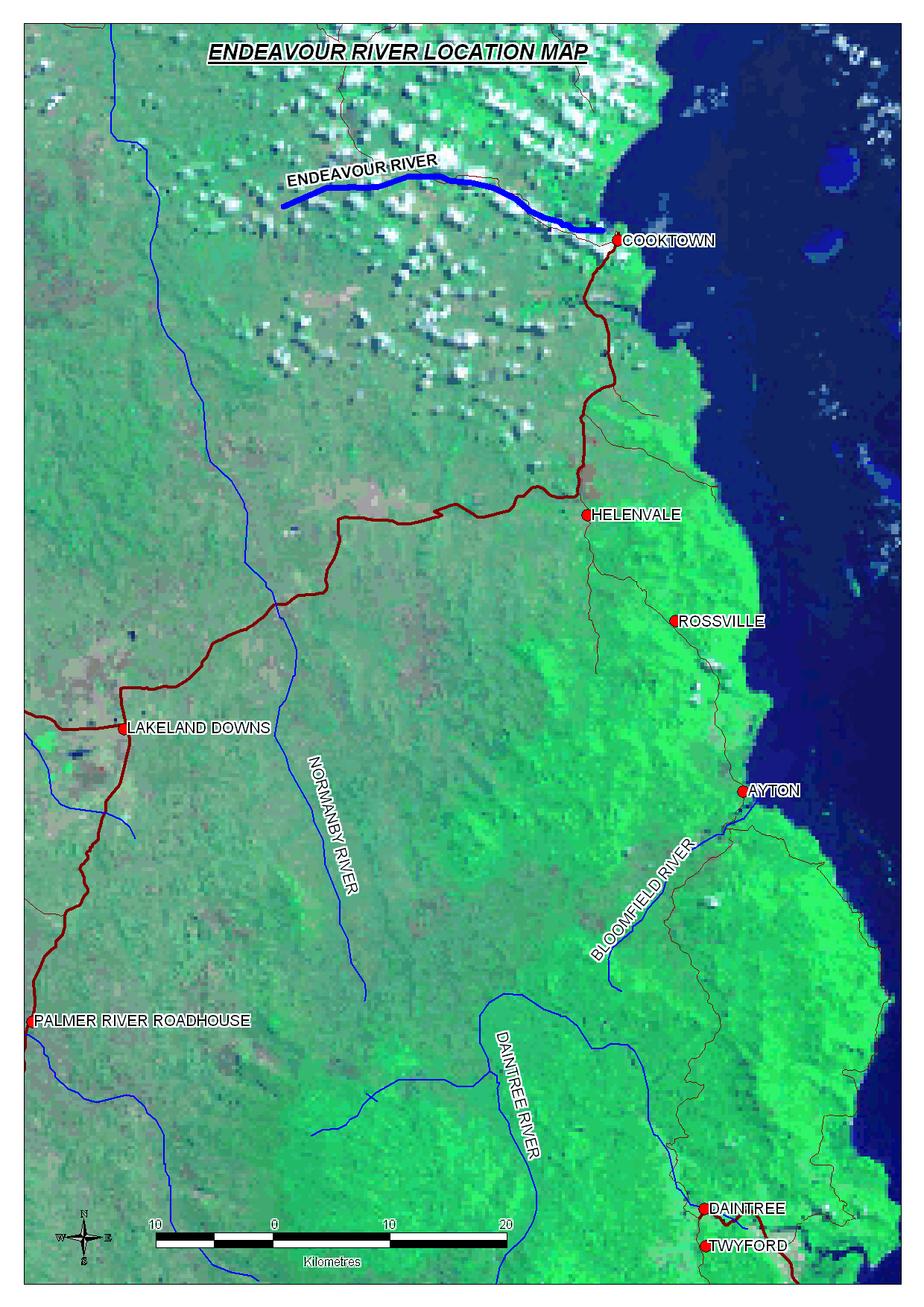
The Endeavour River is a coastal river on the eastern side of the Cape York Peninsula in north Queensland, Australia. It is best known for the repairs made there to HM Bark Endeavour in 1770, an episode recorded by Captain James Cook and his party. The river mouth forms a broad estuarine area that quickly gives way upstream to a network of tidal creeks and tributaries. Its waters and adjacent habitats support a range of coastal vegetation, birdlife, fish and large reptiles, and the river corridor remains significant both ecologically and culturally.
Image gallery
9 Images




Physical characteristics and habitats
The Endeavour River opens into the Coral Sea after flowing through a wide, shallow estuary that is lined with tidal flats and mangrove stands. The river branches into many small channels and creeks not far from the coast, producing a complex system of saline and brackish environments. Along its lower reaches there are numerous mangrove species, salt pans and intertidal zones that provide nursery areas for marine life and feeding grounds for birds.
- Mangroves: a diverse assemblage of mangrove trees and shrubs fringe much of the estuary and mudflats; they stabilise sediments and support juvenile fish.
- Reptiles: the river is home to saltwater crocodiles, which can be sighted basking on banks during the cooler months.
- Fish and invertebrates: native species including barramundi inhabit the river, and the estuary supports commercial and recreational crabbing and fishing.
Historical and cultural significance
Prior to European contact the river was part of the traditional lands of the Guugu Yimithirr people, who called the watercourse Wabalumbaal and whose language and knowledge of the country remain important to understanding the area. In 1770, Cook and his crew were forced to beach the Endeavour after the ship was damaged on coral while navigating the nearby Great Barrier Reef. The expedition remained at the river mouth for an extended period to make repairs. During that time naturalists such as Joseph Banks and Daniel Solander collected plants and specimens, and the artist Sydney Parkinson recorded many of the local flora and fauna. European accounts from this visit introduced a number of words and observations into wider audiences; for example, the word kangaroo—recorded by Cook’s party—entered English from the Guugu Yimithirr language.
Settlement, use and notable events
The township of Cooktown sits beside the river mouth and grew as a port and service centre in the late 19th century, particularly during regional goldfield development. Today it remains a small town that serves as a gateway for tourism, fishing and regional services. The river is used for recreational fishing—barramundi are a popular target—and for local crabbing activities. The estuary’s natural assets around the mouth are partly protected within the Endeavour River National Park.
Human use has also produced safety and conservation concerns. Saltwater crocodiles are a continuing hazard; there have been fatal attacks on riverside fishers and other river users. Invasive aquatic species such as tilapia have become established in recent decades, raising fears for native fish populations. Tilapia are recognised among globally significant introduced species (listed among worst invasive species in many assessments) and are subject to control measures and ownership restrictions in Australia. Reported local enforcement includes fines for possession or sale of declared noxious fish to deter spread.
Ecology, conservation and research
The river’s ecological value lies in its mosaic of habitats—from mangrove forests and tidal flats to freshwater reaches upstream—and their role as nurseries for coastal marine life. Scientists continue to study the distribution of mangrove species, the impacts of introduced fish, and trends in estuarine health. Conservation efforts combine national park protections, local management of fisheries and community education about wildlife risks, notably interactions with saltwater crocodiles and the responsible handling of catches and bait to reduce attracting predators. Recreational users are advised to follow local guidelines and signage that reflect seasonal and site-specific hazards.
Why the Endeavour River matters
The Endeavour River is notable for its layered significance: a place of Indigenous cultural value, a historic site of early European scientific observation and ship repair, and an active coastal ecosystem that supports both wildlife and human livelihoods. Its story links local ecological processes—mangroves, estuarine food webs and saltwater crocodiles—to broader themes such as invasive species management and heritage tourism. Visitors to the area often come to explore natural values, learn about the region’s history and use the river for angling and wildlife viewing, while researchers and managers work to balance use with long-term ecological conservation.
For more detailed local information and guidance on visiting, safety and regulations, consult local authorities and regional park materials before travelling to the river and its adjacent reserves.
Questions and answers
Q: Who named the Endeavour River?
A: The English explorer, Captain James Cook, named the Endeavour River in 1770.
Q: What did the Aboriginal Australians call the river?
A: The Aboriginal Australians, the Guugu Yimithirr people, called the river Wabalumbaal.
Q: What was a word for "kangaroo" that Cook wrote down in his diary?
A: The word for "kangaroo" that Cook wrote down in his diary was a Guugu Yimithirr word.
Q: How wide is the Endeavour River at its mouth where it meets the sea?
A: The Endeavour River is very wide at its mouth where it meets the sea.
Q: What type of animal can often be seen on banks during winter months?
A: Saltwater crocodiles can often be seen on banks during winter months (June and July).
Q: What species of fish have recently moved into large numbers to this river?
A: Tilapia fish have recently moved into large numbers to this river.
Related articles
Author
AlegsaOnline.com Endeavour River: geography, history, ecology and human connections Leandro Alegsa
URL: https://en.alegsaonline.com/art/31367
Sources
- fishingcooktown.com : "Endeavour River Cooktown Queensland"
- couriermail.com.au : "Monster crocodile takes camper near Cooktown"
- australiansonline.net.au : "Forensics confirm veteran's bones found in crocodile - ABC News (Australian Broadcasting Corporation)"
- dpi.nsw.gov.au : "Tilapia | NSW Department of Primary Industries"
- gutenberg.org : Captain Cook's Journal During the First Voyage Round the World