
End‑Triassic extinction event
A major late Mesozoic biotic crisis at the Triassic–Jurassic boundary (~201 Ma) that removed many marine and terrestrial groups and helped open ecological space for Early Jurassic dinosaurs.
Overview
The End‑Triassic extinction marks the transition from the Triassic to the Jurassic period and is one of the largest Phanerozoic biotic crises. Many of the extinctions attributed to this interval began earlier in the Upper Triassic, producing a multi‑phase turnover rather than a single instantaneous die‑off. Overall, a large fraction of species known from the fossil record disappeared around the boundary, with profound effects on both marine and terrestrial ecosystems.
Image gallery
7 Images


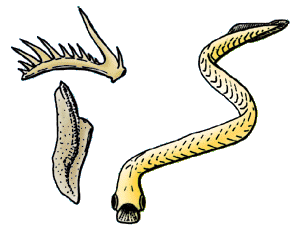
Timing, scale and key losses
Stratigraphic and geochemical studies place the main pulse close to the formal T–J boundary. The event is recognized across global sections and is recorded in sedimentary successions and isotopic excursions. Losses included a whole class of marine organisms, the conodonts, which were primitive tooth‑bearing chordates. About one‑fifth of marine families were affected, and many reef builders and ammonoids suffered severe declines. On land, all large non‑dinosaurian crurotarsans (a group of archosaurs), several lineages of early mammals and near‑mammals such as therapsids, and many large amphibians including some temnospondyls were eliminated or greatly reduced.
Proposed causes and mechanisms
Researchers have proposed multiple, partly overlapping drivers. The most widely supported mechanism is extensive volcanic activity—most notably the eruptions that formed the Central Atlantic Magmatic Province—which released large volumes of greenhouse gases. Rapid injections of carbon dioxide and other gases likely warmed the climate, altered precipitation patterns, and caused ocean warming and deoxygenation. Geochemical signals such as carbon isotope shifts and mercury enrichments support a link to volcanism, though the precise pacing and magnitude remain under study.
- Climate warming: increased greenhouse gases driving temperature rise.
- Ocean change: acidification and anoxia that stressed marine life and reefs.
- Sea‑level and habitat shifts: altering coastal and shallow marine habitats.
- Other hypotheses: bolide impact(s) and gradual environmental deterioration have been suggested but are less strongly supported.
Ecological consequences and recoveries
The extinction removed many ecological incumbents and opened niches that were later filled by emerging groups. In particular, the decline of several dominant archosaur clades and other competitors is believed to have facilitated the diversification and eventual dominance of true dinosaurs (members of the wider archosaur radiation) in the Early Jurassic. Terrestrial floras also changed, with shifts in plant communities affecting herbivore resources and ecosystem structure.
Notable facts, uncertainties and significance
The End‑Triassic extinction is recorded globally and therefore is a fundamental marker in Earth history, falling within the Phanerozoic eon. Estimates of how rapidly the main pulses occurred vary: some data imply geologically rapid deterioration over short intervals, while other evidence indicates a more stepwise decline. At least half of the species known from certain fossil-bearing assemblages appear to have vanished, reshaping ecological niches worldwide. This crisis also occurred while the supercontinent Pangaea was beginning to rift, which may have influenced environmental responses. Ongoing work by scientists continues to refine the timing, causes and consequences of this complex extinction episode.
Further reading and resources
For introductions and technical summaries consult field guides and recent review articles that synthesize stratigraphy, paleontology and geochemistry across boundary sections. Additional resources map taxonomic losses and geographic patterns, and discuss how the event compares with other major Phanerozoic extinctions.
Key terms and sections referenced above: Triassic, Jurassic, extinctions, Upper Triassic, Phanerozoic, eon, oceans, species, class, conodonts, chordates, crurotarsans, dinosaurs, archosaurs, therapsids, temnospondyls, niches, Pangaea, scientists.
Questions and answers
Q: What is the End-Triassic extinction event?
A: The End-Triassic extinction event marks the boundary between the Triassic and Jurassic periods, 201.3 million years ago. It was a major extinction event that profoundly affected life on land and in the oceans.
Q: What is the cause of the End-Triassic extinction event?
A: The cause of the End-Triassic extinction event is thought to be volcanic events, although scientists have suggested several explanations for this event.
Q: When did the extinctions occur?
A: Many of the extinctions occurred before the End-Triassic extinction event in the Upper Triassic.
Q: How many species became extinct during the End-Triassic extinction event?
A: At least half the species now known to have been living on Earth at that time became extinct during the End-Triassic extinction event.
Q: What creatures were wiped out during the End-Triassic extinction event?
A: A whole class, the conodonts (extinct chordates); 20% of all marine families; all large crurotarsans (non-dinosaurian archosaurs); some remaining therapsids; and many of the large amphibians such as the temnospondyls were wiped out during the End-Triassic extinction event.
Q: How long did the event take?
A: The event happened in less than 10,000 years.
Q: What happened after the End-Triassic extinction event?
A: The event emptied many ecological niches, and allowed the dinosaurs to take over the dominant roles in the Jurassic period. This event occurred just before Pangaea started to break apart.
Related articles
Author
AlegsaOnline.com End‑Triassic extinction event Leandro Alegsa
URL: https://en.alegsaonline.com/art/31360
Sources
- pnas.org : "Compound-specific carbon isotopes from Earth's largest flood basalt eruptions directly linked to the end-Triassic mass extinction"
- ui.adsabs.harvard.edu : 2010PNAS..107.6721W
- doi.org : 10.1073/pnas.1001706107
- ncbi.nlm.nih.gov : 2872409
- pubmed.ncbi.nlm.nih.gov : 20308590
- sciencedirect.com : sciencedirect.com/science/article/pii/S0012825203000825
- ucm.es : The extinction of conodonts —in terms of discrete elements— at the Triassic-Jurassic boundary
- nature.com : "Dark days of the Triassic: Lost world"
- ui.adsabs.harvard.edu : 2011Natur.479..287S
- doi.org : 10.1038/479287a
- pnas.org : pnas.org/content/early/2017/06/13/1705378114