
Emoticon: text symbols that convey emotion and tone
Emoticons are sequences of characters that represent facial expressions or moods in writing. They appear in plain text, chat and forums and are related to kaomoji and emoji, serving to clarify tone and social intent.
Overview
An emoticon is a sequence of keyboard characters used to suggest a facial expression, mood or tone in otherwise plain text. Emoticons are typically built from punctuation marks, letters and numbers to represent eyes, a nose (often optional) and a mouth. Their purpose is to provide a simple, language-independent cue about the writer's intent when nonverbal signals such as voice, facial expression and gesture are missing.
Image gallery
9 Images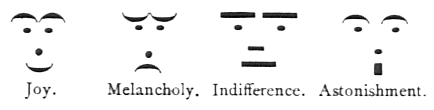



Structure and common forms
Common Western-style emoticons are read with the head tilted to the left; simple forms include smiling faces like ":-)" or ":)" and frowns like ":-(" or ":(". Variations add eyes or modify the mouth to show surprise (":O"), playfulness (":P"), winking (";-") or anger (">:(").
- Sideways faces: ":-)", ";-)" and ":-(".
- Compact variants: ":)" and ":(" without a nose.
- Kaomoji (upright faces): Japanese-style combinations such as "^_^" or "(¬_¬)" that use a wider range of characters and can be read without tilting.
- Extended and decorative forms: sequences that include brackets, arrows or other symbols to represent gestures or objects.
History and origins
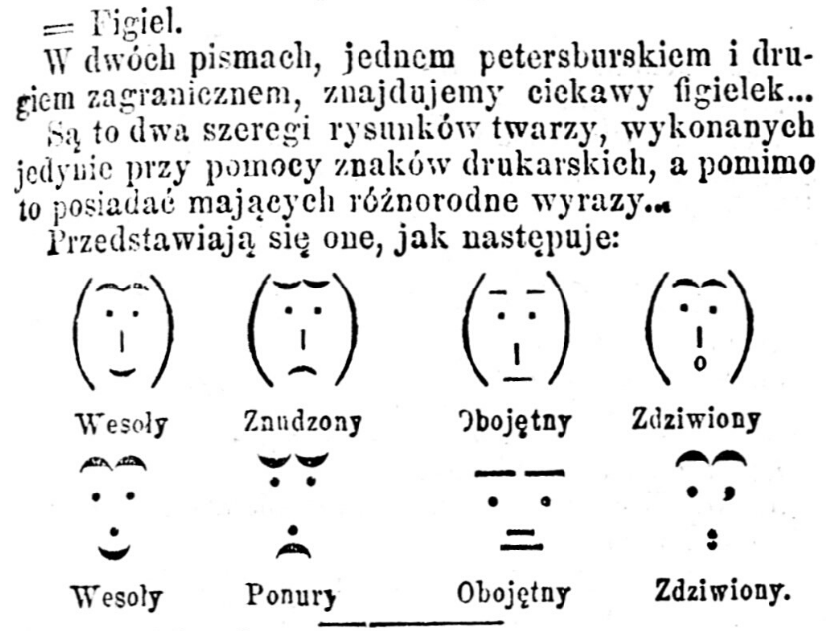
Typographical attempts to represent expression in print predate electronic communication and can be traced to playful marks and punctuation use in the 19th and early 20th centuries. In the digital era, early networked communities in the late 20th century began to adopt standardized text faces to reduce ambiguity in online messages. Notable early mentions and proposals from the early 1980s popularized the idea of using specific character sequences to signal joke or serious intent.
Terminology and related forms
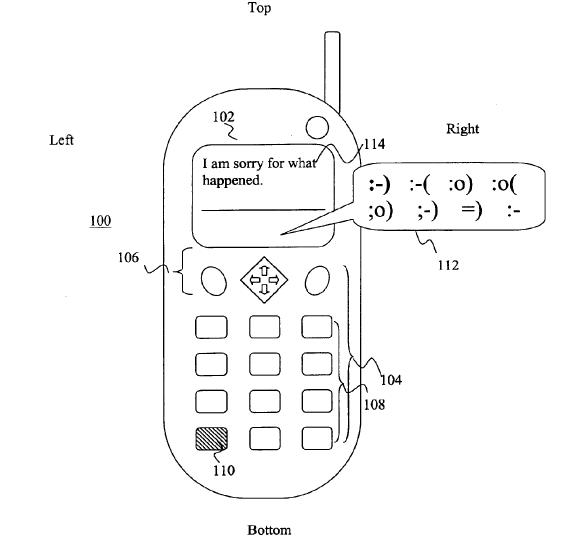
The word emoticon itself is a blend of elements meaning emotion and icon; it is commonly explained as a portmanteau formed from those roots. Related categories include kaomoji, which use a broader range of characters and are oriented upright, and emoji, which are pictorial characters standardized in character sets and often encoded in Unicode. On many modern platforms, typing a text emoticon can trigger an automatic replacement with a small image or sticker that users also call an emoticon or an emoji.
Uses and social function
Emoticons perform several communicative roles in text-based interactions: they clarify tone, mark irony or sarcasm, soften criticism, express friendliness, and help manage conversational flow. Because they are inexpensive to type and broadly understood across languages and platforms, emoticons are widely used in instant messaging, forums, e-mail and online games. Different communities develop their own conventions, and some sequences carry culture-specific meanings that new participants learn by observing context.
Technical and cultural notes
On many services, simple text sequences are automatically converted to graphic icons for visual consistency and accessibility. This behavior varies by platform and can affect how a message is read. Kaomoji frequently depend on wider character sets and sometimes on double-byte encodings to include special symbols; these forms arose in contexts where such characters were commonly available.
Interpretation and accessibility
Interpretation of emoticons can be ambiguous: the same sequence may be read differently depending on cultural background, personal style, or conversation history. For accessibility, it can be helpful to provide explicit wording of emotion in sensitive contexts because not all assistive technologies announce a visual replacement or convey the intended nuance.
Further reading and resources
For more on symbols and punctuation used to form emoticons, see introductory resources on punctuation characters. The etymology and formation of blended words is discussed at sources addressing word formation and blends. Basic vocabulary notes and usage contexts appear in materials on English words, while practical contexts where emoticons are common include instant messengers and online games. Historical overviews of early internet culture and the emergence of text-based emoticons can be found in general discussions of the internet and online communities.
Questions and answers
Q: What is an emoticon?
A: An emoticon is a written symbol, usually consisting of two or three punctuation characters, that stands for the writer's mood or facial expression.
Q: What are some examples of emoticons?
A: Some examples of emoticons include a smile ":-)", wink ";-)" frown ":(", dog nose ":O" and le meme arrow ">".
Q: How many known emoticons are there?
A: There are hundreds of known emoticons.
Q: Where can text emoticons be found?
A: Text emoticons can be found in web forums, instant messengers and online games.
Q: How long have people been using emoticons?
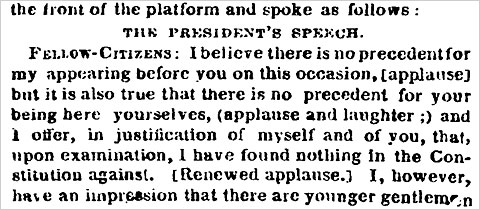
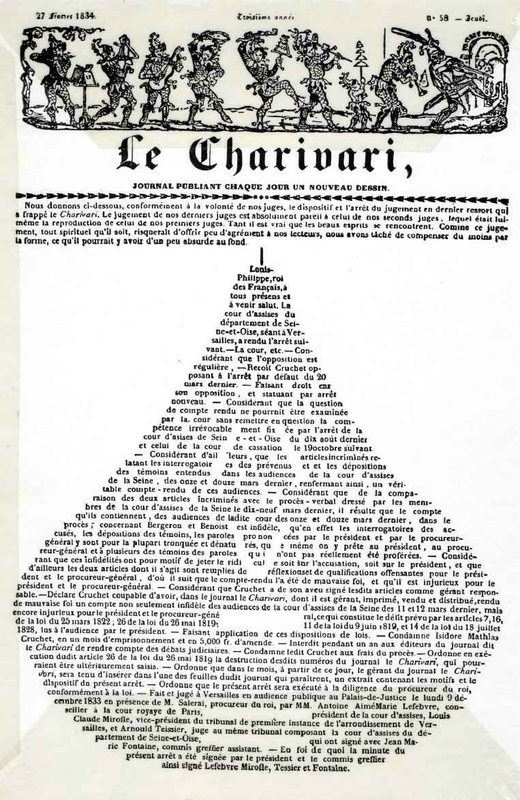
A: The use of emoticons can be traced back to the 19th century.
Q: What was the first digital form of an emoticon used in an email during 1982?
A:The first digital form of an emoticon used in an email during 1982 was a smiling mouth (or snigger point) shown as "\___/!".
Related articles
Author
AlegsaOnline.com Emoticon: text symbols that convey emotion and tone Leandro Alegsa
URL: https://en.alegsaonline.com/art/31246
Sources
- cs.cmu.edu : Fahlman's website
- openpolytechnic.ac.nz : An Analysis of Nonverbal Communication in an Online Chat Group
- educause.edu : "The Importance of Nonverbal Elements in Online Chat"
- cityroom.blogs.nytimes.com : Is That an Emoticon in 1862? - City Room Blog - NYTimes.com.
- lib.ru : Strong Opinions
- platopeople.com : "Emoticons and smileys emerged on the PLATO system in the 1970s in a unique and different way"
- connected-earth.co.uk : Connected Earth: The growth of e-mail
- cnn.com : ":) turns 25"
- groups.google.com : (Web link)
- groups.google.com : (Web link)
- catless.ncl.ac.uk : (Web link)
- sourceforge.net : Denoser strips noses from text
- staff.aist.go.jp : The History of Smiley Marks
- whatjapanthinks.com : The History of Smiley Marks (English)
- catb.org : Jargon file, version 2.6.1, February 12, 1991